Showing posts with label Philippines. Show all posts

Saturday, May 24, 2014

The fabric search

I had thought that one of the possible pleasures of travelling in the Cordillera region of the Philippines would be to see some of the weaving for which the region is known. Traditionally, both the women and men of the region wore either short wrapped skirts (women) or longer strips of elaborately tied fabrics (men) that were woven in colours and patterns that identified their ethnic affiliation. The fabric is densely woven on backstrap looms, usually in stripes with more complex inlaid borders.

We saw some of the weaving on our travels - but nothing that I admired enough to buy. I already have a stack of Philippine weaving that languishes on my shelves, bought over many years. Much of what I saw on this trip was, sadly, of lesser quality than the older cloths I already have and so there was little motivation to buy more (other than the desire to support local crafts - but I have to stop somewhere) . I guess this decline in quality is inevitable. As I wrote in my post on the rice terraces, people in these regions now have more knowledge of the world beyond their mountains and valleys and more options, whether real or imagined, for earning their living. Weaving is time-consuming and, like all handicrafts, brings few financial rewards for the time spent. As the traditional fabrics transition from items of everyday wear to souvenirs for tourists the imperative for weaving wanes and skills are lost.

We ended our mountain trip in Baguio, a rapidly growing city that in the early twentieth century was a 'hill station' for the American colonisers to escape the heat of Manila summers. It was a welcome escape for us too, from the hottest weeks of the Manila year. I went in search of the Narda's emporium - quite a Baguio institution. Narda Capuyan and her husband Wilson began their business just outside Baguio the 1970s - using the traditional weaving skills of local women to make fabrics they thought would be commercially marketable. Remarkably, they are still functioning more than forty years later. Their shop has a small selection of fabrics made in traditional weaves and patterns, some of them made into garments:
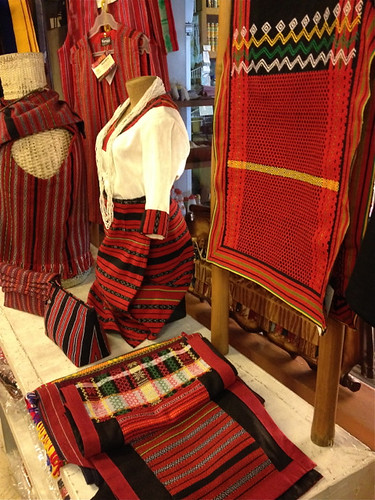
Baguio fabrics - Narda's

By the way, I love the photo of Narda herself on the website, dressed in a wonderful riot of local weaves. However,I think you'd have to be (a) tiny and (b) a Filipina to carry off this look successfully!

Most of the stock at Narda's is an adaptation of traditional weaving skills, patterns and colour combinations, many of them using ikat dying techniques:

Baguio - Narda's fabrics non-traditional

And to anticipate those of my commenters who will ask 'but what did you buy?' I was very restrained and bought three scarves - two of them for gifts and one to replace a much-used Narda's scarf I lost a couple of years ago:
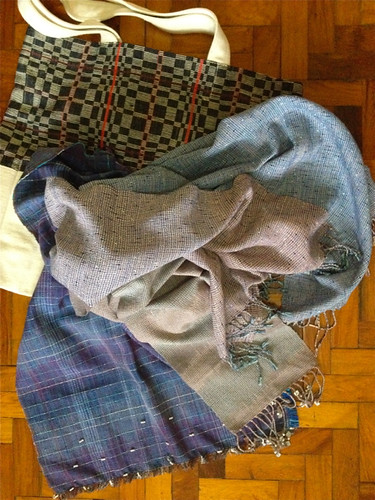
Baguio purchases

You can see I was rather taken by the scarves that had detailing of small pearls or shell beads. The carry-bag in the background of the photo of my purchases was not from Narda's but from the very sophisticated giftshop at the BenCab Museum. The checkered fabric in this bag is 'abel' and is from the coastal region of Ilocos that borders the mountains, where the use of floor looms rather than backstrap looms enabled different weaving techniques to be used.

Benedicto Reyes Cabrero, most commonly known as BenCab, has built a modern, light-filled museum with extensive gardens just outside Baguio with galleries for his own work, the work of other modern artists and, most interesting for me, an extensive and well-displayed collection of wood carvings that are such a rich artistic tradition for the Cordillera region. BenCab's work is very accessible and widely known, though not always critically acclaimed and he has been designated a National Artist of the Philippines.
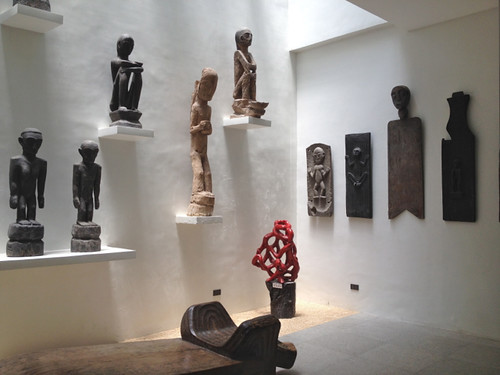
Baguio BenCab museum

My fabric search was not particularly successful but, even so, it seems impossible for me to visit the Philippines without in some way reconnecting with its craft traditions.

Friday, May 16, 2014

Cordillera journey

We've returned from seven days' travelling through the mountainous Cordillera region of the northern Philippines. I've always scoffed a bit at the notion of 'bucket lists' - things you think you would most like to before you die - because it seems to me that enjoying what life offers up to you can be even more enriching. But I must confess that I've had a hankering to revisit the Cordillera region of the Philippines before I'm too old for the trip, or the region is over-run by tourism, or the inhabitants find it's just too hard to maintain the rice terraces for which the area is renowned.

Banaue rice terraces 3

My Philippine family didn't need too much persuasion to make the journey, even though it involved long car trips over often precipitous roads ominously littered with rocks from previous land-slips. The compensation was that every turn of the road revealed an even more beautiful landscape of clouds, mountains, valleys, ravines, and the rice terraces.

Banaue rice terraces

People dispute the age of the terraces, but general agreement is that they are around 2000 years old. The walls are constructed of intricately arranged stones, sometimes with mud used for mortar, and they echo the contours of the slopes to maximise the area of each rice-growing segment. Water drains from the top to the bottom of the terraces in an ingenious feat of hydraulic engineering. A number of the areas of terraces have received UNESCO World Heritage listing, but to see those you really need to have a four-wheel drive vehicle, or consign yourself to the local overloaded jeepneys, and be willing to trek considerable distances across the mountains. This was beyond our capabilities and we contented ourselves with visiting the towns of Banaue and Sagada and driving and walking to the more accessible viewing points.

Banaue rice terraces 2

When this is the view from your hotel room in Banaue...

Banaue- view from hotel room

it's very tempting just to sit and knit and watch the mists and shadows and showers pass across the landscape.

Maintaining and farming the terraces is hard work and requires a strong sense of community to ensure that each unit-holder does nothing to unsettle the balance of the ecosystem of the terraces. The inaccessibility of the Cordillera region protected its peoples from Spanish colonisation and minimised the impact of US rule in the first part of the twentieth century. But modern communication technologies and better road access provide wider temptations and opportunities beyond the local for young people. There is some government support for maintenance of the terraces, but I can't help but wonder how they can be sustained into the future.


Wednesday, May 7, 2014

Banig: intricate patterns

I'm in the Philippines again - this time for my grandson's third birthday. Yesterday we had an excellent lunch at one of Manila's many shopping malls. At this time of the year, when Manila is at its hottest, it's easy to see the attraction of the enormous shopping malls - air conditioning! Most of the malls are so extensive that you can stroll and admire and shop and have coffee (or ice cream) as you would in a suburban shopping street. But it's cooler. Far cooler than outside.

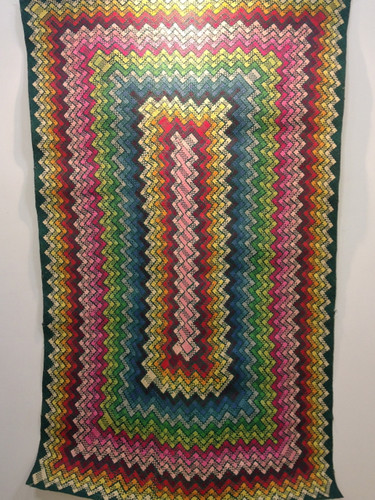
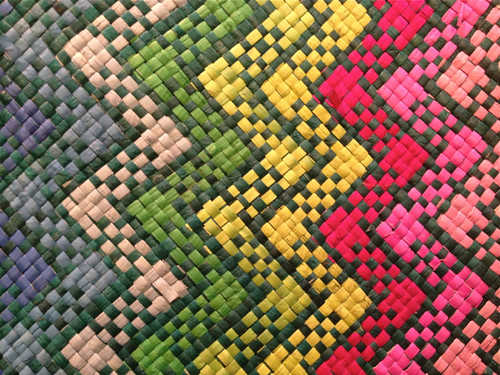
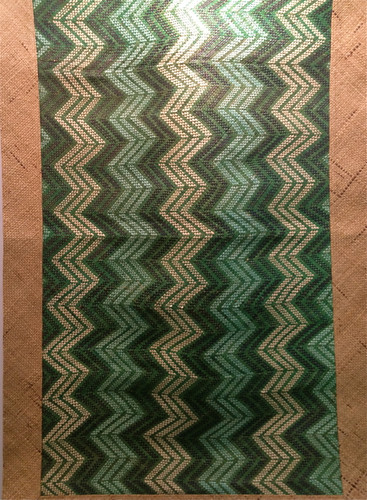
The visit to the mall had the added benefit of a small display of woven banig in its vast entrance atrium. Banig are woven from straw or grasses and traditionally functioned as sleeping mats. They still serve this purpose today, but over time banig makers have sometimes chosen to embellish their mats with colourful and intricate patterns. Nowadays they're as likely to be used for decoration as they are for sleeping.

Samar banig 1
Samar banig 4

Often the patterns are mesmerisingly geometric:

Samar banig 3
Samar banig 3 close-up

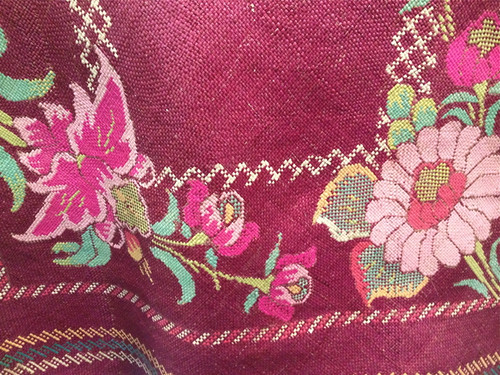
But occasionally you can be surprised by an exuberantly floral design:

Samar banig flowers

The banig in this display were from Samar, in the central Philippines. I learned that they are woven in Basey - a town renowned for the intricacy and colour of its banig weaving. The mats are made from tikog, a grass that is specially cultivated in the nearby province of Leyte. The tikog gives a sheen and pliability to these banig that makes them quite special.

I think the traditions of banig and of patchwork quilts share much in common. Both take materials that are readily to hand and otherwise without value and create useful, necessary, everyday objects. But with both these traditions the makers bring their sense of design and the desire for self-expression to the task. The results are idiosyncratic and often very beautiful.

Samar banig 2

Monday, October 21, 2013

Depicting the world around

I really enjoy reading the newspapers when I'm in the Philippines. Not only do they make life in Australia, where news can be made from politicians misusing hundreds of dollars of public funds (only hundreds of dollars) seem (thankfully) very dull and uneventful, but they present a range and diversity of opinion pieces that I find entertainingly unpredictable. There's lots of religion and pious advice, there's cultural and artistic comment, and often expert political, historical or sociological analysis. A few days ago I read a thought-provoking piece in the Philippine Inquirer by Maria Ceres P Doyo titled 'Poverty Porn' in which she explored the way that graphic images of poverty are used. She sees 'poverty porn' as
the use and display of stark images of persons in extreme poverty that border on the exploitative and intrusive, in order to generate sympathy and donations, to increase newspaper circulation and TV ratings, or even to gain fame.
In her view, even noble ends do not justify exploitation.

A day or so after reading this article I saw a small exhibition of photographs by an English photographer, Justin James Wright. He'd spent many months photographing the inhabitants of Isla Pulo, a precarious water's edge squatter community on the northern side of Manila Bay. The photographs were arresting - mostly black and white, with every detail of both the back- and foreground perfectly clear. Though the people depicted were very poor, the photographs didn't seem exploitative. I wondered why... Clearly the photographer knew well the people he'd photographed, and they trusted him. But that's not enough. I think the answer is that all the subjects were captured in dignified situations where they were active participants; working, studying, playing, just getting on with life in ways they and the photographer valued. I liked the work so much I bought one of the photos:

Isla Pulo photo

Many of the most striking photographs were of children, but I was taken by this photograph of Loretta, a woman in her seventies who still works at recycling discarded items to survive.

The matter of how to depict the world around you came up again in a different way. While I was in Manila we decided to visit Corregidor Island - a rocky island within the entrance to Manila Bay that has been used to fortify and protect the Bay for many centuries. Over time it had been inhabited by the Dutch, the British and the Spanish as colonial dominance of southeast Asia and the Pacific ebbed and flowed.

Corregidor lighthouse

At the end of the nineteenth century the island, along with the rest of the Philippines, was ceded by the Spanish to the USA after the Spanish-American war, and across the first half of the twentieth century Corregidor became a significant military base for the US colonial victors. There are reminders of the American presence in the extensive ruins of barracks, guns and mortars across the island.

Corregidor barracks

Corregidor is best known as the last heroic stand of the American and Filipino troops against the Japanese invasion of the Philippines in the early stages of the Pacific phase of the second world war. In 1941 the Japanese invaded the Philippines from the north, until the allied troops retreated to Corregidor. Even after the formal surrender of the mainland trooops to the Japanese, and the infamous Bataan death march, the troops on Corregidor continued their resistance until in May 1942 General Wainwright surrendered to the Japanese forces. For the last phase of resistance, around 7000 troops sheltered from constant Japanese bombardment in the Malinta tunnel - a main tunnel about 200 metres long with lateral tunnels forming barracks and hospitals.

Malinta tunnel
Malinta tunnel interior

We took a tour of the island on a 'tramvia' - an attempt to recreate the trams that once joined the various sites of the island - and went to the sound and light show that described the experiences of the Malinta tunnel. Our visit raised the usual questions of how best to represent the past to those of us inhabiting different times and different cultures. Coming from Australia I have no difficulty in accepting that we need to memorialise defeats as well as victories, and, in this case, Corregidor is also a site of victory as there was a battle in 1945 in which the island was re-taken from the Japanese. Inevitably, history needs to be simplified for casual tourists, and in a country where many of the inhabitants, including some of the still most powerful families, either were forced or chose to cooperate with the invading Japanese forces, 'history' can be a divisive force and is best dealt with delicately. One of my greatest regrets is that a visit to the island isn't possible for more people, as the 90 minute boat trip to and from the island and cost of the tour is prohibitively expensive for most Filipinos.

War history isn't my thing at all, but I'm always fascinated by people's stories in challenging circumstances. How did General Wainwright cope emotionally with surrender after resisting so valiantly and fruitlessly? What were the stories of the female nurses who chose to stay on the island through the worst of the bombardment and nurse the injured? How did the US and Filipino troops relate to one another when forced into close proximity? What risks were taken by residents of Bataan in smuggling supplies to the island?

Inevitably, there were lots of stories we weren't able to hear.

Corregidor coast

Monday, October 14, 2013

Happenstance

Somehow, a pleasure that occurs through happenstance is doubly pleasurable. I'm in Manila, Philippines, for a brief family visit. Yesterday we filled in an afternoon by visiting the Pinto Art Gallery in Antipolo, an old area of Spanish settlement in the hills that surround Manila. The Gallery - and even more so the Silangan Gardens that surround it - were a delightful surprise. The complex of Mexican style buildings and galleries descends the hillside, with winding paths, shady trees, ponds and fountains, half-hidden sculptures, rustic benches, and arrangements of tables and chairs for lingering and chatting.

Pinto garden

We wandered through the gardens and galleries - my small grandson particularly delighted by the steps and open spaces. The spacious, inter-linked galleries are hung with Filipino art from the early 1990s to the present.

PInto Art Gallery

There's a strong focus on figurative paintings and sculptures, and many of the large earlier works are reminiscent of Mexican painters such as Diego Rivera. The later collections are more diverse, and some of the works are more to my taste. As often happens, I was attracted to works with references to domesticity and textiles, such as 'Elisa and Laura's pink dresses' - a 2010 work on canvas by artist Marina Cruz that combined laser printed images of children's dresses with overlaid areas of hand embroidery:

Pinto gallery Marina Cruz dresses

The galleries and garden are the creation of neurologist and art patron Dr Joven Cuanang - and there's the first happenstance. Several years ago Dr Cuanang treated my son for a serious spinal condition, and, fortuitously, he was in the gallery yesterday for the opening of a new exhibition. I'm not really sure that he remembered Michael, but if not he gave a most gracious impression of doing so. My favourite part of our conversation was Dr Cuanang's response to my heart-felt compliments on his garden. When he told me it was all his own work I must have looked very astonished as he hastened to elaborate that he had given all the instructions to the workers. Inadvertently, we had gate-crashed the exhibition opening, though I'm not sure if it can still be considered gate-crashing if you converse with the host of the occasion. There were glasses of bubbly, and politicians, telenovela stars, and a sprinkling of ambassadors in attendance. I even got to chat with the Australian ambassador, and there were lots of opportunities to brush with local fame. Happenstance that we chose to visit just at the time of the exhibition opening.

We didn't feel sufficiently at home to stay for the food that followed the opening and so we took our merienda at the garden coffee shop. The food took ages to arrive, but I think the delay was forgivable when we discovered that the yema pastries that accompanied our salted caramel ice-cream were literally freshly baked. [Yema, by the way, are filipino sweets made (nowadays) of condensed milk and egg yolks. Our pastries had a most refined version of yema as the filling between the delicate pastry layers].

Pinto cafePinto yema

After many of the more famous guests had drifted away we went to view the works of Daniel de la Cruz, whose exhibition was the occasion for the gathering. Many of the works were quite delicate feminine figures, often in precarious positions, but still in graceful control.

Pinto balancing figures

A fun afternoon. Wonderful gardens and well-displayed art, lots of space for my two-year old grand-son to run around, and opportunities for celebrity-spotting for the locals.

Pinto garden 2

Monday, October 15, 2012

Mabuhay

'Mabuhay', the purser said as the plane prepared to land. 'Welcome to the Philippines'. It was 5.30am and the temperature outside already was 27 degrees centigrade. I've had an overnight flight from Sydney to Manila via Melbourne and I'm sleep deprived and twitchy and my eyes feel full of sand. But I do feel welcome.

There are brilliant bunches of spiky yellow and red tropical flowers gathered in the forest gardens in the country-side and brought to the city house:

Yellow flowers 1
red flowers

There are heaps of rambutans and bunches of tiny sweet lady finger bananas also gathered in the country-side, and buttery-textured Philippine mangoes and papaya from the market:

rambutans
Bananas and papaya

For lunch we ate tuna in soy sauce and a vegetable stew of pumpkin, beans and tiny eggplant in coconut milk, followed by neon-green bibingka (sticky rice and coconut milk cake topped with brown sugar and wrapped in banana leaf).

Bibingka

I'm in the Philippines for a week before a three-week trip to China.

Mabuhay.

Wednesday, April 4, 2012

12 in 12 Books - March

All right. I admit it. Not buying books is MUCH harder than not buying clothes. I'm trying very hard not to buy books. Every time I even begin to think about buying a book I restrain myself. Even so, this month I bought three books, so that I'm halfway through my year's quota after only three months.

But I think I had such good reasons for buying these books. Their purchase was unavoidable. However, I expect I will feel that way, for new and unexpected reasons, about every book I buy this year.

While I was in Manila I visited Solidaridad bookshop.

Manila Solidaridad

The bookshop opened in the mid-60s and has always been owned by renowned Filipino novelist, publisher and commentator F Sionil Jose. It's located in Ermita which is one of the old bayside areas of Manila. In the seventies, when I first visited the bookshop, Ermita had already passed its period of grandeur, but still had some interest as a rather bohemian place where writers, academics, political activists and journalists congregated. The centre of Manila has moved westward since then and Ermita is now very tatty and down at heel. But the bookshop somehow survives. It still stocks an interesting selection of literature and, in particular, a good range of Filipino literature.

Even though English is widely spoken in the Philippines, and journalism and comment in English is robust and widespread, few novels are written - either in English or local languages. F Sionil Jose has been the most prolific Filipino novelist in English, writing novels in a realist tradition that deal with issues of family, of class, of identity and of dislocation. I've read a number of his works over the years and so when I discovered a new 2011 publication, The Feet of Juan Bacnang, I couldn't resist purchasing it. It was the perfect place to buy a copy.

Filipino books

The second purchase was equally meant to be. I bought a detective novel - Charlson Ong's Blue Angel, White Shadow. Given the relative scarcity of Filipino novels in English, and my liking for detective fiction, this also was irresistible.

The third purchase? Well, if you ever plan to travel to Macao and you're as addicted to reading as I am, make sure you travel with a good supply of books. I finished the single book I'd taken with me soon after I arrived in Macao and went searching for a bookshop. I'm sure the concierge at my hotel had been asked for many things in his job, but someone seeking directions to a bookshop was clearly well outside his experience. I could easily have found Rolex watches or Parisian couture clothes, but books were much rarer. Eventually I stumbled on a Portuguese bookshop with a small but interesting selection of books in English where I bought a copy of Andrew McGahan's 2006 novel, Underground. It's not one of McGahen's best works (I was very impressed by Last Drinks, set in the era of the Fitzgerald enquiry into police corruption in Queensland) but it's an interesting political comment on the dangers of repressive political leadership in Australia in a post 9/11 world.

So, buying all three books was either irresistible or unavoidable. But I do have to count them in my year's total. I'm coming to the conclusion that I set an impossibly low target for the year.

Friday, March 30, 2012

The pleasures of revisiting

Mostly, I think we associate the pleasures and rewards of travel with discovering new places; of doing new things and experiencing different cultures. But there are also pleasures - different pleasures - to be gained from spending time in places you've visited before and already know well.

Sometimes the pleasure comes from doing things you've done before and that you know you will enjoy. You plan these things and anticipate the delight they'll bring. Shopping at Silahis in the old part of Manila - Intramuros - is always on my list of things to do. I've posted before about this four-storied treasure house of Filipino arts and crafts, and of my fears each time I visit that the Filipino crafts I value will no longer be available. But so far Silahis continues to provide many pleasures.

Silahis

I'd love to buy some of the big, intricately woven baskets they sell, but the thought of trying to get them home on the plane, and the reaction of Australian quarantine once I arrive is enough to deter me. So I bought textiles - as always. I bought a yellow hand-woven Yakan cloth from the southern Philippines that I'll use for a table runner and some yellow and indigo abaca cushion covers. Abaca is traditionally woven by the T'boli people of central Mindanao using intricate ikat warp-dyed weaving techniques and naturally-dyed fibres. My cushion covers are less intricate and use modern dyes but still enable the weavers to make a living from their craft.

Silahis textiles

This is what we saw on our way home from Intramuros:

Manila flooding
(Sorry for the out-of-focus photo taken hastily from the car window).

I'd tried to time my visit to the Philippines for the dryest time of the year, but the seasons are now less reliable and there were several downpours during my visit. Some of the older areas of Manila, which also have very old drainage systems, are now at or even below sea level as land has been reclaimed from Manila Bay. They're very prone to flash flooding.

Sometimes the pleasures come from unexpectedly discovering new places and new experiences. We decided we'd have a brief family holiday at a beach resort. I'm not generally enthused about beach resorts - anywhere in the world. However, our trip to Laiya, Batangas was a great success. Even though the swimmers amongst us reported that the beach was rather too rocky for swimming, a beautifully landscaped swimming pool, plentiful, well-cooked local food, picturesque cabanas along the edge of the sea, and (in my case) a thorough, firm massage, more than compensated for the less than perfect beach. Anyway, if you come from Australia, it's a bit pointless going anywhere else in search of a wonderful beach. What I particularly liked about the beach was that it is clearly still part of local people's lives. Small fishing boats set out from nearby villages and in the morning and afternoon school children use the beach as the shortest route to and from school and home.

Palm Beach resort
Laiya beach

Sometimes the pleasures come from remembering things that had slipped from your mind. Given that it lasted for almost four centuries, the Philippines bears relatively little trace of its Spanish colonisation. There are the Spanish surnames of most Filipinos; there's some evidence of Spanish influence on the vocabulary of the local languages and, most noticeably, there's the Catholic religion - though even the practice of Catholicism has significant local characteristics. But on my visit this time there were a couple of experiences that reminded me of this Spanish influence. One was simple. We were driving through the town of Nagcarlan, Laguna when we stopped for a brief visit to a Catholic chapel and cemetery that's now maintained by the National Historical Institute. It's interesting partly because of its unusual underground crypt with graves of Franciscan friars, but also because in the 1890s it was used for secret meetings at which the Katipunan rebels plotted the overthrow of the Spanish rulers. The province of Laguna was a major site both of Spanish dominion and eventually resistance and evidence of their presence is scattered through the towns and villages.

Nagcarlan chapel
Nagcarlan chapel crypt

A more modern Spanish connection was a performance we saw of the ballet, Giselle, by a group called the Philippine Spanish Dance Connection - primarily a Spanish dance company incorporating many Filipino dancers. It was classical ballet, but with a modern version of the story and brilliant staging using the projection of images to literally give layers to the story. We had some ballet neophytes with us and they were riveted by the updated tale of lovers faithful beyond death.

Sometimes the pleasures come from just going about your everyday life. Most simply, we happened to be in Magdalena on the one day when the native orchids bloomed. They were in bud one day, bloomed the next, and were all gone by the third day.

Magdalena orchids 2

Or, we were driving home from the local shopping centre when... we saw the dancing traffic cop...in person...in real life! We had front row, or at least front car seats for his performance. There's something so admirably Filipino about this. It's about a talent for transforming mundane and tiresome necessities into participatory, and even fun, occurrences.

And sometimes the pleasures come just from spending time with family and getting to know a new grandson.

Joshua

I imagine I'll be revisiting, again, soon.

Wednesday, March 28, 2012

More textures

Inadvertently, my holiday knitting has been a perfect choice. I decided to knit Heidi Kirramaier's Windward scarf from some mustard coloured Wollmeise yarn I acquired from a friend.

Mustard scarf

The pattern relies on different textures for its effects - garter stitch, stocking stitch and reverse stocking stitch shapes pieced together asymmetrically. Both the colour and the mixture of textures seemed to echo the mats, floors* and walls of the bahay kubo where I've been staying.

Knitting this scarf has the same kind of appeal as knitting a Baby Surprise Jacket. For some time you don't know just how the pieces are going to fit together as you knit at different angles and around corners. It's been an excellent project for travelling. It's had just enough interest to keep me knitting, but it can be stopped and started and knitted in company as needed. Most satisfying.

* Yes, Ingrid - to answer your comment on my previous post - the floors do bounce a little as you walk on them. It's one of the things I enjoy; along with the shower water going straight through the gaps in the slatted floor to water the dense vegetation beneath the house.

Monday, March 26, 2012

Philippine textures and patterns

I've been spending time in the Philippines again - visiting family and catching up with my grandson. After a rather rocky, premature start in life, he's flourishing, and very cute.

I again spent time outside the bustle, pollution and traffic jams of Manila in Magdalena - about 100ks south of Manila in an area of rice paddies, coconut plantations and densely populated rural towns - though the house in which I stayed is on a steep hillside and gives a very good impression of being in the midst of a tropical forest.

Magdalena window

I think it's impossible to stay for any time in a bahay kubo (house of local materials) without becoming very aware of the house's textures and patterns. In my case, the awareness borders on obsession. I love the combination of the everyday woven floor mats and the bamboo slat flooring on which they rest, and the transition from woven walls and bamboo supports to fabric-covered shutters:

Magdalena banig & floor
Magdalena wall and shutter

I like the way the doorways provide vistas of different patterns and textures, and of light and shadow:

Magdalena walls
Magdalena verandah

Some of the banigs (woven mats) - particularly those from southern Mindanao - are so beautiful they are really art pieces. Though they are made to be floor mats, I'm pleased they're hanging on the walls. Even so, they will fade and fall apart over a relatively short period of time. They're very transient things of beauty:

Magdalena Mindanao banig

Outside the house is equally textured with the patterns of leaves, of one-day-blooming native orchids, and of the dense overhead foliage:

Magdalena plant
Magdalena orchids
Magdalena trees

Judging from the photographs I took, my obsession with textures and patterns continued beyond the house and its surrounds. We had lunch one day at at Patis Tito, a restaurant outside the town of San Pablo, Laguna that has wonderfully ornate ceiling decorations:

Patis & Tito

And on the same day visited Ugu Bigyan's pottery in Tiaong, Quezon with its superbly planted gardens and meandering paths inset with pottery motifs:

pavement leaves
Fish pavement

I think my design preferences are usually for strong, simple, relatively unadorned lines and forms. But these busy patterns and textures are so much a part of an honest tradition that their detail and decorative qualities don't seem overdone or too ornate. It's been very pleasurable to observe and take note of them.