Showing posts with label books. Show all posts

Tuesday, January 6, 2015

Reading cooking

I read a lot. There's no particular virtue in this. I grew up in a small Australian country town before television arrived and listening to the radio and reading were my entertainment and my escape from the everyday. I read through the children's section of the local library and at around 12 was allowed to borrow from the adult library, under the censoring eye of Mrs Cooke, the librarian. Even so, my tastes were distinctly lowbrow. I'm not at all sure that the library held the great classics of literature; if it did, I never discovered them. I remember reading Frances Parkinson Keyes, Elizabeth Gouge, Georgette Heyer; writers whose books I've not seen for years. It was only in my last year of high school that an enlightened teacher introduced me to Jane Austen, Dickens and EM Forster, and then university study had me devouring the great nineteenth century novels. Even so, my main purpose in reading was enjoyment and, mostly, escape. I can remember a very distinguished professor of literature once telling me that I had excellent taste in second rate novels. Even today you can tell that I'm stressed or in need of solace when I'm rereading Anthony Trollope or Margaret Oliphant.

I still read for pleasure and escape. For some reason I've recently been rereading quite a bit. Partly this is because of a slight guilt I feel at spending so much on books (even frequently purchased Kindle books mount up over time) and partly it's because I read so much and with such distracted attention that I often forget the detail - or even the overall narrative - of what I read. When I was helping to pack my daughter's books for her house moving I came across an old copy (originally mine!) of Nora Ephron's 'Heartburn' and galloped through it. Read this book if you haven't already done so. It's a fictionalised account of Ephron's bitter marriage break up with Carl Bernstein of Bernstein and Woodward Watergate fame, and it's larded with comfort food recipes that have butter as a significant ingredient. (Ephron once said in an interview 'You can never have too much butter – that is my belief. If I have a religion, that's it') While there's some bitterness, it's laugh-out-loud funny and ultimately life-affirming (as we used to say in english literature tutorials in the 1960s).

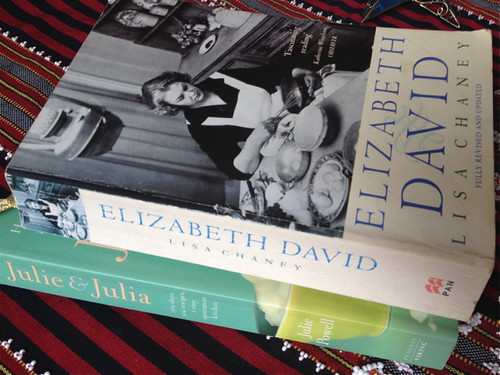
For no particular reason I then reread Lisa Chaney's biography, 'Elizabeth David'. I suspect every Australian woman who moved out of home and began cooking in the 1950s or 60s has a Penguin edition of at least one of Elizabeth David's cookbooks stashed somewhere. I grew up with the then-accepted Australian diet of plainly cooked meat and veg, and a vast array of cakes, biscuits, slices, and everyday desserts. Elizabeth David's books came at just the right time for me, when hitherto unknown vegetables such as zucchini and eggplant were available in greengrocers' shops, and modest Italian restaurants were almost within reach of a student's budget. Elizabeth David was a pernickety perfectionist who became even more difficult as she aged, but her recipes, her evocative writing style, and more importantly, her insistence that good, local, fresh food was within any cook's reach, revolutionised many people's approach to food.
Cooking books

More than a decade after Elizabeth David's first books, Julia Child published her voluminous 'Mastering the Art of French Cooking'. Julia Child has recently had a resurgence of recognition through Julie Powell's 'Julie and Julia' and the same-named film starring the wonderful Meryl Streep. I raced through my rereading of 'Julie and Julia'. Fun, fun, fun. Julia Child, by the way, shares Nora Ephron's love affair with butter - such a guilty pleasure nowadays. It's interesting to compare Elizabeth David and Julia Child. The similarities are obvious in that they shared the desire to place fine food and good cooking within the reach of the everyday cook. But they do this in very different ways. Julia Child's recipes are painstaking - every step is outlined and every difficulty anticipated. Elizabeth David, on the other hand, is more interested in inspiring her readers by evoking the traditions and spirit of the recipe. She encourages you to improvise and above all, to sacrifice all to freshness and seasonality.

I feel much more at home with Elizabeth David than Julia Child, though there are recipes from both that are still very much part of my go-to cooking repertoire.

After all this cooking reading I was inspired to bake. This happens infrequently nowadays. I had some peaches that were nearing the end of their usefulness and I remembered a recipe for peach pie in 'Heartburn'. But my copy of 'Heartburn' has disappeared again - I expect recaptured by my daughter. I retreated to one of those recipes I've made so many times that it is foolproof. It came to me from my old friend Erika as an apple cake recipe, though I never knew her to make it with apples; I've eaten her cake with apricots, berries, plums (yum), but not apples. I've made it with apples many times and it's great, but I thought it would also be good with peaches. It was. So, in the spirit of Nora Ephron's recipe-laced prose I offer you...

Erika's Apple (or Peach) Cake.


120g butter
100g sugar (white or natural - whichever you prefer)
3 eggs
1 teasp vanilla
200g self-raising flour (I've used white flour, but 50/50 wholemeal and white is also good)
2 apples, quartered (or 2-3 peaches or plums, or whatever)
3 tabs milk
1 tablespoon extra sugar

Beat sugar and butter till well-incorporated. Add eggs one at a time, while beating. Add vanilla. Fold in sifted flour, roughly a third at a time, alternating with milk. Place mixture in greased cake tin and press in quartered or chunkily cut fruit. Sprinkle with extra sugar (and cinnamon if using apples). Bake in preheated 175 celsius oven for around 35 minutes. The cake is fine by itself, or good served with cream or sour cream.

If you are feeling energetic, you can make a crumble of roughly mixed butter, flour and brown sugar to sprinkle on top of the cake before baking.
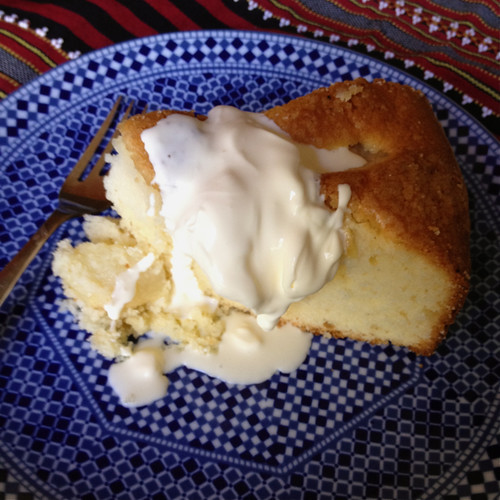
Peach cake

This is what my mother would have called a 'plain cake' - one to be served everyday to family or farm-workers, but not the kind of cake you make if you wish to impress someone with your baking!


Tuesday, October 9, 2012

12 in 12: Books - September 2012

I think this will be my last post on my attempt to limit my book-buying. In September I just abandoned all hope that limiting my book-buying to 12 books for the year was a manageable project. I long ago passed this target. I've had even more time to read since I left paid employment and this, together with the temptations of my kindle, has meant I've been chain-reading. Chain-reading is what reading addicts do. You finish one book and immediately, without time for reflection, begin another one. Most of what I've been reading isn't even worth reporting, except to note I've been binging on Swedish novelist Liza Marklund's thriller series featuring edgy investigative journalist Annika Bengtzon. The binge began because I went to see the movie 'Last Will' which was based on the most recent novel of the series, and then one book led to another...and another...and yet more.

But perhaps I should mention a couple of 'picture books' I've purchased.

September books

The first is the vibrant Pop Knitting by Britt-Marie Christoffersson, who has been an innovative knitwear and textile designer in Sweden for almost fifty years. She is clearly yet another well-known knitting guru who, probably because of the vagaries of book translation, publication and distribution, is less well-known in the English-speaking world than she deserves to be. A friend had already purchased this book but when I saw it I knew I wanted a copy of my own. Christoffersson experiments with texture, construction and colour combinations - all of which are made even more exciting by the vibrant and unexpected colours she uses.

pop knitting 1pop knitting 2

The second 'picture book' I purchased is Jane Brocket's Vintage Cakes - subtitled 'more than 90 heirloom recipes for tremendously good cakes'. I'm a long-term reader of Jane Brocket's very English blog and several years ago reflected on some of my reactions to her first book, 'The Gentle Art of Domesticity' . Since that first publication, Brocket has published a number of other books, including beautifully photographed and styled books on knitting and quilting. Both her blog and the books she produces reflect a modern attraction to what I think of as 'optional domesticity' - the kind of pleasure that can be derived from traditional domestic tasks when it is no longer necessary for women to perform them. The crafts and pastimes of Brocket's blog and books are comfortable, decorative, require care and thought but only amateur levels of expertise, and can be done as time and whim determine. Optional domesticity.

Her latest book, Vintage Cakes, fits this pattern. All the recipes are within reach of the competent home cook. They're similar to the recipes I've inherited from my mother and grand-mother. Lots of butter, sugar and eggs, and sufficient variation to provide interest and change for the cook and consumer. Brocket has a keen eye for the topical and this book is perfectly timed for what I've observed is a current fad for baking (not cooking more generally, but baking more specifically). So far I've tried only one of the recipes - the lemon drizzle cake - which was a delicious mix of sharp lemon, sweet syrup and buttery cake. A great hit with my visiting family members (and me!)

lemon drizzle cake

So, I'm hanging my head in shame with my failure to limit my book-buying. It's clear that my delight in buying clothing is less of an addiction than my book-buying and consequently limiting clothes-buying is easier to achieve. From now on there will be no more shameful posts about my consumerist book-buying habits. I'll just buy books and not count them.

Monday, September 3, 2012

12 in 12: Books - July and August

I've kind of taken my eye off my book-buying. At one level the attempt to limit my book-buying to 12 books for 2012 has been an abject failure. But there's a sliver of silver lining in that I do now think more before I purchase a book, and there have been a number of occasions on which I've actively resisted the urge to buy.

July was fine. I bought only one book - Mo Hayder's sensationalist and morally questionable Birdman when I wanted something distracting to read. August has been a buying disaster. I blame the Byron Bay Writer's Festival. I've already noted how impressed I was by Australian novelist Alex Miller's interview at the Festival - so I felt I needed to buy his latest book, Autumn Laing which I've still to read. Text Classics (a venture by Text Publishing to re-publish out-of-print Australian 'classics' at wonderfully cheap prices) has included some crime fiction which tempted me. I discovered I hadn't read Peter Temple's An Iron Rose (1998) and of course couldn't resist buying it. I am a Peter Temple fan. His early books are well-plotted, well-written and deeply Australian, but his most recent novel, Truth, is an example of how an alleged 'crime novel' can transcend its genre. I laughed out loud with Shane Maloney's Stiff. There were others - but I won't bore you with a full disclosure of my temptations and falls.

Prolific Singaporean writer Shamini Flint was one of the Festival's great entertainments. The friend with whom I was staying already had one of her books featuring Inspector Singh of the Singapore police. I galloped through it. Fun, fun, fun, and along the way interesting and challenging insights into various south-east Asian cultures and cultural stereotypes. I've subsequently bought another two of the series in e-book format and have devoured them, too.

And then there's book group reading; in particular, Irish-born, now Canadian, Emma Donoghue's Room. I'm sure I've already written somewhere that I have a very low tolerance level for whimsy, which leads me to be suspicious of novels or even films that are voiced by children or (heaven forbid!) animals. So I was not predisposed to like Room, whose narrator is five-year-old Jack, imprisoned in an impregnable shed with his kidnapped mother for his whole life. This is an interesting contribution to the genre of novels that teases out how we learn about our world by focusing on people whose initial socialisation has been stunted or severely limited. This novel is not whimsical. And despite the horror of the situation it depicts, it's essentially a story of the capacity for survival through caring relationships.

So, disaster on the book-buying front. I haven't even totalled the number of books I've bought in August because it's just too many. And I've already bought one book for September!

Sunday, July 1, 2012

12 in 12: Books - June

I'm not sure why I'm continuing to blog about book-buying when I'm so clearly not going to meet my target for the year. Maybe because I think it might at least limit my book-buying tendencies if I have to publicly acknowledge them? Possibly because it provides an opportunity to think about the patterns of my buying and reading? Or maybe just because I like writing about books.

I was doing reasonably well for most of June. My love affair with the Kindle is continuing and I bought Jo Nesbo's Devil's Star (yet more and yet more Scandinavian crime fiction) and my book group's read for this month, Anna Funder's Miles Frankin prize-winning All That I Am.  I'm not sure that the Kindle is an ideal medium for my book group reading. One of its shortcomings (yes, even such a fan as I am has to admit there are some) is that it's much harder to flip back and forth to reread bits and pieces and think about how they relate to each other. I guess over time I'll work out what format is best for what kind of reading.

Then, in the last few days of the month I bought two more books, but I really do have a good excuse. I read of Nora Ephron's untimely death at 71. She's best known as a scriptwriter - Silkwood, When Harry Met Sally, and as that most aspired for combination, scriptwriter/director - You've Got Mail, Sleepless in Seattle, and Julie and Julia. My first awareness of Nora Ephron was as the author of the novel Heartburn, which was a loosely disguised acerbicly funny account of the break-up of her marriage to Carl Berstein, the journalist of Watergate fame. I loved the dry, self-deprecating, strong wit of the novel, and remember both laughing out loud as well as trying the peach cobbler recipe that pops up in the middle of the story. Later the book was made into a film with Meryl Streep playing the Nora Ephron character...which then led to this wonderful Ephron tribute to Streep:


Wouldn't you love to be able to write lines like that?

Like so many of my books, Heartburn somehow disappeared, so I've purchased a replacement. It wasn't available in e-book format, so this time I've bought a 'real' book.  And mainly because I couldn't resist the title I also bought Ephron's book of essays I Feel Bad About My Neck: and Other Thoughts on Being a Woman.

So that's four more books for this month - but so much reading pleasure.

Tuesday, June 5, 2012

12 in 12 Books: May

Infatuation with my Kindle has completely undermined my challenge to limit book-buying to 12 books for the year. As I mentioned before, it's just so convenient. Too convenient. Not only can I carry it with me anywhere, but I can buy books at any time; anywhere.

This has not only led to a book-buying spree, but it's also having an impact on the kind of books I'm reading. I was going to write that it's had an impact on the quality of my reading, but that brings into question the whole notion of 'quality' that I don't want to engage with just now. In practice, it's meant that when I finish a book, instead of thinking about what I might read next and taking stock of the books on my mental 'to read' list, I've downloaded yet another crime novel.

So, to the damage. I've bought - and read - five books this month. Four of them have been crime fiction - two Peter Robinson's (Banks is a rather shameful pleasure), a Camilla Lackberg and Martin Cruz Smith's 'Three Stations'. Cruz Smith's central character Arkady Renko, out of favour with whatever group is in power in Russia and forever forsaken in his private life, is another favourite. I also read this month's book group choice on my Kindle - Lionel Shriver's 'The New Republic'. Awful. I rarely get bored by novels, but this was the kind of book where all its tricks and tropes are displayed in the first couple of chapters and then simply repeated. I actually think this recent publication is a bit of a cheat. Shriver wrote 'The New Republic' early in her career as a writer and it was not then accepted for publication. However, subsequent to the success of such books as 'We Need to Talk About Kevin' her publishers clearly thought it would have a market. You can see in 'The New Republic' the writer she would become - absolutely in tune with the big issues of the time, clever, satirical, a bit of a misanthrope, a pithy wordsmith. In this case the issue at the centre of the novel is the press and the creation as well as the reporting of 'news'. Most topical for today. Maybe that's one of the reasons the publisher has released it. But the novel's high point is the way she chooses to embody the theme, and once you've 'got' that, it's all rather repetitive.

So, I've bought five books this month. That makes a total of eleven books till the end of May, and given I've already bought another one in June I've reached the target for the year. And I'm not even half-way through the year. Maybe I should just surrender at this point.

Friday, May 18, 2012

Infatuation

I'm infatuated by the Kindle I bought last weekend. I'm in thrall to it. It accompanies me everywhere. I can no longer imagine how I managed for so long without it.

kindle

Over the last year or so I've had many discussions with friends about whether or not to buy a Kindle. A range of advantages were argued - that you could buy books more cheaply; that you no longer had to find storage for books; that a wide range of books was easily available; even that it is good for the environment not to produce paper books. But no one mentioned what in fact has converted me so immediately. It's just that the Kindle is so light and easy to carry in my handbag. It is simply so convenient. I'm one of those people who must have something to read if I need to wait ten minutes for a train. If I'm by myself, I can't imagine having coffee without something to read. One of my great pleasures is reading over breakfast. I can't go to sleep without reading. The Kindle is so light and small that I can have it with me all the time, and, because it is wireless, I can download books any time, almost anywhere. No more panicking when I run out of books to read while traveling.

Some people have asked me whether I miss the tactile sensation of reading a paper book - the pleasure of page turning and the physical sensation of making your way through the book. I feel slightly embarrassed to admit that I miss none of these sensations. I think books for me have always been about the story and the words. I've never been very good at caring for books. I'm just as happy reading a tatty paperback as I am reading a hardback; I spill food on my books from time to time, turn down the corners of pages to mark my place, and occasionally squash them in bed when I fall asleep while reading. So the abandonment of paper for an electronic format hasn't bothered me (though I'll have to wait and see how it copes with spilled coffee and breakfast crumbs).

The Kindle has none of the glamour and pizzazz of an i-pad. On the whole it's grayly utilitarian. But I have been charmed by the range of screensavers (if that's the proper word) it has in its resting state. It displays in random sequence a number of different black and white geometric designs - all based on previous reading technologies - calligraphic designs, pencils, pens, typeface. I imagine these designs are used to suggest that the Kindle and its kind are just the next step in written communication. I'm hoping there's no irony in the designs.

kindle 2kindle 1kindle 3

I have to think about how my Kindle purchase affects my 12 books in 2012 book-buying challenge. I guess I'll just have to count the books I buy for the Kindle. But what do I do about free books - those out of copyright? Do I count them, or, because I don't pay for them, are they more akin to book borrowing or using a library?

So far I'm charmed by my Kindle. Quite infatuated.

Tuesday, May 8, 2012

An insight to another world

I'm running very late with my report on book-buying for April. I bought only one book...but what a book!

Tanizaki

One of the widely-read members of my very widely-read book group suggested reading Junichiro Tanizaki's The Makioka Sisters (written between 1943 and 1948). Reading this book was one of those experiences that made me feel rather stupid and culturally myopic. First of all, I felt embarrassed I didn't know the works of Tanizaki at all (though he is apparently one of the most widely read Japanese authors of the first half of the twentieth century), and secondly, that I had never encountered this wonderful novel.

For once, whoever wrote the Wikipedia entry for Tanizaki got it absolutely right in describing Tanizaki's work as 'complex, ironic, demure, and provocative'. One of my book group likened The Makioka Sisters to Jane Austen's novels and, unlikely as this sounds, this also is absolutely right. It's a novel of relations between sisters of different characters and preferences. It's a novel where marriage prospects, and money, and connections, and reputation, and honour, are the subjects of obsessive forensic examination. It's a novel where the life of each sister inevitably affects the prospects of the others. See what I mean? All very Jane Austenish, but set in Japan in the years leading up to the second world war.

Another characteristic the novel shares with Austen is that it's set in a period of great social change when world-shaping events were occurring in the broader society, but where the focus is on the minutiae of day-to-day life. As a reader you gradually realise that the 'China Incident' referred to in passing from time to time (usually as an excuse for not engaging in an excessively ostentatious exchange of gifts or hospitality) is the horror of the second Sino-Japanese war.

As well as enjoying this book as a novel it had all the fascination of an excellent ethnography where I felt as if I'd been given an insight to another world view that has quite different 'taken for granteds' from the world I normally inhabit. I'm recommending it to all and sundry.

Wednesday, April 4, 2012

12 in 12 Books - March

All right. I admit it. Not buying books is MUCH harder than not buying clothes. I'm trying very hard not to buy books. Every time I even begin to think about buying a book I restrain myself. Even so, this month I bought three books, so that I'm halfway through my year's quota after only three months.

But I think I had such good reasons for buying these books. Their purchase was unavoidable. However, I expect I will feel that way, for new and unexpected reasons, about every book I buy this year.

While I was in Manila I visited Solidaridad bookshop.

Manila Solidaridad

The bookshop opened in the mid-60s and has always been owned by renowned Filipino novelist, publisher and commentator F Sionil Jose. It's located in Ermita which is one of the old bayside areas of Manila. In the seventies, when I first visited the bookshop, Ermita had already passed its period of grandeur, but still had some interest as a rather bohemian place where writers, academics, political activists and journalists congregated. The centre of Manila has moved westward since then and Ermita is now very tatty and down at heel. But the bookshop somehow survives. It still stocks an interesting selection of literature and, in particular, a good range of Filipino literature.

Even though English is widely spoken in the Philippines, and journalism and comment in English is robust and widespread, few novels are written - either in English or local languages. F Sionil Jose has been the most prolific Filipino novelist in English, writing novels in a realist tradition that deal with issues of family, of class, of identity and of dislocation. I've read a number of his works over the years and so when I discovered a new 2011 publication, The Feet of Juan Bacnang, I couldn't resist purchasing it. It was the perfect place to buy a copy.

Filipino books

The second purchase was equally meant to be. I bought a detective novel - Charlson Ong's Blue Angel, White Shadow. Given the relative scarcity of Filipino novels in English, and my liking for detective fiction, this also was irresistible.

The third purchase? Well, if you ever plan to travel to Macao and you're as addicted to reading as I am, make sure you travel with a good supply of books. I finished the single book I'd taken with me soon after I arrived in Macao and went searching for a bookshop. I'm sure the concierge at my hotel had been asked for many things in his job, but someone seeking directions to a bookshop was clearly well outside his experience. I could easily have found Rolex watches or Parisian couture clothes, but books were much rarer. Eventually I stumbled on a Portuguese bookshop with a small but interesting selection of books in English where I bought a copy of Andrew McGahan's 2006 novel, Underground. It's not one of McGahen's best works (I was very impressed by Last Drinks, set in the era of the Fitzgerald enquiry into police corruption in Queensland) but it's an interesting political comment on the dangers of repressive political leadership in Australia in a post 9/11 world.

So, buying all three books was either irresistible or unavoidable. But I do have to count them in my year's total. I'm coming to the conclusion that I set an impossibly low target for the year.

Wednesday, February 29, 2012

12 in 12 books: February

February proved to be goodish on the book-buying front. I bought two books. So I'm now a bit ahead of where I should be with my book-buying, but I hope I can be more restrained somewhere later in the year to compensate.

Feb books

As with my clothes buying challenge last year, limiting my book-buying has revealed previously unacknowledged habits and attitudes. One of the things I've discovered about myself is that I find it almost impossible, if I'm by myself, to have a coffee or lunch out without a book to read. It must be the kind of deep association that cigarette smokers have with drinking tea or coffee. It's not that I'm at all embarrassed or uncomfortable about eating alone in public - in fact, I quite enjoy it. I don't feel the need to retreat behind a book. Maybe it's just because I was never allowed to read at the table as a child that I find reading while eating so pleasurable.

I blame my first book purchase for the month on that habit. I was in the city and needed to have lunch and I didn't have a book with me. I felt a deep need to have a book to read and so I bought Anne Enright's 2007 Booker prize-winning novel 'The Gathering'. I'm deeply concerned about the viability of publishers and publishing in the transition from real books to e-books. I don't disapprove of e-books. I think anything that makes reading easier, more accessible and pleasurable for people is to be lauded. But I am concerned that publishers find ways to continue to make book production profitable so that good writing gets published. One of the outcomes of this rethinking of publishing practices seems to me to be an outbreak of schemes to market cheap books. In Australia, where inscrutable world-wide book distributing agreements have meant very expensive books for many years, this is an unexpected pleasure. This book of Anne Enright's was only $9.95 as it was part of a celebration of Vintage's first 21 years as a publisher. They republished 21 of their most successful books. A present for their readers.

Buying Charles Dickens 'Our Mutual Friend' was a mistake; but not a mistake I will regret. My book group had decided we should read or reread some 'classics' and decided on 'Dombey and Son'. For some reason I thought the book we'd selected was 'Our Mutual Friend' and bought a copy. I've now discovered my mistake. But I suspect reading one Dickens will make me want to read another, so this can happily join my growing pile of books to read in 2012. And it also cost only $9.95. For whatever reason (copyright?) 'classics' are sold more cheaply. Dickens is very good value reading - you get lots of words for your dollar!

My 2012 reading has been slowed down over the last few weeks by reading Frank Moorhouse's doorstop of a book - 'Cold Light', which I hasten to add was a Christmas gift - I didn't buy it. Such a wonderful read. It's the third book in a trilogy about Edith Campbell Berry, who, as a young woman leaves Australia to work for the League of Nations in the cause of world disarmament. By this final book in the trilogy Edith returns to Australia in 1950 after the second world war doomed the ideals of the League of Nations and she finds herself out of a job. Edith settles in Canberra in the vain hope of gaining a diplomatic position, but finds herself caught up in the planning of Canberra and the movement to resist the banning of Communism. The book is a most wonderful combination of a personal story and political and diplomatic settings and events. Thoroughly recommended for whenever you need a BIG book to read.

Saturday, February 4, 2012

12 in 12 books: January

I forgot to post about my progress with my personal challenge to buy only 12 books in 2012. So far, so good.

Alice Waters

I bought only one book - Alice Waters' cookbook 'The Art of Simple Food' which, though published only in 2007, is already well on the way to becoming a classic. I'm hoping it will inspire me to cook simple meals with fresh ingredients, frequently. Once upon a time I think I was regarded as quite a competent cook; but living by myself has made me lazy. I'm fully aware that buying cookbooks has a kind of magical quality to it - you trick yourself into believing that somehow the act of buying the book will of itself improve the quality of your cooking. I know what I really need to do is overcome my laziness about putting effort into cooking for myself: but I am hoping that the new book will provide sufficient inspiration to overcome my laziness.

By the way, I've added an exception to my no-book-buying resolution. I'm allowed to buy gift books for others. This is a necessary variation as I just couldn't manage without buying books for my grandchildren.

Even though I've not bought books I have been reading. Mainly I'm still reading books I was given at Christmas time and books I bought last year. I also read some of my daughter's books when I was staying at her place. So far I haven't lacked for very pleasurable things to read. But this challenge has made me realise that I'm in the habit of just popping into bookshops if I have a few minutes to spare. The Bookshop of Doom in the Devonshire Street tunnel is a particular temptation on my way home from work, and a visit to the city seems incomplete without a few minutes in Kinokuniya.

Monday, January 2, 2012

12 in 11: December and ...finale

Did I succeed and reach year's end with only twelve clothing purchases across the year? Yes I did! I bought no clothes in December and so (with a little bit of creative counting urged on by my readers) I reached my goal for the year.

Across the year I've bought three pairs of shoes (Mary Janes that accommodate my heel inserts and that are already extremely worn; some Trippen sandals and glittery beaded slippers from Malaysia that need a particular occasion for wearing); two pairs of winter pants - beautiful fine wool Alistair Trung sale pants I've been wearing for 'best' and some indestructible heavy fabric grey pants I've just about lived in; a black Nicola Waite overdress that I wear either over pants or with thick tights (Nicola Waite makes such great clothes for larger women); three long-sleeved t-shirts for winter; a summer Marimekko oversized t-shirt that's currently my go-to favourite; and a grey Mandarina Duck handbag I've used almost every day since it was purchased. The final item is some earrings I bought on a visit to the Canberra Old Bus Depot Markets. I subsequently bought some additional earrings and a necklace while travelling but at the urging of my readers decided not to count these as they fall into the categories of both handcrafts and souvenirs.

So what have I learned from this challenge? Probably that it's good to have some external constraint on my clothing purchases - it's kept me honest to know that I need to publicly justify them. I've ended up with purchases that have been practical (as well as beautiful in some instances) and that - with the exception of the beaded slippers - have been well worn across the year. I'm surprised to find just how many of the items I've bought have been 'brand' items. As I wrote in an earlier post I've liked to think of myself as disregarding brand snobbery. I think I've now discovered that I just like to be selective about the brands I'm snobbish about!

I've enjoyed this challenge and what it has taught me; and I've enjoyed the comments it's elicited both within this blog and in person. I don't think the challenge can be continued indefinitely - my summer clothes in particular are just about falling apart and need rethinking. I don't think the challenge has brought a major change to my purchasing patterns; I've just been a bit more restrained. I've decided to keep an informal clothes-buying tally across 2012, but not on the blog, to see whether publicly acknowledging my purchases does make a significant difference to what I buy.

I was gloating about my success with this challenge to my daughter when she suggested that I should extend it for 2012 to an area of purchasing where I'd REALLY have difficulty exercising restraint - book buying. This brought me up short. Being careful about the books I buy would be much more difficult than taking care about clothes buying. I've thought and thought about this suggestion and have decided to set myself a 12 in 12 book challenge for the year. This will be really hard but just might make me thoughtful enough to use all the sensible alternatives there are to the indiscriminate book buying I currently practice. So, in 2012 I intend to

* use libraries. My local library is the excellent City of Sydney Library with its many convenient and interlinked branches, and I also have access to the library at the university where I work. I have no excuse for not using them.

* read currently unread books that I own. There are not many of these as I'm not a great browser of book shops unless I need something to read immediately. But I suspect I might find more of these than I think I own once I go searching.

* reread books I own. I have a great affection for nineteenth century literature and could engage in more systematic rereading. In particular, I'd like to reread some turn of the nineteenth century Arnold Bennett (a past favourite) to see what I now think of it.

* borrow books from friends. This really means making a strong resolution to return books I borrow from friends. In the past I've been reluctant to borrow books as I've not always been meticulous about returning them. This needs to change.

So, my 12 in 12: Books challenge begins now. Wish me the will-power and restraint I'll need to succeed!

Wednesday, August 10, 2011

Crime fiction echoing life

I'm not quite sure how or why it happened, but at some stage my blog became my public conscience on a number of matters. There's my public accounting for clothes buying in 2011, and public disclosure of my successes and failures with my sock knitting. And then a few months ago, overwhelmed by shame at my reading habits, I made the resolution to read ten non-crime fiction books before I allowed myself to return to crime fiction. And then promptly forgot about my challenge to myself.

But I must have internalised the intention because, of the next eleven books I read, ten were not crime fiction. A victory of some sort.

However, sometimes reading crime fiction is very rewarding (and very often it's distracting and enjoyable). I've just had a rather freaky reading experience.

Redbreast

Rather belatedly, I've been reading Jo Nesbo's 'The Redbreast' - originally written in Norwegian in 2000 and then translated into English in 2006. [The cover of my edition of the book promotes Nesbo as 'the next Stieg Larsson', which must be rather galling for Nesbo as he was writing to great acclaim well before Steig Larsson published the 'Millenium' trilogy.] A key focus of Nesbo's novel is the story of a group of young Norwegian men who supported Hitler's view of the world and chose to fight with German troops on the Eastern front during the second world war. Also part of the story is modern neo-Nazism, influenced by the stories of these men, and its resentment of modern Norway's values. Nesbo implies that there is a long minority history of pro-Nazi views and affiliations hidden behind Norway's current peace-seeking stance. I was reading this book just as the horrific recent killings occurred in Norway. There was an uncanny parallel between the speeches and views of the some of the characters in Nesbo's novel and those of Anders Behring Breivik. Given it was written in 2000, 'The Redbreast' seemed very prescient.

Sometimes it's easy to justify my reading habits.

Tuesday, May 10, 2011

Miscellany

* Since posting several weeks ago about my ambitions for travel I've been to Orange, to Mount Keira and then, this last weekend, to Brisbane. Next weekend I'm off to Canberra for, among other diversions, the Celebration of Wool at the Old Bus Depot Markets, and then a couple of weeks later I'll be visiting Lennox Head for a good friend's significant zero birthday celebrations. You'd think that would be enough travelling to satisfy even me, but my travelling friend Jan and I are also plotting a more serious bout of travel - ie outside Australia - in mid-June. More of that nearer the departure date

* I've been to Brisbane to celebrate my grand-daughter's fourth birthday. I think four must be the perfect age for a birthday party. The guests were Ana Maria's classmates from kindie (and assorted accompanying parents) and they were both old enough and young enough to find it fun to play happily on the playground equipment of the excellent park in which the party was held. They all came proudly in their dress-up clothes - Snow White, Cinderella(s), Batman, variations on fairies, cloaks, tutus.

party dress

They're not yet old enough to be competitive and critical and sufficiently old enough to enjoy, unselfconsciously, masks and spangles and tiaras. My daughter had done just enough organisation - choosing a great location, food in individual party boxes for the children, cheese and fruit for the grown-ups - and we had perfect weather and absolutely no accidents, mishaps, arguments or tears. A great success.

And I've decided to include a completely gratuitous picture of Ana Maria in her Playful Stripes cardigan, finished earlier this year.

Ana Maria and bubbles 2

* It's a long time since I've enjoyed a knitting project as much as my current Different Lines shawl. Everything about it is perfect. Yet another garter stitch project, but with interest added through the short-row shaping to produce stripes of graded width. The yarn is particularly luxurious - an alpaca / silk blend from Old Maiden Aunt Yarns that I bought from Loop in London on my visit early last year. The yardage on each skein of yarn is less than ideal for this project but, with stern blocking, I think the finished size will be adequate.

striped shawl 2

* One of the benefits (sometimes disadvantages) of my blog is that it enables me to keep track of my reading. I'm somewhat ashamed of my recent reading. Of the last ten books I've noted, nine are crime fiction. Good crime fiction but, nevertheless, definitely escapist reading. I'm a seasoned practitioner of escapist reading so I can't imagine I will ever really change this reading pattern, but I am going to make a serious attempt to broaden my reading. So I'm making a public resolution - no more crime fiction till I've read at least ten books of other genres.

* I've done a bit of clothes-buying - but more about that on my next 12 in 11 update.

Wednesday, February 16, 2011

Re-reading

Books

I read relatively quickly, and I read every day. I can't get to sleep unless I spend some time in bed, reading. So, I often run out of things to read. Even with the temptations of the Bookshop of Doom, and the pleasure of regular book-swapping with friends, from time to time I find myself re-reading books I've enjoyed. Perhaps fortunately, I have quite a bad memory for the detail of books I've read. I'm much more likely to remember the emotional tone of the book than I am to remember the details of the plot. Maybe this is the downside of reading in bed late at night? Anyway, I'm one of those readers who often reads the end of a book when I'm only half-way through, so clearly I'm not deterred from reading by knowing how things end.

And because I only re-read books I've enjoyed, I can take delight from re-reading. Just now, I'm feeling comforted by re-reading (for the third time? the fourth time?) The Balkan Trilogy by Olivia Manning. And when I've raced through the three volumes of this trilogy I have 'The Levant Trilogy' to look forward to. These six novels, that were written between 1960 and 1980, follow the lives of a young English couple, Harriet and Guy Pringle, who become trapped in Romania by the German eastward advance at the outbreak of the second world war. Under increasingly harsh conditions they are evacuated to Greece and then to Egypt. There's much to be critical about with these novels. They have a very uneven attitude to racism and colonialism - though there is always the concern about importing one's own 21st century attitudes to a different time and place - and the writing is often cliched. But I'm captivated by the two central characters and by the depiction of the change in their relationship over time, and I find the investigation of how people adapt when they are strangers in other lands totally engrossing.

In 1987 the BBC made a wonderful television series of the two trilogies under the title Fortunes of War. It starred two young and at that time relatively unknown actors, Emma Thompson and Kenneth Branagh, and has remained in my memory as one of the high spots of television viewing, ever. I have such good recollections that I've ordered the DVD of the series. I'm hoping my re-viewing is just as pleasurable as my re-reading.

The other book I've recently re-read is Christina Stead's 1940s novel, 'The Man Who Loved Children'. A few months ago my book group read Jonathan Franzen's recent novel, 'Freedom' - about which we were all a bit ho-hum, but that's another story. In reading some on-line reviews of the Franzen book, I discovered his praise for 'The Man Who Loved Children'. I think all my book group had read the Stead novel at some time in their lives - usually the very distant past - but we decided to read it again. I have great fondness for my book group, but I must admit that we are a bit lazy. We're all avid readers but feel we've got to a stage of our lives when reading should simply be pleasurable. We don't often challenge ourselves with our book choices. But after reading and discussing 'The Man Who Loved Children' we all agreed that in this case we were delighted that the book group had pushed us to such a dense and rewarding read.

Tolstoy's well-known dictum that 'All happy families resemble one another, each unhappy family is unhappy in its own way' is given a thorough workout in Stead's novel. It's well-known that 'The Man Who Loved Children' is a reworking of aspects of Stead's own childhood - particularly through the central character of the father, Sam Pollitt. Sam is charismatic, energetic, idealistic and ultimately narcissistic, controlling and selfish. He enthralls his children, but forces them to comply with his image of them. Henny, the mother within the family, is discontented, unhappy and sharply bitter. They struggle with poverty, but are improvident with the money they do have. There's a bleakly hopeful ending for Louie, the oldest daughter of the family (the Christina Stead character?), but the reader despairs for the fate of some of the other children.

'The Man Who Loved Children' is not an altogether easy read. I'd forgotten how florid and elaborate the style of writing is - even though it's also often beautiful and moving. And the novel is long and repetitive, though you can argue that the repetitiveness is exactly what reveals the full horror of Sam's interactions with his children. But the need to know what happens and what new awfulness will be revealed carries you along. I agree with Jonathan Franzen that it is a mystery why the novel is not better known and more highly regarded. I think it's a wonderful read (and re-read).

Friday, November 5, 2010

Reminiscence

I'm off to Brisbane for the weekend to visit my grand-daughter... and, of course, her parents. Mostly when I visit I take a book for her as a small gift and this time I'm taking 'Milly-Molly-Mandy Stories'.

MMM cover

I remember Milly-Molly-Mandy with great fondness from my 1940s and 50s childhood. My daughter enjoyed them in the 1970s and I'm interested to see how my three-and-a-half year old grand-daughter - who loves books but is very much a child of the electronic age - responds to them now.

A bit of back-story for those unacquainted with Milly-Molly-Mandy. There are four books, each of them a collection of around a dozen short stories, that describe the daily life of Milly-Molly-Mandy (full name Millicent Margaret Amanda), her family, her friends, and her neighbours. The first of the books was written and illustrated by Joyce Lankester Brisley in 1928, and they've never been out of print since - the kind of publishing phenomenon most publishers would love to be associated with.

It's hard to know where the appeal lies. The stories are simple, highly moral, and contained within a stable and knowable world. The illustrations are open, inviting and archetypal representations of a rather old-fashioned, safe community. The stories have a wealth of detail - of what people eat (I'd totally forgotten about bread soaked in milk, which Milly-Molly-Mandy often has for supper), what they do in domestic situations, what they wear, and how much things cost. There's lots of repetition (Milly-Molly-Mandy's house is always referred to as 'the nice white cottage with the thatched roof'; her best friend is always 'little-friend-Susan') which delights young readers and listeners and drives grown-ups mad.

For me a very important element of the appeal was the map of Milly-Molly-Mandy's unnamed English village that appears at the beginning of each collection of stories. I think most young children love maps and graphic representations of how things fit together.

MMM map

I can remember tracing the movements of the characters in each of the stories across the streets and fields of the maps and deriving satisfaction from my precise knowledge of how things fitted together spatially.

The village of the stories is old-fashioned even for its time. There's no electricity and no cars. People work as grocers and shopkeepers and bakers and postmen and blacksmiths and teachers, and they grow vegetables and flowers. It's a world where small children run errands unsupervised, everyone walks everywhere, strangers are kind, all treats other than 'sweeties' are home-baked, and recycling and reuse are unthinkingly the order of the day. Gender roles are rigidly divided - we learn in the very first story that within Milly-Molly-Mandy's multi-generational family household Mother cooks the dinners and does the washing; Grandma knits socks and mittens and nice warm woollies for them all; and Aunty sews frocks and shirts and does the sweeping and dusting. But I don't think I am being unduly kind to the books, or too biased by my fondness in saying that the female characters are valued no less than the men. They often play a leading role in events, and their activities are seen to be important.

Implicitly, and often explicitly, all the stories have a moral or are 'improving'. Almost always, the morality or the learning is obvious - sharing with friends, whether it's work or sweeties, brings pleasure; delaying gratification often brings longer-term rewards; judging people by their appearance is unfair; winning first prize is less important than acquiring a skill. It's hard to question any of these gentle values, even today.

Finally in this morass of reminiscence, an incident for the knitters among us. Milly-Molly-Mandy wants to make her money go as far as possible and asks Grandma to teach her to knit. After several attempts she knits 'quite a nice kettle-holder' and asks her mother if she thinks it is worth a penny. The story then continues
Why, Milly-Molly-Mandy,' said Mother, 'that is exactly what I am wanting, for my old one is all worn out! But the penny only pays for the wool, so you are making me a present of all your trouble.'And Mother gave Milly-Molly-Mandy a penny and a kiss, and Milly-Molly-Mandy felt well-paid.

So Milly-Molly-Mandy had done a nice thing, had spent her penny, and learnt to knit, and she still had her penny!

There's a moral there, somewhere!

Wednesday, September 1, 2010

Comfort reading

I've just finished rereading Anthony Trollope's novel, Dr Thorne. I think it's the fourth time I've read it. I used to half-joke that you could tell if I was feeling stressed or depressed because you'd find me reading one of Trollope's novels. For me they're the ultimate comfort reading.

This latest rereading has nothing to do with stress or depression - it's simply that in packing and unpacking my books for moving I realised just how many copies of Trollope's novels I have. I couldn't bring myself to discard any of them, so I think I felt obliged to reread to justify their space on my bookshelves. I've just counted, and I have 31 of the 47 novels he wrote during his very productive life - with duplicate bound copies of eight of them. I also have his autobiography, a most comprehensive biography by Victoria Glendinning, two critical studies, and a novel by his amazingly prolific novelist mother, Fanny Trollope. You can undoubtedly describe me as a Trollope fan.

Dr Thorne is one of my favourites. It's part of the Barchester Chronicles series, but unlike the better-known The Warden and Barchester Towers, it focuses on the landed gentry of Barsetshire rather than clerical society. At its centre are issues of class and birth and money and honour and the changing balance amongst these forces as society modernises and changes. Trollope somehow manages to be deeply conservative but also humane. His insight into the complex motivations of human behaviour enables him to show empathy even for unpleasant characters - and even for characters he satirises.

Trollope visited Australia twice in the 1870s. His much-loved son, Fred, came to Australia as a young man and settled as a squatter on land just west of the town in which I grew up, Grenfell. Despite frequent subsidies from his novelist father and a great deal of hard work, Fred's unsuccessful farming experience in Australia foretold that of so many others - too little land, low prices and drought led him to sell his farm, Mortray. [There is still a farm of this name in the area]. Trollope wrote a not-so-successful novel based on his son's experiences in Australia - Harry Heathcote of Gangoil. Rather unreasonably, I feel a very distant personal connection to Anthony Trollope.

I think Lady Anna might be next on my Trollope rereading list. I love the story of how this excellent novel was written. Trollope was an astonishingly industrious writer. No sitting around waiting for inspiration to strike for him. This is what he writes in his Autobiography:
When making long journeys, I have always succeeded in getting a desk put up in my cabin, and this was done ready for me in Great Britain, so that I could go to work the day after we left Liverpool. This I did; and before I had reached Melbourne I had finished a story called Lady Anna. Every word of this was written at sea during the two months required for our voyage, and was done day by day - with the intermission of one day's illness - for eight weeks, at the rate of 66 pages of manuscript in each week, every page of manuscript containing 250 words.

That's a publishable manuscript of 132,000 words in eight weeks. Rather impressive. My hero.

Tuesday, June 1, 2010

A most admirable man

Today I've been to the monthly meeting of my book group. I really had to scramble to finish the book, reading it as I fell asleep last night and finishing it over my coffee and muesli this morning before dashing to work.

Henning Mankell

We'd chosen to read the latest book by Swedish writer Henning Mankell, who is best known for his detective fiction set in southern Sweden, with its gloomy central character Kurt Wallender. [By the way, whatever happened to the remaining episodes of the wonderful series, Wallender, starring Kenneth Branagh, that was bought by Channel 7? I'm sure we didn't see the whole series]. But the book we read for today's meeting, like most of Mankell's more recent fiction, isn't part of the Wallender series.

I don't think 'The Man From Beijing' is as good as Mankell's best fiction, but it is deeply interesting. It's about a shocking crime that has its roots deep in history - across time and continents. It's a crime that's committed in Sweden, but whose motivation and investigation links China, the USA, Mozambique, and, fleetingly, London. Mankell, who now lives half his life in Sweden and half in Africa, is a true citizen of the world. He treads the fine line of recognising cultural difference and yet understanding that globalising forces create links and lines of connection across time and place.

Mankell seems to be an admirable and brave man. Reading 'The Man From Beijing' it's clear that he has engaged with politics over time and doesn't fall easily into current simplifications. He contextualises the actions of such currently reviled political actors as Mugabwe or Mao in a way that acknowledges the complexity of forces and events that led to dreadful outcomes. He seems unafraid to probe unpopular positions.

I heard Mankell speak some years ago when he was in Australia promoting his book 'I Die, But the Memory Lives On'- a non-fiction book that chronicles the heart-breaking story of the Memory Book Project in Uganda where people dying of HIV / AIDS construct books of things precious to them so that they preserve some contact with the children and family they leave when they die. Of course, the profits from the book went to the Project.

It was fitting we read Mankell today as he's in the news because he was aboard one of the ships making a political protest against Israel's blockade of Gaza, and is currently under detention in Israel. In a recent interview he said, "It is with actions that we prove we are ready to support something we believe is important'. Whether or not you agree with his particular political stance, he really is an admirable man.

Monday, April 19, 2010

Unrelated bits and pieces

Mostly, I find it more difficult to find time to blog than to find topics I want to blog about. But over the last week I've completely lacked any blogging inspiration. So, to avoid blogging block, some unrelated bits and pieces from my life.

I've been knitting, of course. It feels as if I've been knitting and knitting and knitting but without any tangible outcome.

Knitting April 10

My lack of outcome might be partly explained by having three projects on the go - the 'Tweed Baby Blanket' by Jared Flood, Mona Schmidt's 'Embossed Leaves Socks' (ravlink) and (less actively) the 'Sage Remedy Top' by Sarah Shepherd (ravlink). The sensible thing to do is apply myself to finishing something but, in a behaviour pattern well-known to knitters, I feel the desire to cast on yet another project. I'll let you know what happens.

I'm reading (of course). Latish last night I watched an episode of the wonderful and much-repeated Forsyte Saga and couldn't resist starting reading my very shabby second-hand copy of 'To Let'- the volume of the lengthy family saga that deals with the events of the TV episode I'd just watched. I first encountered Galsworthy many years ago when the first volume of the series - 'Man of Property' was the novel set for study for the Leaving Certificate. Such an odd selection for a group of very unsophisticated pre-TV Australian country kids. I have no idea what others thought of it, but to me it was the height of sophistication. Reading Galsworthy now, the writing is heavy-handed and the themes rather laboured. But I'm still captivated by the way the novels depict the conflict between the desire for property and possession on one hand and generosity of spirit and holding with an open hand on the other.

I've been to the movies. I've seen 'Brothers' - an American re-make of a Danish movie of the same (translated) title from 2004 that I thought was wonderful. Re-makes of European movies make me very nervous, but this one had been greatly praised. I discovered it's been justly praised, though I think I still prefer the original. It's smaller in scale than the re-make and I remember it as having a tighter focus. The American movie is on an altogether grander scale - wonderful cinematography that I think gives it more grandeur than the original. Great performances from Tobey Maguire and Jake Gyllenhaal as the two brothers.

There will be lots of changes for me in the next few months. I'll be finishing up at work, selling the family home, and moving to a smaller apartment that needs to be renovated. So I'm currently spending lots of time making lists and decisions and feeling generally unsettled. I guess one of the upsides is that all these changes will provide rich pickings for blogging.

Monday, September 28, 2009

Joining the mainstream

Late last week I popped in to one of Sydney's larger bookstores and was confronted by a table piled high with paperbacks and a large sign - 'Cool Scandinavian Crime'.

3 books

I think we need a word to describe the feeling you have when you realise that something you thought you had 'discovered', and that you prided yourself was a sign of your fine discrimination, has become a mainstream commercial trend.

I've blogged a couple of times about my liking for Scandinavian crime fiction, and I've even spent time speculating on why I like it and what it has to offer that is unique and different. But suddenly it's become a marketing ploy. A way to encourage people to buy a job-lot of cheap books. It's mainstream! If I were more generous-spirited I should feel pleased that other people have also found the pleasures of Scandinavian crime fiction - but I just feel miffed that my tastes are, after all, commonplace.

I wasn't so put off by this sudden popularity that I resisted the offer of three books for $50. Not a great bargain when compared with my normal buys from the bookshop of doom in the Devonshire Street tunnel, but the combination of some authors I'd not encountered elsewhere, and Arnaldur Indridason's 'Silence of the Grave' made the offer irresistible.

I've already whizzed through 'Silence of the Grave'. Indridason's novels are set in Iceland and the stories often deal in subtle ways with notions of continuity and the impact of the past on the present; of leaving and returning; and of the influence of the 'outsider' - for both good and ill. I'm reminded of another of my likes - Danish crime series on TV - and 'The Eagle' whose eponymous hero is an Icelander.

So, I'll now have ready access to a greater range of authors and novels to feed my Scandinavian crime addiction. But on the down-side, the thrill of the chase, of searching out and discovering new titles in unexpected places has gone. And I can no longer pride myself on a relatively obscure and discriminating taste.

Pride, however minor and harmless, goes before a fall.

Tuesday, April 7, 2009

A day off

Several months ago I changed my work pattern from full-time to working four days a week. I'd been wanting to do this for some time, and the outcome has been every bit as wonderful as I'd hoped. Usually, I spend my non-weekend day off going out to do pleasurable things; visiting friends, leisurely shopping, going to the movies.

But this week I stayed at home on my day off. Despite the wonderful, clear autumn weather I stayed inside and knitted and read...and really enjoyed myself.

Monday

The next installment of my 2009 Personal Sock Club arrives on 14 April - only a week away. Before yesterday, I had only one of the socks from the last consignment of my personal club completed. Nancy Bush's 'Traveler's Stocking' in The Knittery Slim Sock has been quite a challenge for me, and I'd allowed myself to be distracted by Ysolda Teague's Ishbel scarf. But yesterday I cast on for my second sock, and with daylight streaming through the window to illuminate the dark yarn, and increased familiarity with the pattern, I finished the rather elaborately patterned cuff on the second sock. With lots of Easter knitting time coming up, I think I'll be able to finish the socks before the manilla envelope with my next sock installment 'arrives'.

I also managed to finish reading Arnaldur Indridason's 'The Draining Lake'. I've blogged before about my captivation by Swedish crime fiction, and this is a sideways move - Icelandic crime fiction! I'd had this author recommended to me, but this is the first of his novels I've read. It's great. It provides an insight into both modern day and Cold War era Iceland with its somewhat claustrophobic, gloomy view of life, and has a densely plotted, multi-thread narrative. Highly recommended.

PS - I bought the book for $9.95 from the so-good no-name discount bookstore at the Railway Square end of the much-maligned Devonshire Street tunnel in Sydney.