Showing posts with label Sydney. Show all posts

Sunday, March 23, 2014

To market...

Yesterday I went to the weekly Eveleigh Market.

Redfern Eveleigh market

Even though it's only a pleasant 15 minute walk from home, and even though it's packed with wonderfully fresh produce, I don't often shop at the market. Partly because it's expensive - though you can argue, and I often do, that the freshness of the produce means you get much better value from whatever you buy - but mostly because I still have to visit the supermarket for those staple items that are not local or in season. And I really don't like household shopping.

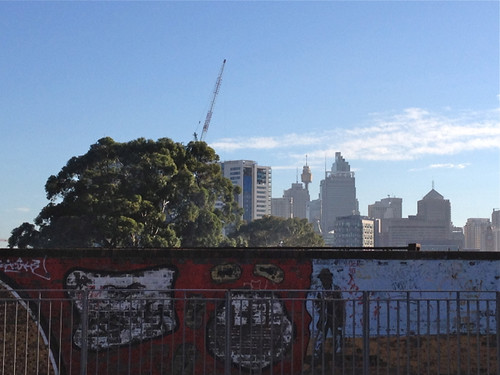
But maybe because I hadn't been to the market for some time, yesterday's visit was a pleasure. It's really an enjoyable walk as I trundle along with my old lady shopping trolley. There are morning glimpses of the city skyline across the historic Lawson Street mural:

Redfern City skyline

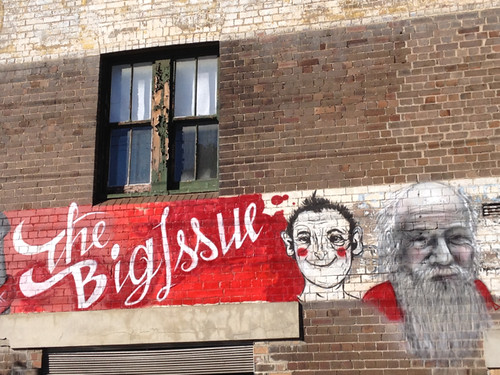
there's the fun of the Big Issue production site.

Redfern Big Issue

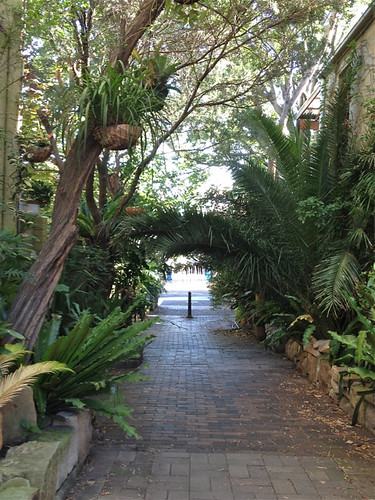
I like the small lanes that link the back streets I walk along:

Redfern lane

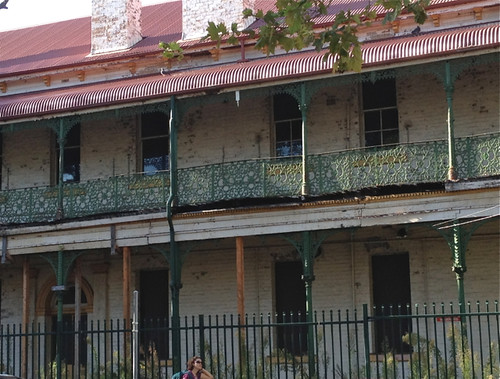
and I wonder about the ever-delayed restoration plans for the beautiful deserted old buildings that were once the headquarters for the Eveleigh railway workshops:

Redfern ruin

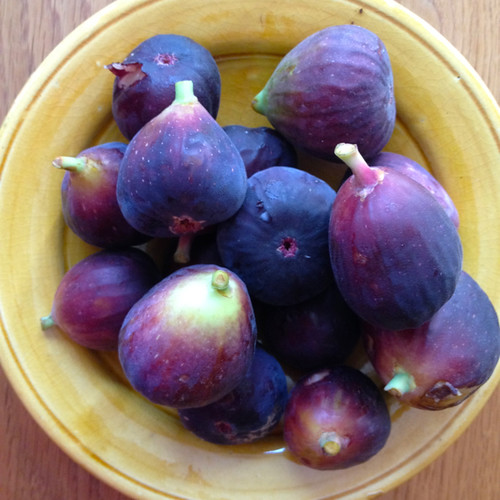
But yesterday's greatest pleasure was the figs. Plump, fresh, and picked just at the right time. Luscious. Yum.

Eveleigh figs

Saturday, September 15, 2012

Filling my days

Often, when friends or acquaintances discover that I've finally left paid employment (I'm still avoiding the ageist 'R' word) they ask me whether I have plans for this phase of my life. I'm never sure just how to answer this question because for me the greatest pleasure of no longer going to work is that I don't have to make any plans. I'm enjoying the lack of structure. Of course I have to plan to shop for groceries or catch up with friends or visit family, but there are days when I can just make it up as I go along. There's also space in my life that enables me to respond to a last minute invitation from a friend to join a group from the Asian Arts Society of Australia (TAASA)who were visiting the Sydney Biennale exhibition at the Art Gallery of NSW specifically to look at some of the work by Asian artists.

It was a wonderful couple of hours. With the guidance of curator Dr Lim Chye Hong we looked only at four works and had time to examine them in detail, discuss them and tease out meanings and relationships. Chye observed that many of the works in the current Biennale clearly were marked by the hand. So many modern works of art are highly conceptual, and often involve film, video and digital elements. But all the works we examined on this visit were highly crafted by hand.

I'm always particularly interested in art works that incorporate traditional crafts, or where the technical skill of the artist is evident. I also love works that use paper and its textural qualities, so a room filled with paper shopping bags of various sizes and provenances where Japanese artist Yuken Teruya had carefully cut and torn shapes from one side of the bag to create miniature trees within the bags, was a magical experience.

Yuken Teruya Notice - forest

Even more surprising was a work by very young inner Mongolian artist. At first sight (and indeed, second and third sight) Gao Rong had recreated, in full-scale, loving detail, the cramped but ordered interior of her grandmother's home. This was interesting and moving. But when we eventually discovered that the whole structure was created in fabric, with embroidered detail, the work became extraordinary. The mould and cracks on the walls, the weathered and worn surface of the chests, the floral patterning on the ubiquitous thermoses, the clock and the photographs on the wall - all were embroidered.

Gao Rong 'The Static Eternity' AGNSW

I was moved by a more traditional work by Yun-Fei Ji - two long horizontal scrolls that depicted the uprooting of agricultural and village life to create the Three Gorge Dam on the Yangtze River. What was remarkable with this work was the use of traditional painting techniques to depict, with great subtlety and layers of meaning, a modern phenomenon.

Yun-Fei Ji 'The Three Gorge Dam Migration' AGNSW

I was particularly interested in this work as next month I'm travelling to China and will spend several days on a boat trip on the Yangtze to the area depicted in this work. Chye raised interesting ideas in discussing the politics of this work. The Dam is often depicted as an environmental disaster that displaced millions of people. Undoubtedly this is so. But Chye reminded us that China has a long history of damming rivers and generally intervening with nature to either suit the will of its rulers or accommodate its people. I'm looking forward to my trip in the Yangtze.

This experience finally persuaded me to visit Cockatoo Island, where many larger art works had been installed for the Biennale. Friends had been urging me to visit, the Biennale is closing this weekend, and Spring weather and the freedom of my days made a visit irresistible. Anyway, what's not to like about an excursion that begins and ends with a ferry trip on Sydney Harbour?

Sydney city from ferry
Harbour Bridge 2

Cockatoo Island is fascinating even without the Biennale. The Biennale is icing on the cake. For those who don't know it, the Island is situated in the inner reaches of Sydney Harbour.

Cockatoo Island

After white settlement it was initially used as a prison in the first part of the nineteenth century, when convicts were forced to build barracks and a chapel that still remain. Then for more than a century it was used as a shipbuilding site and so is still littered with the vast industrial structures and spaces of that time.

Industrial Precinct Cockatoo Island

The echoing spaces are perfect locations for many of the larger artworks of the Biennale, such as Cal Lane's lacy work constructed from a shipping container and surrounded by sand stencilled into lacy shapes. I was reminded of Chye's comments at the AGNSW that so many of the Biennale's works are 'marked by the hand'. This huge metal construction in an industrial space had memories and associations of hand-made fabrics - of doilies, tablecloths and wallpaper.

Cal Lane, Cockatoo Island

Inevitably, my favourite works were those made of paper or textiles. I looked for ages at Monika Grzymala's work 'The River', created in collaboration with the Euraba Artists and Papermakers, where rushes and twigs gradually transform to filaments of thread and leaves of paper.

Monika Grzymala & Euraba Artists and Papermakers

I encountered again a work I'd seen several years ago at the excellent and surprising White Rabbit Gallery in Sydney - Jin Nu's 'Where Have All the Children Gone?'

Jin Nu 'Where Have All the Children Gone?' Cockatoo Island

This collection of painstakingly made, translucent silk dresses was hung in a room that had been one of the bedrooms of a supervisor's house on the Island. Both the dresses and the location were nostalgic with inevitable longings for times past and unknown histories. When I see this collection of small girls' dresses it also provokes thoughts of unborn girl children as a consequence of China's one-child policy.

Li Hongbo's 'Ocean of Flowers' drew gasps of delight as you entered a big room filled with flowers constructed from pleated and folded brightly coloured paper. But even here there was a dark side. When you looked closely the 'flowers' formed themselves into shapes reminiscent of cannons and guns - muzzles pointed in all directions.

Li Hongbo Cockatoo Island

Such a great excursion. Such a great way to spend one of my many free days. I have so many photographs. No gallery, however beautiful, could match Cockatoo Island as a location for artworks. Like so many of the works, the Island itself is 'marked by the hand' with its evidence of layers of Sydney's settled history.

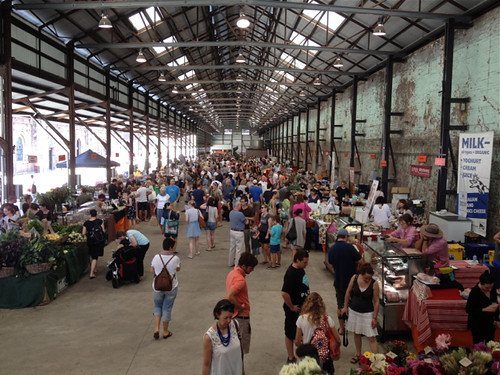
Harbour Bridge from Cockatoo Island

Friday, July 27, 2012

Trending

Pitt St Mall

Today was a perfect Sydney winter's day. Sunshine, a bright blue sky and crisp, cold air. This morning I had some errands to do in the city, which really was looking its sparkling best. My pleasure in the day was increased by the display in the shop windows of a well-known, international, very, very expensive luggage store:

Yayoi flower
Yayoi plus reflections

Yayoi tentaclesYayoi tentacles plus reflections

They're colourful, exuberant works by prolific Japanese octogenarian artist Yayoi Kusama. Earlier this year I visited an exhibition of her work in the wonderful Gallery of Modern Art in Brisbane where my grand-daughter and I had great fun sticking stickers in the Obliteration Room installation conceived by Kusama. Kusama, who was integral to many of the experimental art movements of the 1960s, and has been continuously devising and executing her works since then, is very trendy just now. A current exhibition of her work at the Whitney Museum in New York has had people queuing around the block to view it. She has an obsession with dots and with gigantic life-like but not realistic forms that makes her work very playful and approachable.

It was such a delight to see these works just there on George Street for passers-by to enjoy. An added delight is the way the shop windows reflect the street and its buildings and integrate them with Kusama's works. Sydney can share this trend with New York.

Wednesday, July 18, 2012

My daily Sydney revisited

My daily Sydney seems to have transformed itself into a building site. I don't think Sydney in general is currently experiencing a growth spurt.  Most of the statistics seem to report a lull, if not a downturn, in the building industry. So I can only conclude that most of the building that is being done, is being done around me (how's that for an egocentric view of the world?).

Over the last year or so this building inserted itself into the view from my living room window.

Redfern apartments

It's a block of apartments that replaced a much uglier, though smaller, building. As I'm absolutely convinced that a more densely populated city is the only sustainable future for Sydney, I don't mind this development - though it does block out some of the early morning sun from my apartment in winter. However, this is what is immediately next door to the new apartment block:

Redfern excavation

A hole in the ground that will become a second apartment block of similar height and design. I'm relieved that the pile-driving for the foundations, with its ear-shattering vibrations is finished, but I still have many more months of building activity to hear and observe. I wonder what impact, if any, these buildings will have on the neighbourhood. The area in which I live is already so densely trafficked and used for commuter parking that I can't imagine there will be a noticeable change in traffic patterns. My best hope is that the influx of new residents might actually improve shopping and restaurants - most of which are currently very utilitarian.

Then this is what I see as I go out the front door of my building:

Watertower scaffolding

My in-need-of-repair apartment building is swathed in scaffolding like a Christo exhibit or an elderly aunt protecting her dress with an apron. The 110 year old fabric of the building is in need of patching, repairing, replacing and painting. We've already done the back of the building and are now working on the front. The sides will be done later in the year.

At work it's more of the same. Tall apartments are rising on Broadway, opposite my office window.

Cranes

The construction has reached a stage where the cranes that top the structure are outside our twenty-seventh storey window.  Most distracting. The cranes seem to dance with each other, and the assured delicacy with which the drivers lift and swing their cargo (sometimes workmen in crates) between the buildings is breathtaking.  Exclamations of 'look what they're doing now!' have become commonplace in our office.  By the way, the green splodge in the bottom right-hand third of this photo is the scaffolding on my apartment building.

When I exit my work building by the back door to attend meetings in another building this is what I see:

UTS excavation

Yet another excavation, this one for a new building for UTS's Science Faculty. And no, this is not the  building designed by Frank Gehry that has received so much publicity. Its hole is much more advanced and it's not part of my daily round. I love the surprise of the hoarding that surrounds this building site:

Book hording

It's been painted with the colourful spines of books - real titles by real UTS academics. It always makes me smile as I pass by.

See what I mean - construction everywhere. A transformation of my daily Sydney.

Tuesday, January 25, 2011

January in Sydney

This year, the Sydney Festival has passed me by. I was preoccupied when I needed to focus on the program and book tickets in advance; then I was busy or out of town over Christmas and New Year; and finally when I focussed on shows or events I might like to see they were already finished or booked out. Oh well, I guess there's always next year.

But thanks to one of my friends I did get to see one thing. Sydney has a traditionally planned and planted Chinese Garden on the edge of Chinatown. It was a gift from Chinese sister city, Guandong, for Sydney's Bicentennial celebrations in 1988. [1788 was the year when British settlement of Australia occurred. Celebrating this settlement - which happens tomorrow on Australia Day, January 26, is always slightly uneasy as it can also been seen as marking the dispossession of Aboriginal Australians]. Anyway, the Chinese Garden is beautiful. In the twenty years or so since it was planted the trees have grown to maturity and it's become a sanctuary in the middle of a very busy part of Sydney. This January the Gardens are the site for an event called Power Plant at Darling Harbour. There are lighting installations throughout the Gardens, often coordinated with sounds. Some are absolutely magical; others less so. The organisers had done their best to regulate entry so the Garden wasn't too crowded, but nevertheless there were lots of people and consequently neither the quiet not leisure to linger that would really have done justice to some of works.

While it's not technically part of the Sydney Festival, I've also been to the opera to see Bizet's Carmen. This is not really one of my favourite operas. It's full of cliches and stereotypes, at least for a modern audience, and I guess it suffers from being just too familiar. The music has been used for advertisements, muzac, circuses, anything - you name it. I've seen the opera a number of times over the years, and after this recent viewing, while the music was going round and round in my head, I reflected on other experiences of seeing Carmen. I didn't grow up with opera - not even Carmen - but I did go to the movies (the pictures) a lot as a child. I first encountered Bizet's music in Carmen Jones, a film made in the mid-fifties. My hazy recollection is that the film was quite faithful to Bizet's score, but that the story was set during the second world war and the whole cast were African Americans. The role of Escamillio, the matador of the opera, was rewritten as a boxer. Even now, every time I hear the the 'Toreador' music from Carmen, I have the lyrics from Carmen Jones running through my head - 'Stand up and fight until you hear the bell...'. I really must watch the movie again.

I also remember seeing the exquisite Australian ballerina, Lucette Aldous, sometime in the early 1970s, dancing with Garry Norman in the ballet that is set to Bizet's score. I remember it because it was probably the most emotionally moving dance I've ever seen.

But to return to the current Opera Australian performance. It was very good, without being wonderful. There was lots of colour and movement, splendid sets and costumes, Australia's towering opera heart-throb Teddy Tahu Rhodes as the bull-fighter Escamillo, and an extremely good performance from visiting artist Rinat Shaham as Carmen. She not only sang passionately, but looked the part, acted convincingly, and danced well. All very enjoyable.

As always, the pleasure of going to the opera was heightened just by visiting the Opera House. I feel so fortunate to arrive for a performance on a hot summer's late afternoon

opera and bridge
opera sails

and to leave after several hours of delightful music to discover a cooling southerly breeze and the city lights.

bridge lights
opera lights

Monday, November 15, 2010

Just so Sydney...

Bondi

When visitors to Sydney ask me what they should see and do, the cliff top walk from Bondi Beach to Coogee, along the western edge of the Pacific Ocean, is always one of my recommendations. It's wonderful at any time of the year, but in October and early November when the stretch of the walkway between Bondi and Tamarama becomes the venue for Sculpture by the Sea, it's a great Sydney celebration. Yesterday was the last day for this year's display, and it coincided with the first really hot and sunny day of summer. People came in their thousands...

Bondi walk

I was pleased my friend Christina and I had started early - mostly to avoid the worst of the heat of the sun - and were walking north from Tamarama, in the opposite direction from most of the crowd.

There were over a hundred sculptures exhibited, the majority of them from Australia, but with significant representation from Japan, some from India, and a scattering from other countries. There were also invited participants who are already world-renowned sculptors, such as, this year, Sir Anthony Caro. One of the wonderful thing about this exhibition, apart of course from the superb location, is the scale of most of the works. It's rare you have the opportunity to see so much work on such a grand scale, and yet not be overwhelmed by it. I was particularly delighted by the works that seemed at one with their location, like the giant chook (complete with interior eggs) settling into the sand in the centre of Tamarama beach

chook
Tae-Geun Yang (South Korea) Sitting Hen
[This one's for Bells]

and the archway which seemed to frame the transition from the rocks to the sea

arch
Vlase Nikoleski (Australia) Monument for Small Changes

At the end of the walk and viewing you can vote for your favourite sculpture. The arch above was my friend Christina's choice. I had great difficulty choosing between David Horton's Jarrett in London whose shapes suited the rocky edge of Tamarama

red

and the delicate silvery Leaf Vessel by invited New Zealand artist Virginia King.

Silver leaf

I eventually voted for this leafy form whose shadow linked it to the land, but whose shape echoed the boats and surfboards on the ocean below.

This combination of sculpture and beach and rocks and sea, free to anyone of any age who wishes to visit, casually dressed, slathered in sunscreen, chatting, picnicking, eating ice-cream, seems to be just so Sydney.

Saturday, June 12, 2010

Knitting, and more...

Such a treat - a whole day of knitting. This morning there was the monthly meeting of the Inner-City Branch of the NSW Knitters Guild, and this afternoon, after a meander through The Rocks, via the convict-hewn Argyle Cut

Argyle Cut

and past views of the Harbour Bridge,

SHB

a get-together to mark World-Wide Knit in Public Day.

WWKIP Day

We had around 90 people gathering in the charmingly old-fashioned community hall lent for the day by the Sydney City Council. Sally had organised everything so well, and we had generously donated prizes for competitions and just for attending. Good company, lots of chat, and time to knit. Lovely.

All this knitting has given me a day's respite from the film festival, and some time to process last night's film. Like Jody, I saw Michael Winterbottom's 'The Killer Inside Me'. Winterbottom's clearly a very gifted film-maker who works across many different genres. With this film he tries his hand at film noir and captures the suspense and the macho laconic characteristics of such films well. Casey Affleck plays a small-town deputy sheriff whose encounter with a sex-worker (Jessica Alba) with a taste for violent sex sets off a set of associations that leads to further violence, deception and murder. I have quite a high tolerance for violence in movies, but this film is uncomfortable. There's a very fine line for movies such as this one between depicting the 'reality' of extreme violence and titillating the audience through its depiction. I'm not sure that Winterbottom always stays on the right side of such a line in this film. It's very disturbing because much of the violence in this film is against women, and often shows the women, as well as the Affleck character, to take sexual pleasure in violence and abuse. The film's led to much interesting discussion and critique.

So, a disturbing and interesting film with a great performance from Casey Affleck - even though I wanted to shout at him to stop mumbling! There was often only tenuous integration of more peripheral characters into the plot, and motivation for the truly awful acts of violence was treated most cursorily. Maybe a 3.5.

I've a very full day of film festivaling tomorrow - four films on my program.

Friday, June 4, 2010

Rain, rain...

Sydney does sunny days spectacularly well; but it also does rain most dramatically. This was the view from our office today -

Rain

Our tower building was engulfed in rain and rain clouds. Sheets of rain fell from the sky. It was ideal weather for staying at home (not an option for me) or for going to the Sydney Film Festival (which I did this evening).

Unlike Jody, I don't have a subscription ticket, but I do have a 30 ticket pass I'm sharing with a friend. This means I don't have the delight of seeing the unexpected wonders of a program organised by others, but it does enable me fit SFF participation around my other commitments.

Part of the pleasure of the Festival is that many of its sessions are held in the faux baroque, slightly tatty glamour of the State Theatre:

State theatre
State interior
State interior 2

The State is the last of the grand cinema palaces that were built in Sydney in the 1920s and 30s. It's miraculous that it survived the wave of theatre demolitions that happened in the 1960s and 70s when television made such gigantic cinemas uneconomic. It's now a much-loved Sydney icon.

I saw my first SFF film for 2010 tonight - Todd Solondz's 'Life During Wartime'. The film revisits the characters from the director's earlier success, 'Happiness', though this later film stands well by itself - fortunately, as I hadn't seen 'Happiness'. It's an unlikely black comedy about the possibilities and impossibilities of forgiving and forgetting, about sisterly relationships, and about pedophilia. It's supposedly set in Florida, though actually shot in Puerto Rico, and is vibrantly and hyper-realistically colourful. The film has a suberb cast - Shirley Henderson, Allison Janney (from 'West Wing') and Ciaran Hinds among others - and there's a rather irrelevant but perfect cameo performance from the seductive Charlotte Rampling. I liked the film a lot and scored it 4 out of 5. I'll be interested to read Jody's review

Fee reminded me that I should participate in the June busy lists she and Jody are posting, so here's my cumulative list for June so far:

Bunches of flowers bought 0
Number of rows knitted (socks) 56
Time spent tidying up 2.5 hours
Films viewed 1

Wednesday, May 12, 2010

My daily Sydney

The popular image of Sydney is of a sparklingly beautiful city - the Sydney Harbour Bridge, the Opera House and the intense blue waters of Sydney Harbour. This vision of Sydney is real, and most of us have easy access to it. But most of us also can't afford to live with a Harbour view. Our daily Sydney is quite different.

I live quite close to the city centre and about a 20 minute walk from my workplace. However, this walk must be one of the least pleasant walks imaginable - beside a busy and polluted road full of cars and trucks, across two even busier intersections, and with little of interest to see along the way. So I often take the train to work - just one stop. It takes about the same amount of time and I walk just as far, but I find it much more interesting. Not more beautiful; just more interesting.

It starts with the bustle of Redfern Station and the tangle of rail tracks leading to the city centre:

Transition: from suburbs to city

At Central Station I exit the station via one of Sydney's most reviled landmarks - the Devonshire Street Tunnel. My trip to work actually involves two of the most hated structures in Sydney - more of the other, later.

Devonshire Street tunnel

I could write a whole post about the Devonshire Street Tunnel. It's a long (300 metres?) underground walkway that enables pedestrian access from the south-east to the north-west sides of the mass of railway lines that's Central Station. Everybody complains about it. That it's unpleasant, and particularly that it's unsafe. I'm puzzled by these reactions. In comparison with many of the tunnels that link lines and platforms for the London Tube or the Paris Metro, the Devonshire Street Tunnel is bright, well-lit, clean and very much populated - mainly by students making their way to the many colleges and universities in the area. It's certainly not beautiful, but I find it interesting. There are usually several buskers at various levels of expertise - some of whom have been busking in the Tunnel for many years - and then there are the murals. I think around 1998 a series of murals were installed to mark the impending 150th anniversary of railways in Australia.

I love these murals charting the history of the railways from their beginning in Australia to the end of the twentieth century, and I'm amazed that whoever is responsible for their upkeep does such a good job - removing the frequent graffiti and repairing even worse damage from time to time. It's become for me a kind of symbol of perseverance in maintaining public space.

mural 1

I emerge briefly from the Tunnel to the architectural chaos of Henry Deane Plaza (Henry Deane was the engineer responsible for electrifying Sydney's railways) and the traffic chaos of Railway Square

Railway Square

and then plunge into the Tunnel extension where I find...

Bookshop of doom

the Bookshop of Doom, aka Basement Books, that stocks the most wonderful selection of remaindered and otherwise cheap books, including those two most important categories - crime fiction and knitting books. This is usually much more of a distraction on my way home from work, when browsing, and buying, are very tempting.

At the end of the Tunnel is a walkway that contains the oldest railway line in Sydney, which used to run between Central Station and the goods wharves at Darling Harbour. The wharves have long disappeared (though I remember my great-uncle Mick, then more than 70 years old, working on the wharves and in the wool stores that still lined the wharves in the 1960s) and the railway line now runs only to the Powerhouse Museum. From the walkway I can enter the Architecture and Design Faculty building of the University of Technology, Sydney, via an exterior escalator!

Escalator

Why do I find outside escalators so appealing? I guess it's something about a pleasing confusion of categories; that what is usually interior becomes exterior. This whole area is currently a building site for new student accommodation, so there's now the additional interest of watching the progress of the new building.

I pass through the building and exit to a walkway over frantically traffic-ridden Harris Street, whose intersection with Broadway is reputed to be the most polluted intersection in Sydney

Harris Street

and from where I have a splendid view of the most reviled building in Sydney, the UTS Tower, whose 27th floor houses my office.

UTS Tower

I will confess up front that I like the Tower. It's not the most beautiful building in Sydney, but it's far from being the ugliest. I think it's a straight-forward, honest interpretation of the 1960s architectural style labeled 'concrete brutalism'. I know few will agree with me about the Tower's robust attractions, but even those who hate the exterior must agree that the view from my windows when I finally reach my office is wonderful:

Tower view

I think most of us who live in the inner suburbs of Sydney realise that the sparkling 'emerald city' is also a city of grunge. I like this contrast, and I find my way to work endlessly entertaining.