Showing posts with label travel. Show all posts

Thursday, March 12, 2015

Things, stuff, collections

I'm travelling again. At present I'm in London where a house swap has provided me with a month's stay in a very swish apartment in Royal Docks. I like to travel because I like the glimpses it gives of other ways of living; other ways of constructing the everyday. Things, stuff, collections, what is more formally defined as material culture, are wonderful illustrations of ways of living. There are certain museums I like because they provide these kinds of insights into people's lives. I've been lucky enough to find some of them on this visit.

The Geffrye Museum in London's rapidly gentrifying east end, is one such treasure.
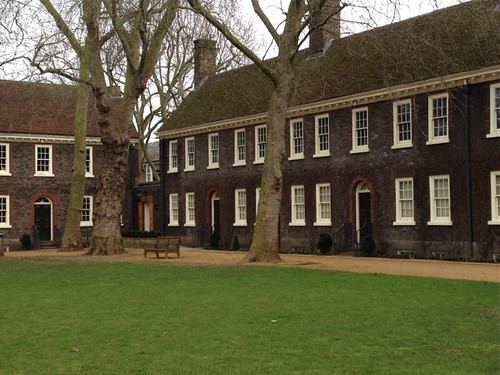
Geffrye Museum exterior

It's a simple, but very lovely 18th century building that was built as an almshouse. It's quite narrow as it originally was a series of independent dwellings - like a long terrace. But now all the interiors have been joined together so there's an enfilade through the building with a series of rooms opening off the hall.
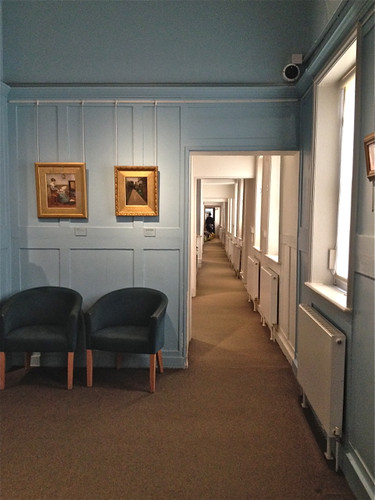
Geffrye Museum interior

And the 'rooms' are just that - reconstructed living rooms that provide glimpses of how the 'middling sort' (the middle classes) lived from Tudor times to the late twentieth century:

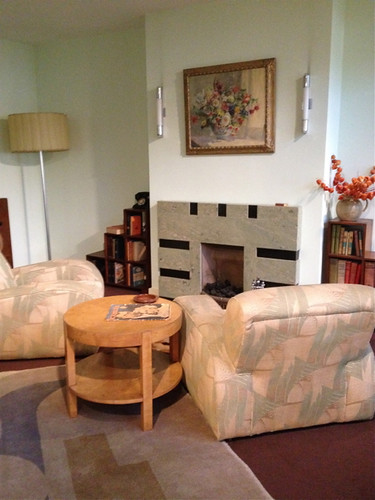
Geffrye Museum 1790sGeffrye 1930s

The rooms above are representative of the late eighteenth century and the 1930s. As I child, I grew up with a living room in the style of the 1930s room above, even though it was the 1950s. Perhaps that says something about 'style' in Australia? I still use my parents' living room chairs from that period, though they've been reupholstered several times. Unlike many of the better-known museums the Geffrye had relatively few visitors other than a couple of school groups, so I could linger and wonder over the exhibits.

I also visited the museum exhibition that must thrill the heart of every collector or hoarder:
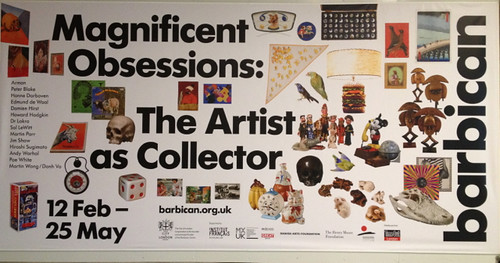
Magnificent Obsessions

This exhibition, of artists' collections of objects, was fascinating. The great temptation is to believe that the objects give you insights to the artists' work. I can't help but wonder just how these collections are stored and displayed in people's houses. Who dusts them? Are they regularly rearranged? Are they cataloged? Are they loved, or is the thrill in their acquisition? The exhibition raises lots of interesting questions - most centrally, when does 'stuff' become 'art'? Some of the collections, like that of Hanne Darboven, are wonderfully random, with objects of different kinds and different sizes crammed together. Others, like Sol Le Witt's collection of photographs are precisely ordered and displayed. Still others have a double level of obsession where one artist, Danh Vo, has curated, ordered and displayed the collection of another artist, Martin Wong:
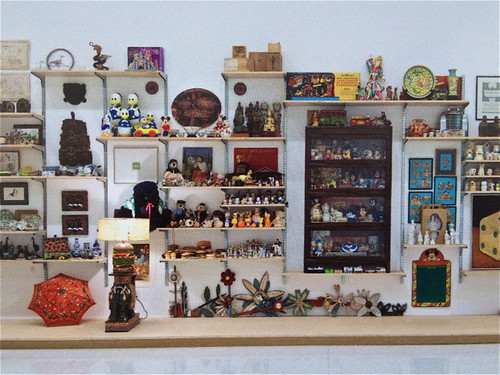
Mag Obs Wong

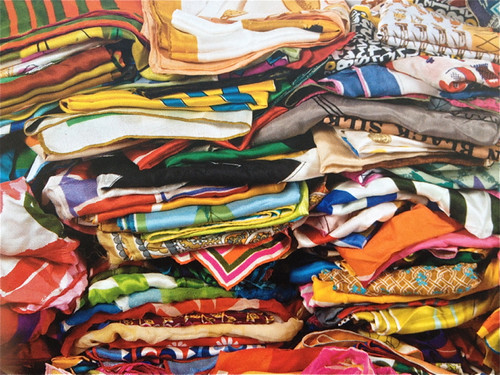
Possibly my favourite of the many wonderful collections was Pae White's collection of scarves by prolific mid-twentieth century fabric designer Vera Neumann.
Mag Obs scarves

I'm not sure what engaged me most - the extraordinary range of Neumann's scarf designs or Pae White's persistence in finding and gathering the scarves. Either way, I can't help being fascinated by such obsessiveness.

It's not a museum in the usual sense, but I imagine Kew Gardens must be one of the world's best collections of plants. Wikipedia tells me it is the world's largest collection of living plants. There are thousands upon thousands of species of trees and plants which (at least to me) reflect Britain's history of travel, exploration and colonisation. The beautiful Palm House with its specimens from many more tropical countries is a particular example of collecting and curating:
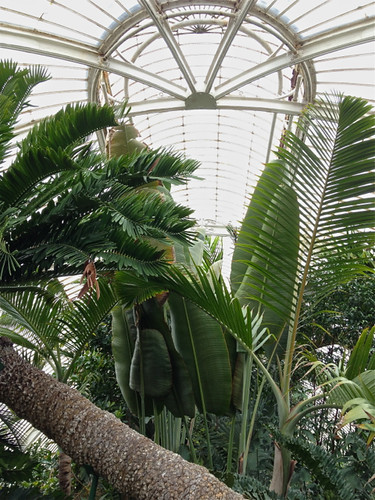
Kew Gardens palm house

The gardens also reflect the British obsession with gardening and landscaping. We were a month too early for the renowned display of bluebells, and just a couple of weeks too early for the grand display of daffodils, though some early bloomings were a sign of the splendour to come:
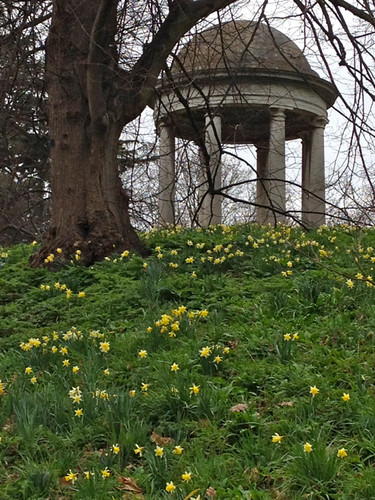
Kew Gardens folly and daffodils

However, we were just in time for the display of crocuses and the occasional quiet snowdrops:
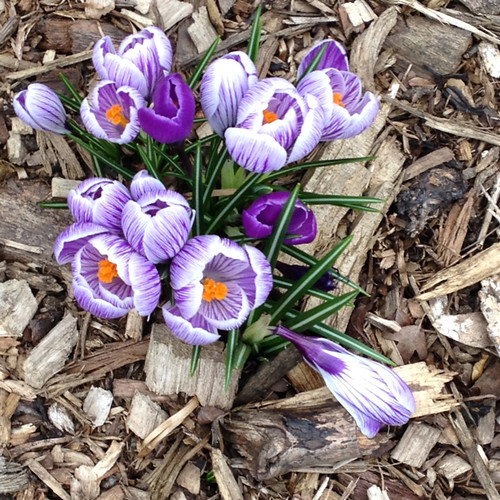
Kew Gardens crocuses
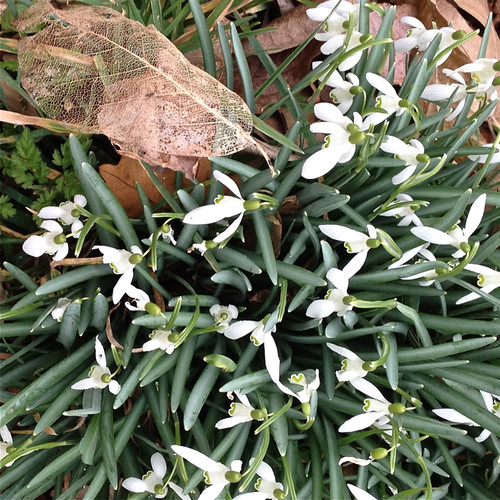
Kew Gardens snowdrops

Now I think about it, being a tourist is just another form of collecting, and museums are convenient ways of curating experiences for tourists - though of course they have other functions. I'll continue to blog about the experiences I collect - though I'm only too aware that I have been a much less dutiful travel blogger on this trip than I have been previously.

Friday, December 19, 2014

Bye-bye Brisbane

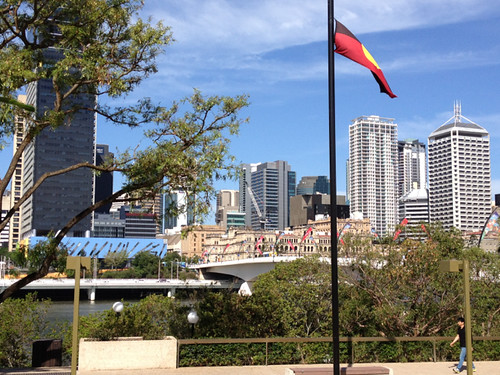
Brisbane view

I've just returned from what will probably be my last visit to Brisbane for some time. My daughter and grand-daughter, who have been in Brisbane for nearly seven years, are returning to Sydney, so I'll have no reason for visiting as regularly as I have over those seven years. There are things I've grown to like about Brisbane. Particularly when I've visited in winter, the old tourism slogan of 'beautiful one day, perfect the next' has seemed to describe the bright blue skies, the pollution-free air, the meandering river and the almost tropical landscape with its profusion of flowering trees and bushes. Summer, of course, is a different matter with its heat and humidity. Urgh!

There are two things I'll particularly miss about Brisbane. One is the Tangled Yarns store with its interesting range of yarns, its bright, welcoming space, and its colourful displays. I wrote about my admiration for this store earlier this year. But even if I were continuing to visit Brisbane, this pleasure would no longer be available because the store is, sadly, closing. It will be greatly missed.

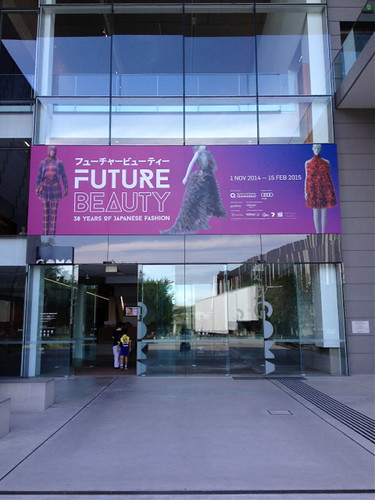
I'm also an avid fan of the gallery complex at Brisbane's South Bank so I took a break from helping with house packing up to visit the latest exhibition at the wonderful Gallery of Modern Art (GOMA) - 'Future Beauty: 30 Years of Japanese Fashion'.

QAG entrance

Visitors are not permitted to photograph the items in this exhibition, but the advertisement on the Gallery site gives an impression of the more outrageous designs. What it doesn't really show, however, are the items I found most inspirational; the folded, sculptural, deceptively simple shapes that so revolutionised fashion in the 70s and 80s. There has been some rather critical discussion recently of the phenomenon of displaying 'fashion' in art galleries. But it's a move that has been undeniably popular and has opened galleries to a wider range of people. In the case of this particular exhibition I think it's also not just about what is 'fashionable' but about notions of the body and how it is presented and perceived. It explores how two-dimensional designs can be translated to the unpredictably three dimensional and mobile human form.

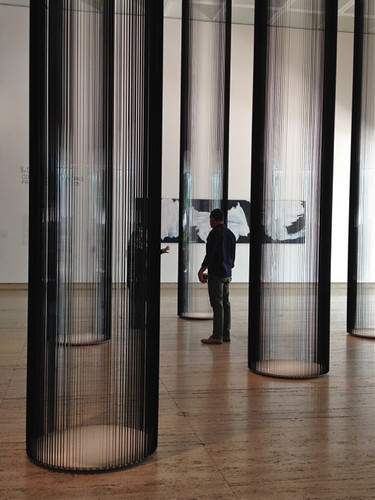
I found this special exhibition both thought-provoking and beautiful, but I was equally engaged by a number of the Gallery's own exhibits as I meandered through the lovely (cool) spaces of the Queensland Art Gallery on my way back to the bus stop. There is a shimmering colonnade that on closer inspection is composed of VHS tape.

QAG Kempinas columns

The information on the work noted that the Lithuanian artist, Zilvinas Kempinas 'is interested in the way that magnetic videotape holds images of the past, but these will soon no longer be viewable. Rather than its promise of progress, technology often reveals instead dead-ends and monumental failures'. As someone who constantly worries about what will happen in the future to the images and other documentation I now have stored on today's technology, this was a poignant reminder of the probably inevitable transience of the records of our lives.

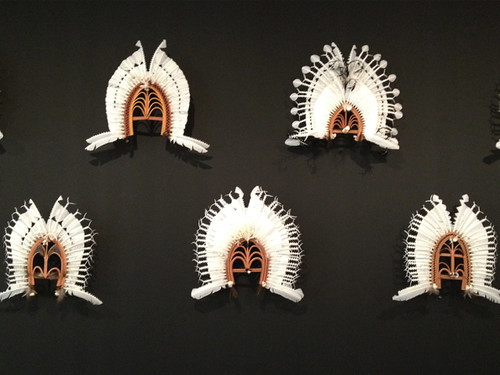
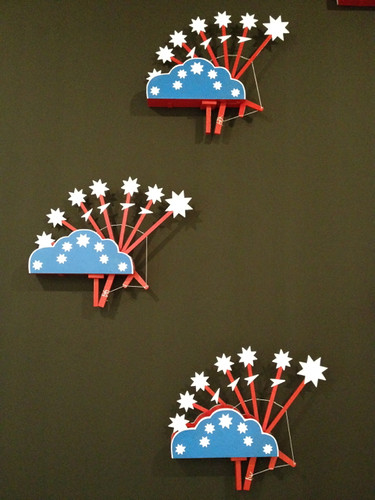
The walls of the main entrance space of the Gallery are currently elegantly hung with dance masks and zugub (dance machines) from the Torres Strait Islands:

QAG George Nona
QAG Patrick Thaiday Zugub

One of the things I've admired across my many visits to the GOMA and QAG is their commitment to exhibiting art from the Torres Strait Islands, and the Pacific more generally. Sydney is a very multicultural city and when here I'm conscious, in many different ways, of our location in Asia. But Brisbane reminds me much more immediately of our Pacific connection. Maybe it's the climate, and the visibility of Pacific Islanders within the community, but for me these relationships have been reinforced by the galleries and their collections.

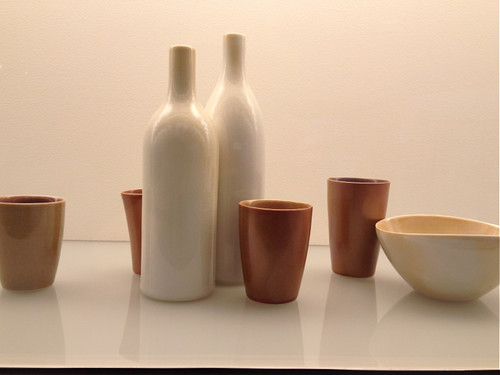
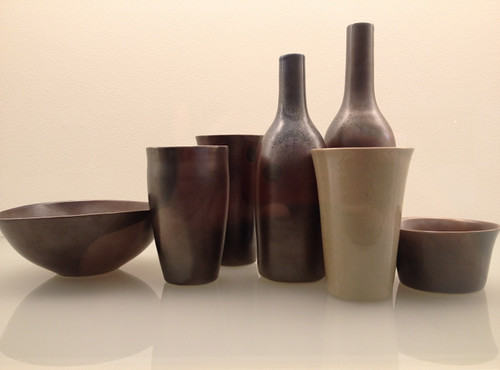
And finally, just before I exited the Gallery, I was distracted by the ceramic collection and its current display of works by Australian potter Gwyn Hanssen Pigott.

QAG pots
Gwyn Hanssen Pigott

I just stand in front of these works and sigh with pleasure. They are perfection. Each of the pots is perfect in itself, but placed together each of the shapes increases the perfection of the others. They remind me of Alberto Morandi's paintings, which also make me sigh with pleasure.

It's not often that you have the opportunity to get to know another city reasonably well through informal visits over some years, when there's no pressure to see as much as possible in limited time, but I've had this opportunity with Brisbane. But for now, bye-bye Brisbane.

Monday, November 3, 2014

To the new world

This has been a long-delayed post. It's now more than a month - indeed, nearer two months - since I returned from my transatlantic knitting cruise, but I feel I need to finish the account of the places I visited.

Canada St Anthony's harbour

I now have quite a different mental image of the north Atlantic after my cruise from Copenhagen to New York. Before this trip I think I imagined this area as a vast space of nothingness, but I now see it as a series of stepping stones that link Europe and North America. There was no more than a day at sea between any of our destinations, so that when we finally reached St Anthony in Newfoundland it seemed just another of the icy northern lands where stoic people had made accommodations to live in challenging environments. I hope the locals aren't insulted by my saying that the town itself is rather charmless, though from my brief visit it's clear that the hills and forests that surround the town offer wonderful opportunities for walking.

This is what really struck me about St Anthony -

Canada St Anthony's Grenfell Centre

I grew up in a small town in rural Australia called Grenfell, which coincidentally has almost the same small population, around 2500, as St Anthony Newfoundland and Labrador. However, Dr Wilfrid Grenfell, who features so largely in the history and current well-being of Newfoundland, is an altogether more admirable figure than the nineteenth century Gold Commissioner after whom my home town is named. Located in the Grenfell Centre in St Anthony is a small but very well-curated museum that focuses upon Wilfrid Grenfell who brought medical services to much of poverty-stricken Newfoundland and Labrador in the early twentieth century. As well as recounting Grenfell's achievements, the museum graphically depicts the deprivation and hardship undergone by the residents of the maritime provinces at that time. The Centre also has an excellent tourist shop that includes a range of handcrafted items, including examples of hooked rugs for which the area is well-known. I don't need another hobby, but if I did I think rug-hooking might be near the top of my list.

Canada St Anthony's hooked rug

I fell in love with St John's, which was the second of our stops in Canada. St John's, the capital of the province of Newfoundland and Labrador, climbs the hill behind its harbour so that you have a wonderful panoramic view of the city as you arrive by sea:

Canada St John's view from Harbour

Even from a distance you can see the colourful houses that line the streets. This is yet another town - like Reykjavik, like Thorshavn, like the tiny towns of Greenland, where people seem to compensate for the drabness of their long winter landscapes by the riotous colours of their houses. I spent ages wandering up and down the steep streets, marveling at the ways people had individualised their houses with colour:

Canada St John's coloured housesCanada terraces St John'sCanada St John's coloured terraces

St John's had a number of shops selling locally made handcrafts of wonderful quality. There were more examples of the hooked rugs that combine fine craft with charmingly naive designs, and lots and lots of handknitting - jumpers, hats, scarves, mittens in a riot of cables and colourwork designs. Despite all the temptations I bought only some patchworked coasters. I think I was spoilt for choice and too distracted by the architecture of the hilly streets. I even happened upon a film crew packing up for lunch after filming an episode of Republic of Doyle, a Canadian tv series set in St John's that I'd enjoyed watching half a world away.

Our visit to Halifax in Nova Scotia was much more focused upon yarn and knitting. Much to my surprise, I found I have no photographs of the city itself, though I have many of our yarny activities. We had the great privilege of visiting Lucy Neatby of Tradewind Knitwear Designs in her home, which also serves as her studio. With her brightly multi-coloured hair and clothes, Lucy is all-of-a-piece with the riotously coloured knitting she designs. She's a designer who follows her passions, and at present her passion is for double knitting. She's exploring the possibilities of this technique in all kinds of ways, but the most interesting (for me) are the floral mandala-like pieces that can serve as pot-holders, table mats, even blankets if the knitter is sufficiently enthusiastic and skilled.

Canada Lucy Neatby double knitting handsCanada Lucy Neatby double knitting 1Canada Lucy Neatby double knitting 2Canada Lucy Neatly double knitting 3

We also visited the dyeing studios for Fleece Artist and Handmaiden yarns. Watching the dyers was mesmerising. It requires a combination of skill, experience and intuition to get the colours 'just so'. While there are colours that are repeated again and again because of their popularity, we were told that each of the dyers inevitably has favourite combinations and that this capacity to experiment brings continued freshness and innovation to the range of yarns that are produced.

Canada Halifax Fleece Artist drying yarn

As with other places we visited on the cruise I was left wanting to see more of the maritime regions of Canada with their distinctive history and traditions, and their focus on crafts and fibre.

Canada Halifax lighthouse

Saturday, October 11, 2014

Days of miracles and wonders (to quote Paul Simon)

I hadn’t expected Greenland to be so wonderful. I think I had very few expectations of Greenland; it’s a part of the world I’d rarely thought about. We spent a day cruising through Prince Christian Sound and some of its tributaries.

Greenland Prince Christian Sound

The miracle was the weather – clear, cold, and even some sun. We were told this happens rarely, even during the few summer months in which the Sound is navigable. The wonders just kept coming, as the large ship maneuvered through the Sound with cliffs rising steeply on either side. There were waterfalls around every corner,

Greenland Prince Christian Sound waterfall

several glaciers that tumbled down to the water’s edge

Greenland Prince Christian Sound glacier

and glimmering, bright icebergs.

Greenland Prince Christian Sound iceberg

Greenland has a small population, Fewer than 60,000 live in small towns and villages around the coastline and on islands as the interior isn't habitable. While cruising through the Sound our enormous cruise ship anchored off the tiny settlement of Aappilattoq (population around 130) so that the ship's tender could deliver some supplies of fresh food and pizza to its residents. For much of the year the town is reachable only by helicopter. You can just see the colourful houses of Aappilattoq at the bottom of the picture below:

Greenland Prince Christian Sound Aappilattoq

On each of the two days following our voyage through the Sound we anchored at towns on the southern tip of Greenland. In Nanortalik our cruise passengers more than doubled the local population of around 1500. There was time to stroll and linger on the seats scattered along the local streets and admire the landscape dotted with colourful small houses, and to wonder about people's lives in such a small and isolated community.

Greenland - Nanortallik
Greenland Nanortalik blue house
Greenland - Nanortallik houses

For a small fee (we scrambled to find our leftover Danish kroner) we were admitted to the community hall where the Nanortalik locals had organised coffee and cake as well as a performance by the local choir. The small choir ranged in age from members in their thirties to those in their eighties and the songs and their harmonies were disconcertingly like those of the Tongan church near me in Sydney. I suspect this similarity has more to do with the Nanortalik choir being from the local church than it does with any traditional relationship between Greenland and Tongan music! I particularly liked the two organising women in the choir who had gone to the effort of dressing in local costumes:

Greenland - Nanortallik choir

I imagine someone, somewhere, must have written a thesis, or at least an essay, on the very eclectic elements of this national costume. Some bits seem modern; others quite traditional. Maybe these combinations are just what the Greenlanders like to wear. I didn't notice what the turtleneck collars were made from (I was too overwhelmed by all the other components) but they sit above an elaborate beadwork yoke-like cape that's worn on top of a brightly coloured satin shirt with beadwork cuffs. Below the top is a patterned fabric cummerbund and then seal fur shorts with contrasting leather, fur and leather applique stripes at the front. The shorts are worn over trousers that seem to have several components including bright floral inserts and crocheted panels. The trousers are tucked into sealskin boots that also have intricate leather applique patterns. I found these costumes of many elements fascinating.


Greenland Nanortalik beaded yokeGreenland Nanortalik bootsGreenland Nanortalik leather shortsGreenland Nanortalik leather applique

In comparison with Nanortalik, Qaqortoq, which was our final stop in Greenland, seemed bustling. Its population is around 3,000 and there's a harbour with fishing boats and a fish processing plant (and an iceberg)

Greenland Qaqortoq Harbour

and a supermarket and a modern high school. There are even blocks of apartments where the distinctive compact architectural style and colourful siding of small houses has been carried over to the larger buildings:

Greenland Qaqortoq apartments

Qaqortoq was still charming: it's small enough to walk from place to place and admire some of the older buildings, such as the early twentieth century church, that have been preserved:

Greenland Qaqortoq church

But the greatest pleasure in our visit to Qaqortoq was to see the icebergs that lingered so close to the town:

Greenland - Qaqortoq iceberg

There were no yarn stores in the towns we visited in Greenland, so one would imagine there were no yarn temptations. However, there was a large tourist store at the harbour that was selling moskus garn - otherwise known as quiviut or yarn from musk oxen. This was another of those yarn transactions where if you think too much about the yarn air miles you hesitate to buy; the yarn was harvested from musk oxen in Greenland, processed in Denmark, then flown back to Greenland for the tourists to purchase. I did hesitate, but I did buy a skein.

Greenland quiviut

I was particularly grateful for this glimpse of a country I imagine I will never have the opportunity to visit again. Days of miracles and wonders, indeed.

Greenland Nanortalik children