Showing posts with label art. Show all posts

Wednesday, July 22, 2015

Go East

Sometimes an ordinary day becomes more than you expect. Yesterday I went with a friend to the Art Gallery of New South Wales. We had no particular purpose; no particular expectations; no particular exhibition that motivated our visit. We were simply filling up a day with an everyday pleasure.

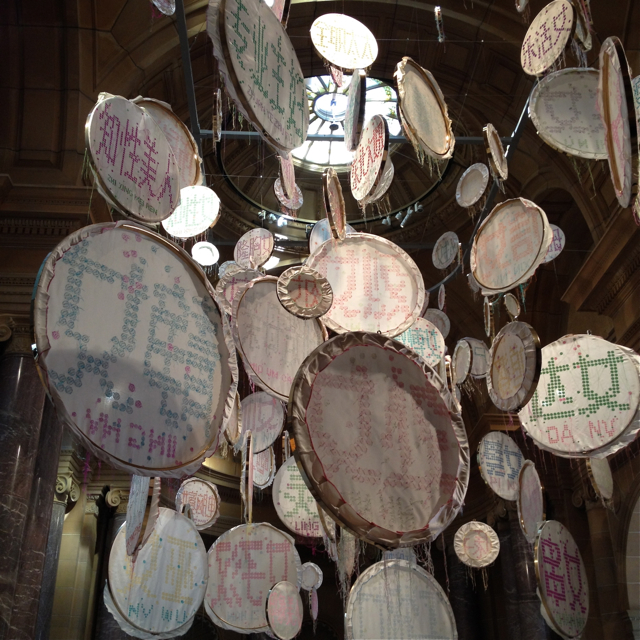
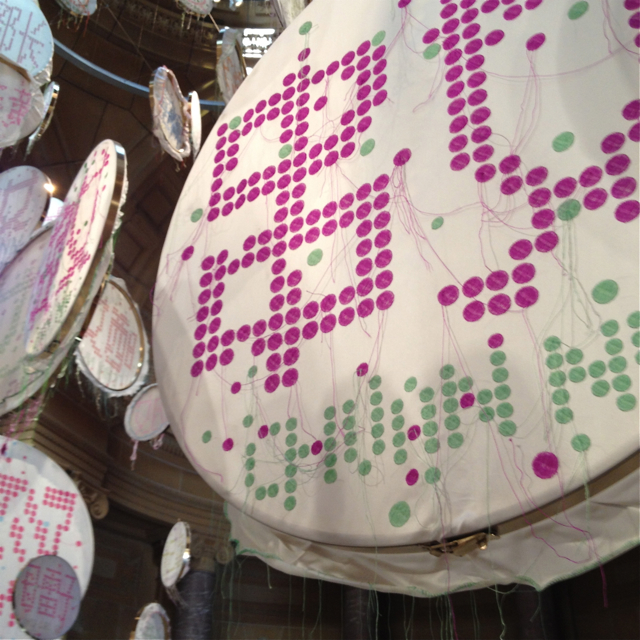
In the entrance foyer to the Gallery was a forest of embroidery and quilting hoops of various sizes encasing embroideries of Chinese characters - with their threads still hanging from the subtly coloured characters.
AGNSW BadgesAGNSW Badges 2

The work is by contemporary Chinese artist Lin Tianmiao and we discovered, by reading the accompanying explanatory description, that the characters were new words that describe women and their roles, made common by social media . Though many of the terms are somewhat derogatory, eg 'husband hunter','gap-toothed beauty', the overall emphasis is on women's agency in modern Chinese life. I liked the use of a traditional women's craft, embroidery, to portray women's roles as depicted through modern technology. Neat. And, as always, I was attracted by the tactile element that comes with the use of textiles. Despite signs warning the work was not to be touched, I noticed many people absently trailing their hands through the hanging threads as they passed by the work. We discovered this work was part of a larger exhibition called 'Go East' and so decided to see the other works in this exhibition.

In Australia we often bemoan the lack of patrons of the arts, so it was a pleasure to discover that this group of modern Asian works was drawn from the private collection of Gene and Brian Sherman. Our galleries don't have the treasures of Western art that one sees in Europe and the USA, but I think as a compensation we in Australia have frequent access to modern Asian art that is well-informed and well-curated.

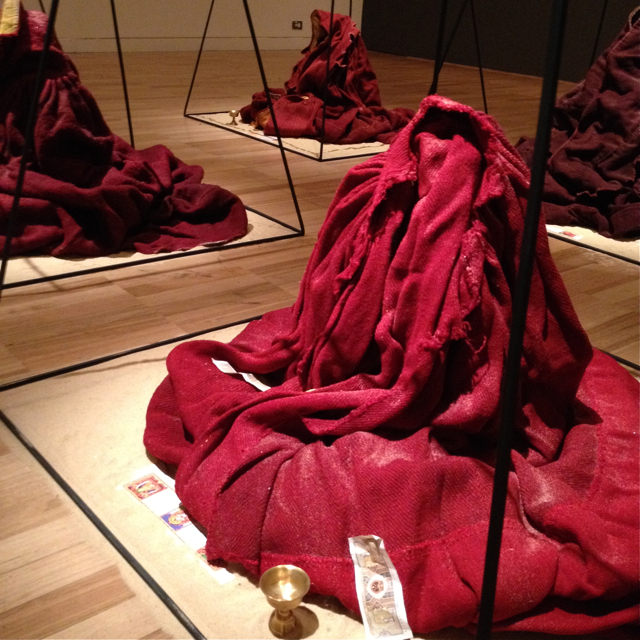
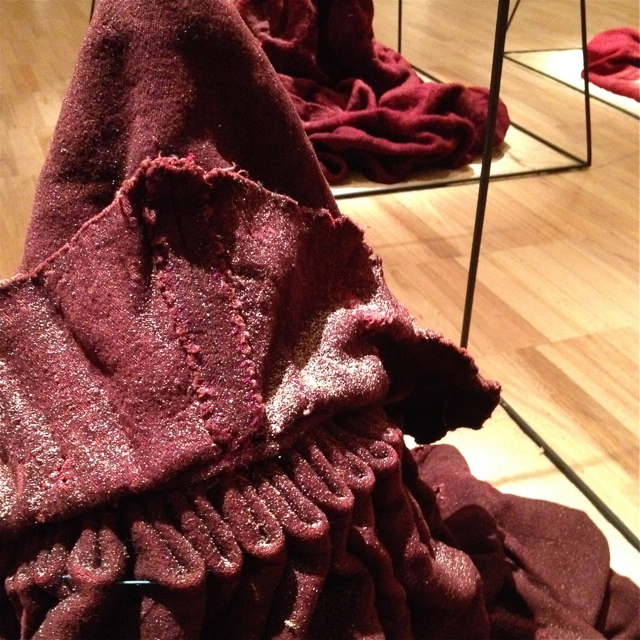
I thought one of the most moving works in the 'Go East' exhibition was 'Zen Meditation' by Tibetan artist Nortse - a collection of six charred monks' robes arranged in frames.
AGNSW NepalAGNSW Nepal 2

My immediate response was to the deep, rich colours and tactile quality of the roughly woven robes, but it takes only a few moments to be reminded of the many Tibetan monks who have self-immolated in their resistance to the domination of Tibet by China. The Chinese currency in the frames is another reference to the economic intrusion and consumerism with which modern Tibet is confronted. The characteristic I find very interesting about modern Asian art is its engagement with the politics and culture of the day. Sometimes, as with the Tibetan robes, the political message is obvious. At other times, such as with the work below, 'There is no voice...', it is more subtle.
AGNSW There is no voice

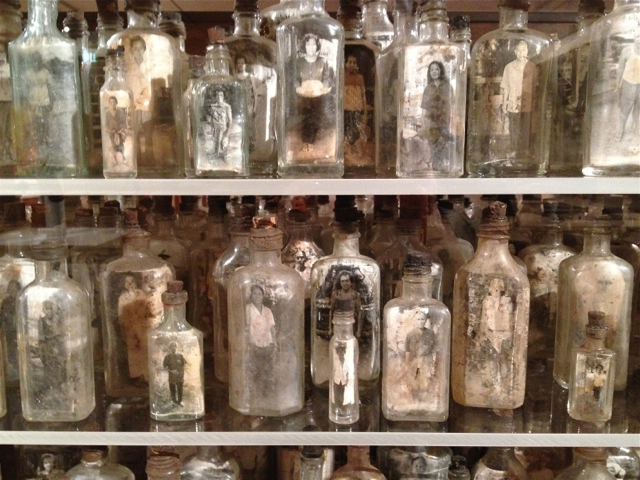
In a collaboration with the older people of the Chiang Mai community, Thai artist Navin Rawanchaikul has constructed an artwork that's a collection of various sized old medicine bottles that have photographs inserted within them. The bottles are crowded into shelves in a simply crafted display case. The older people in the photos are dressed in everyday traditional work clothes and some of the bottles are crazed and clouded. A way of life is fading and disappearing.

'Habitation' is a group of shanty structures built from Ikea packaging and precariously balanced above and below shelves. So many ideas... the need to scavenge to survive; the precariousness, both literal and metaphorical, of a way of life; the creativity of recycling:
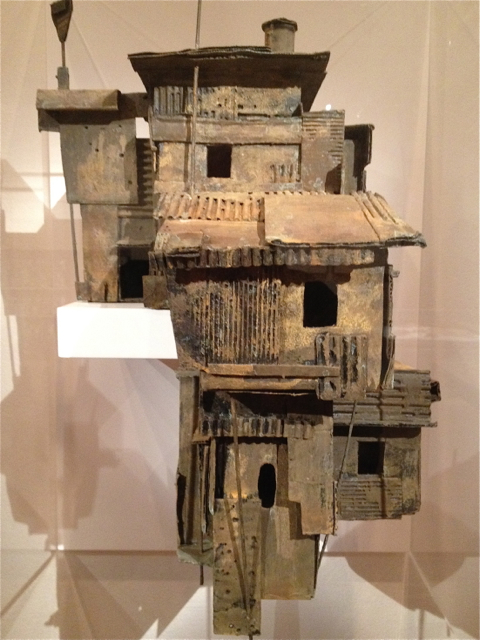
AGNSW Habitation

The creators of these delightful structures are Filipino artists Alfredo Juan Aquilizan and Maria Isabel Guardinez Aquilizan. Their names tugged at my memory - I was sure I'd encountered them before and so I trawled through my blog to discover that I'd written about them five and a half years ago when my grand-daughter and I had participated in one of their interactive works at the Queensland Art Gallery. Sometimes blogging has its uses!

There were, of course, lots of other wonderful works. Lots to be delighted by and confronted by (eg some very lifelike furless silicon rats that seemed to breathe!) I always forget that viewing artworks makes me perceive and interpret the world using quite different processes from those I use in everyday life, or even when I'm reading or viewing films. It's always good to be jolted into a realisation that there are other ways of seeing.

Thursday, March 12, 2015

Things, stuff, collections

I'm travelling again. At present I'm in London where a house swap has provided me with a month's stay in a very swish apartment in Royal Docks. I like to travel because I like the glimpses it gives of other ways of living; other ways of constructing the everyday. Things, stuff, collections, what is more formally defined as material culture, are wonderful illustrations of ways of living. There are certain museums I like because they provide these kinds of insights into people's lives. I've been lucky enough to find some of them on this visit.

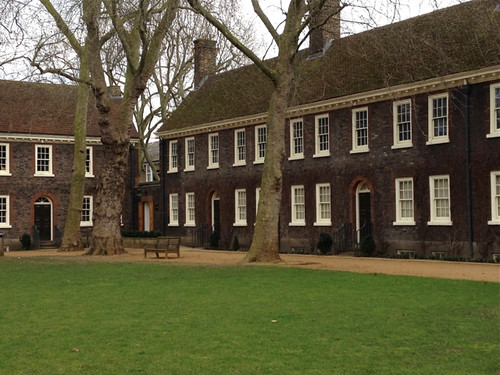
The Geffrye Museum in London's rapidly gentrifying east end, is one such treasure.

Geffrye Museum exterior

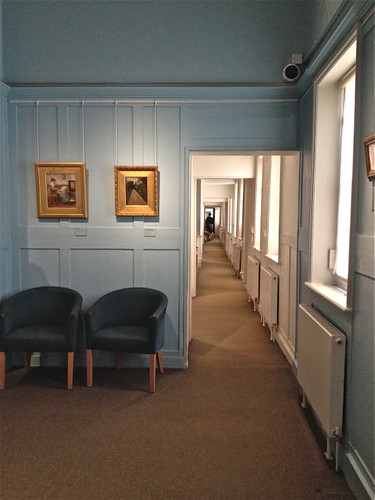
It's a simple, but very lovely 18th century building that was built as an almshouse. It's quite narrow as it originally was a series of independent dwellings - like a long terrace. But now all the interiors have been joined together so there's an enfilade through the building with a series of rooms opening off the hall.

Geffrye Museum interior

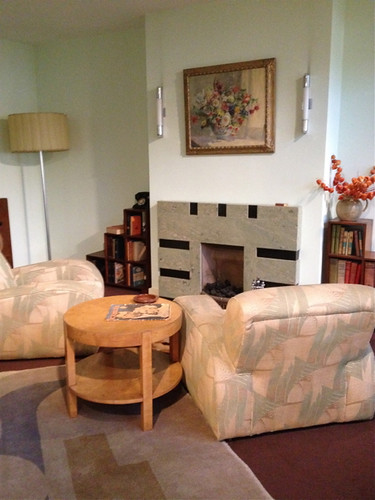
And the 'rooms' are just that - reconstructed living rooms that provide glimpses of how the 'middling sort' (the middle classes) lived from Tudor times to the late twentieth century:

Geffrye Museum 1790sGeffrye 1930s

The rooms above are representative of the late eighteenth century and the 1930s. As I child, I grew up with a living room in the style of the 1930s room above, even though it was the 1950s. Perhaps that says something about 'style' in Australia? I still use my parents' living room chairs from that period, though they've been reupholstered several times. Unlike many of the better-known museums the Geffrye had relatively few visitors other than a couple of school groups, so I could linger and wonder over the exhibits.

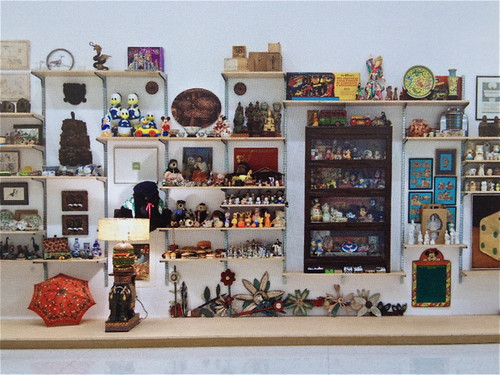
I also visited the museum exhibition that must thrill the heart of every collector or hoarder:

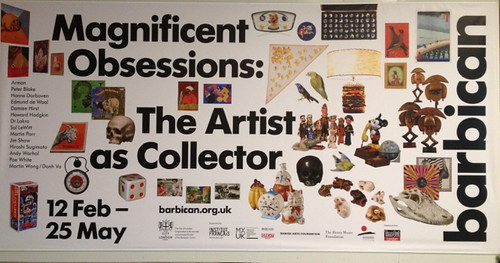
Magnificent Obsessions

This exhibition, of artists' collections of objects, was fascinating. The great temptation is to believe that the objects give you insights to the artists' work. I can't help but wonder just how these collections are stored and displayed in people's houses. Who dusts them? Are they regularly rearranged? Are they cataloged? Are they loved, or is the thrill in their acquisition? The exhibition raises lots of interesting questions - most centrally, when does 'stuff' become 'art'? Some of the collections, like that of Hanne Darboven, are wonderfully random, with objects of different kinds and different sizes crammed together. Others, like Sol Le Witt's collection of photographs are precisely ordered and displayed. Still others have a double level of obsession where one artist, Danh Vo, has curated, ordered and displayed the collection of another artist, Martin Wong:

Mag Obs Wong

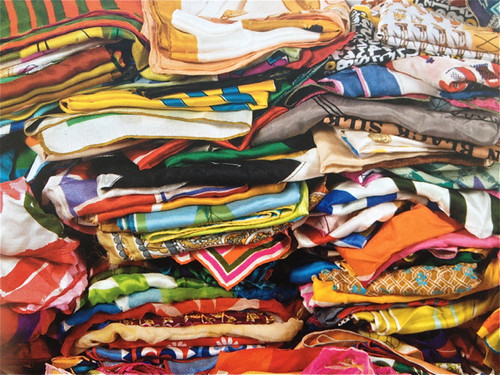
Possibly my favourite of the many wonderful collections was Pae White's collection of scarves by prolific mid-twentieth century fabric designer Vera Neumann.

Mag Obs scarves

I'm not sure what engaged me most - the extraordinary range of Neumann's scarf designs or Pae White's persistence in finding and gathering the scarves. Either way, I can't help being fascinated by such obsessiveness.

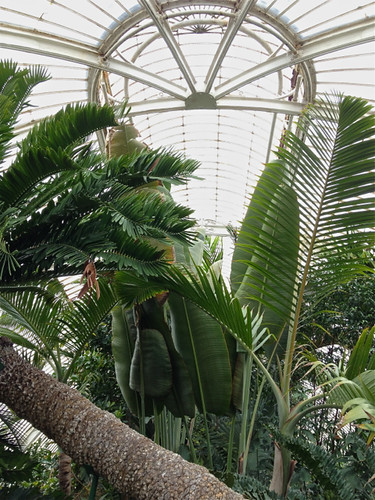
It's not a museum in the usual sense, but I imagine Kew Gardens must be one of the world's best collections of plants. Wikipedia tells me it is the world's largest collection of living plants. There are thousands upon thousands of species of trees and plants which (at least to me) reflect Britain's history of travel, exploration and colonisation. The beautiful Palm House with its specimens from many more tropical countries is a particular example of collecting and curating:

Kew Gardens palm house

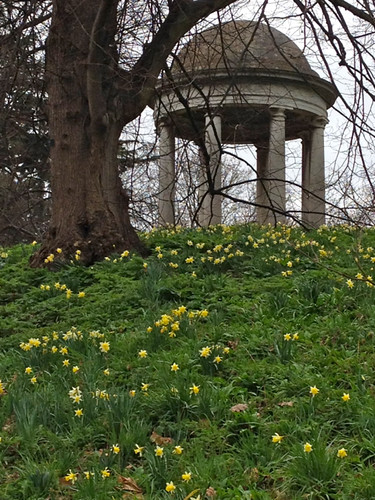
The gardens also reflect the British obsession with gardening and landscaping. We were a month too early for the renowned display of bluebells, and just a couple of weeks too early for the grand display of daffodils, though some early bloomings were a sign of the splendour to come:

Kew Gardens folly and daffodils

However, we were just in time for the display of crocuses and the occasional quiet snowdrops:

Kew Gardens crocuses
Kew Gardens snowdrops

Now I think about it, being a tourist is just another form of collecting, and museums are convenient ways of curating experiences for tourists - though of course they have other functions. I'll continue to blog about the experiences I collect - though I'm only too aware that I have been a much less dutiful travel blogger on this trip than I have been previously.

Friday, December 19, 2014

Bye-bye Brisbane

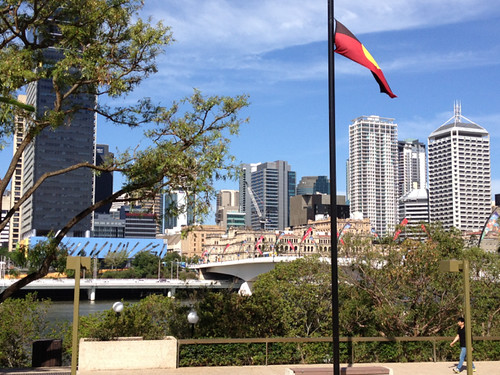
Brisbane view

I've just returned from what will probably be my last visit to Brisbane for some time. My daughter and grand-daughter, who have been in Brisbane for nearly seven years, are returning to Sydney, so I'll have no reason for visiting as regularly as I have over those seven years. There are things I've grown to like about Brisbane. Particularly when I've visited in winter, the old tourism slogan of 'beautiful one day, perfect the next' has seemed to describe the bright blue skies, the pollution-free air, the meandering river and the almost tropical landscape with its profusion of flowering trees and bushes. Summer, of course, is a different matter with its heat and humidity. Urgh!

There are two things I'll particularly miss about Brisbane. One is the Tangled Yarns store with its interesting range of yarns, its bright, welcoming space, and its colourful displays. I wrote about my admiration for this store earlier this year. But even if I were continuing to visit Brisbane, this pleasure would no longer be available because the store is, sadly, closing. It will be greatly missed.

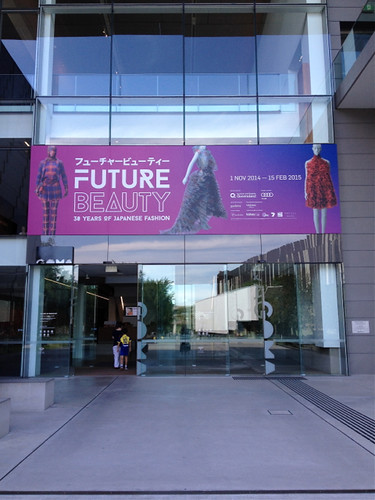
I'm also an avid fan of the gallery complex at Brisbane's South Bank so I took a break from helping with house packing up to visit the latest exhibition at the wonderful Gallery of Modern Art (GOMA) - 'Future Beauty: 30 Years of Japanese Fashion'.

QAG entrance

Visitors are not permitted to photograph the items in this exhibition, but the advertisement on the Gallery site gives an impression of the more outrageous designs. What it doesn't really show, however, are the items I found most inspirational; the folded, sculptural, deceptively simple shapes that so revolutionised fashion in the 70s and 80s. There has been some rather critical discussion recently of the phenomenon of displaying 'fashion' in art galleries. But it's a move that has been undeniably popular and has opened galleries to a wider range of people. In the case of this particular exhibition I think it's also not just about what is 'fashionable' but about notions of the body and how it is presented and perceived. It explores how two-dimensional designs can be translated to the unpredictably three dimensional and mobile human form.

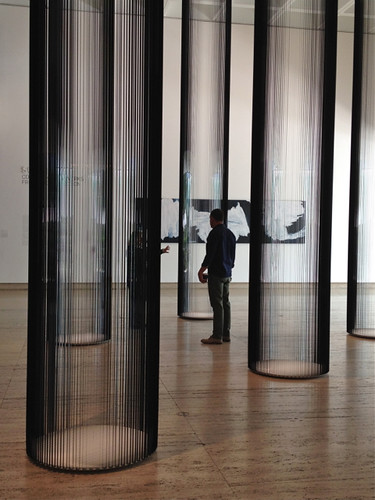
I found this special exhibition both thought-provoking and beautiful, but I was equally engaged by a number of the Gallery's own exhibits as I meandered through the lovely (cool) spaces of the Queensland Art Gallery on my way back to the bus stop. There is a shimmering colonnade that on closer inspection is composed of VHS tape.

QAG Kempinas columns

The information on the work noted that the Lithuanian artist, Zilvinas Kempinas 'is interested in the way that magnetic videotape holds images of the past, but these will soon no longer be viewable. Rather than its promise of progress, technology often reveals instead dead-ends and monumental failures'. As someone who constantly worries about what will happen in the future to the images and other documentation I now have stored on today's technology, this was a poignant reminder of the probably inevitable transience of the records of our lives.

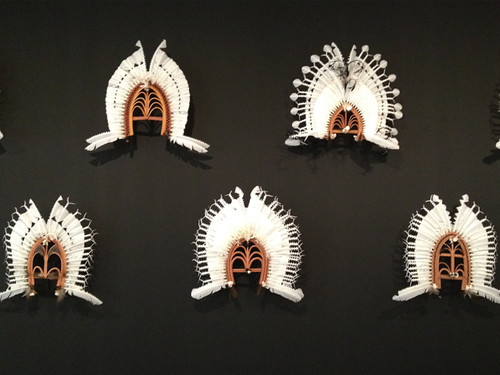
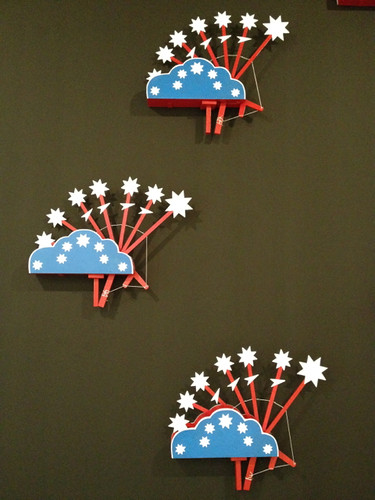
The walls of the main entrance space of the Gallery are currently elegantly hung with dance masks and zugub (dance machines) from the Torres Strait Islands:

QAG George Nona
QAG Patrick Thaiday Zugub

One of the things I've admired across my many visits to the GOMA and QAG is their commitment to exhibiting art from the Torres Strait Islands, and the Pacific more generally. Sydney is a very multicultural city and when here I'm conscious, in many different ways, of our location in Asia. But Brisbane reminds me much more immediately of our Pacific connection. Maybe it's the climate, and the visibility of Pacific Islanders within the community, but for me these relationships have been reinforced by the galleries and their collections.

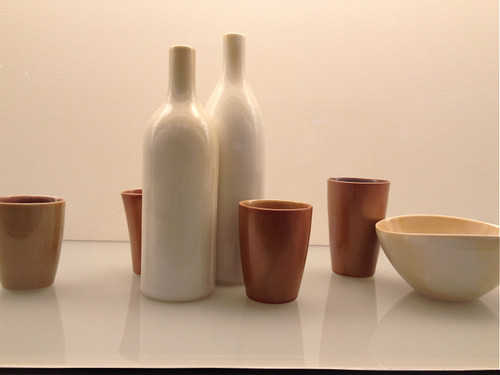
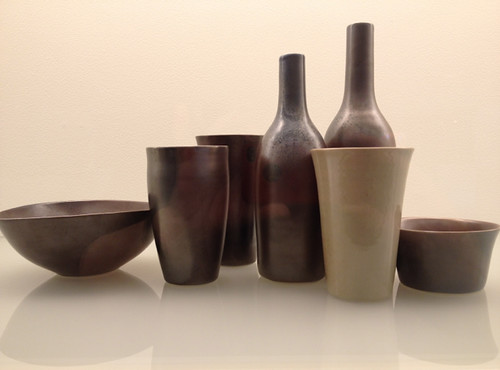
And finally, just before I exited the Gallery, I was distracted by the ceramic collection and its current display of works by Australian potter Gwyn Hanssen Pigott.

QAG pots
Gwyn Hanssen Pigott

I just stand in front of these works and sigh with pleasure. They are perfection. Each of the pots is perfect in itself, but placed together each of the shapes increases the perfection of the others. They remind me of Alberto Morandi's paintings, which also make me sigh with pleasure.

It's not often that you have the opportunity to get to know another city reasonably well through informal visits over some years, when there's no pressure to see as much as possible in limited time, but I've had this opportunity with Brisbane. But for now, bye-bye Brisbane.

Thursday, July 31, 2014

Such vibrant colour

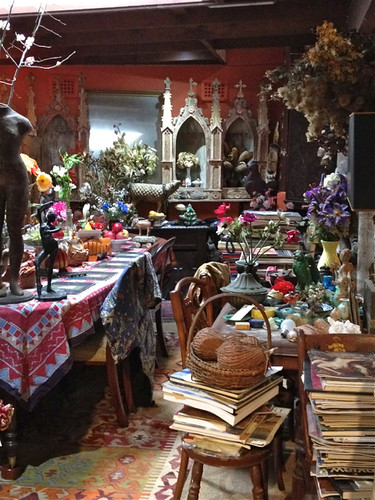
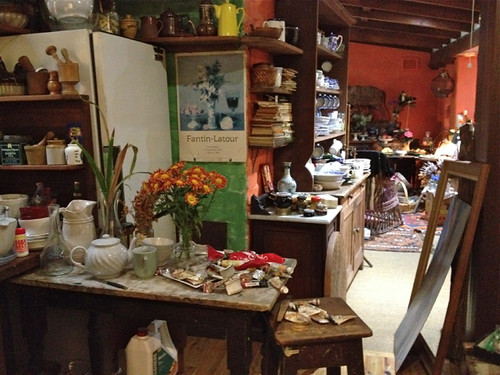
I'm visiting a friend who lives on the north coast of New South Wales. From tomorrow we'll spend three days at the Byron Bay Writers Festival, which seems to have become one of my yearly pilgrimages. But today we travelled to Murwillumbah to visit the Tweed Regional Gallery which, earlier this year, installed a replica of the studio of renowned Australian artist, Margaret Olley.

Olley Studio

Australian painter Margaret Olley's life has been well-documented - she and her studio home have been photographed, painted, and filmed. There are biographies and beautiful catalogues of her many exhibitions. She was a gregarious host and attended many public events and, as she became wealthy, was a generous benefactor to the NSW Art Gallery, as well as a number of regional galleries (including the Tweed Regional Gallery). It seems very appropriate that as her life was so public, so the workspaces of her home and studio are now on public display.

Olley kitchen and studio

The recreations are lovely. There's such vibrant colour, so many wonderful shapes, and such appealing vignettes in the midst of clutter. I wonder why we find artists' studios so appealing? I imagine one reason is that it gives us an insight into the process of an artists' work: not just the end product, but the way the work grows and is constructed. Olley's studio, like that of Giorgio Morandi I saw years ago in Italy, is particularly interesting because it contains many of the objects - the jugs and bowls and fabrics and rugs - that occur and recur in her still lifes and domestic interiors.

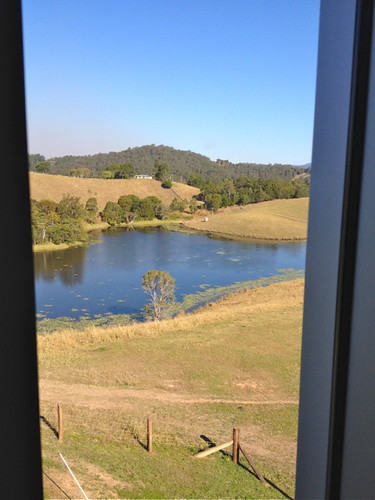
The Tweed Regional Gallery goes from strength to strength. Among other works it currently has an exhibition of works on paper by prominent Australian artists that I found very engaging. And there's always the landscape, attention-arresting as you approach the Gallery and see the river and paddocks with mountains to the west, but just as wonderful when glimpsed through the narrow windows that punctuate the gallery's walls.

Tweed Gallery view

Wednesday, June 4, 2014

THAT time of year... SFF!

It's Sydney Film Festival time. My mental image of attending the film festival has me wearing my warmest clothes and making my way to the cinema through wind and rain. However, with this year's freakishly warm weather I'm still wearing summerish clothes and a cotton scarf - though there were at least a few drops of rain on my way home.

I've had a great start to the Festival; a documentary called 'Tim's Vermeer' in which Texas-based inventor and technical whizz Tim Jenison decides to test his theory that the masterly Dutch Golden Age painter, Johannes Vermeer, was not so much an inspired painter as he was an inspired inventor of technologies to aid in the painterly representations of his domestic compositions. Jenison does this not only by building the lenses and mirrors he believes Vermeer might have used, but also by meticulously reconstructing the room in which 'The Music Room' was painted and then using the techniques he ascribes to Vermeer to himself painstakingly recreate the painting. In the process Jenison learns to make and grind glass, turn chair legs on a lathe, grind and mix paints from seventeenth century materials, and paint. Australia's coming rather late to this documentary which has already created discussion and dispute among its viewers, such as the spirited critique in 'The Guardian' by Jonathan Jones that (rightly) dismisses Jenison's resulting painting as vastly inferior to Vermeer's. But such critiques of the documentary miss the pleasure of the film. The film's about Jenison, not Vermeer. It's about the nature of obsession. And it centres on a charming, ironically self-aware, extraordinarily talented, but I'm sure maddeningly focused, modern polymath.

I think Jenison demonstrates that Vermeer could have used the technical aids he demonstrates, but that even so there's an unrivalled genius to his paintings. Whatever. See the documentary and marvel at Jenison and his obsession.

Definitely four stars.

Wednesday, November 20, 2013

Identifying Mexico

I'm finding it difficult to know what to write about our week in Mexico City. Like Beijing, Mexico City overwhelms you. It's geographically vast, sprawling densely across mountainsides and valleys at an altitude of over 2,200 metres. It leaves you slightly breathless, literally. It's crowded with people - depending on how you measure populations, more than 20 million of them in Greater Mexico City - so getting around can be a series of challenges. It has wide-spread and well-developed transport systems, though they're often very crowded and require local knowledge to negotiate. There's so much to be commented on, but my knowledge is so shallow that I feel rather intimidated.

But as I keep telling myself, my blog is for myself, as much as it is for others, so I want to record some impressions.

It was interesting coming to Mexico after visiting the USA, where I'd seen the wonderful results of philanthropy in action in the artistic and cultural worlds; the Walt Disney Centre for the Performing Arts in LA, the Nasher Sculpture Centre in Dallas, LACMA, to name just a few. In Mexico City it seems that the role of promoting the cultural life of the city, and the country more generally, had been taken on by the state. (As an aside, it seems to me that we in Australia fall very much between two stools in this regard - neither the state nor philanthropists consistently act to promote our cultural life.) In addition, in Mexico City there seems to be a desire to make art accessible to the people, and to encourage thinking about national identity through public and popular structures and events.

This is probably most evident in the wonderful Museum of Anthropology. The two-storey Museum is built around a central courtyard. On the first level is the rich material culture of pre-hispanic Mexico, organised into rooms to display the variety and richness of the various regions and cultures. The Mexica (Aztec) culture of what is now Mexico City takes pride of place in a grand double-height central display:

Mexico City Museum of Anthropology Mexica (Aztec)

Artifacts from other Mexican cultures and traditions, such as these grand and beautiful Olmec heads, are arranged in rooms along the sides of the building:

Mexico City Anthropological Museum Olmec Head

The second level of the Museum displays how people of the various regions live today, with the current-day practices located directly above those of their ancestors. We had limited time and energy, but explored the display from the southern Oaxaca region where we planned to visit. Oaxaca is also the region with the richest textile tradition - a predictable reason for me to visit!

Ethnographic Museum - Oaxaca textiles

In a clearing outside the Museum is a display of the Totonic 'voladores' (flying) rite. The voladores circle a 20 metre high pole, chanting to drums and a pipe. Five of them then climb the pole and while one sits at the top, playing drums and pipe, the others gradually 'fly' in circles, upside down, hanging by one ankle, as ropes release them from the top to the bottom of the pole. It's a ritual that you almost can't watch as their strength and bravery are tested.

Mexico City Museum of Anthropology Totonac 'voladores'
Mexico City Museum of Anthropology Totonac 'voladores' 2

Mexico has a long-established tradition of using murals in public spaces to inform and educate its people. In the twentieth century this tradition has been used to reinforce Mexican identity, but has also resulted in grand, publicly accessible works of art. We visited the campus of the Universidad Nacional Autonoma de Mexico (UNAM) where the Central Library, is a ten-story artistic creation, depicting the history of Mexico from pre-hispanic times. The whole building is covered with mosaic stone murals designed and created around 1950 by artist Juan O'Gorman. All the mosaic stone tiles are in their natural colours - sourced from all around Mexico.

Mexico City UNAM Biblioteca Central 2

The Library, together with other university buildings, such as the Rectory, with its 3D murals by renowned artist Siqueiros showing the people urging the students to reform and advance the country, have been declared a UNESCO World Heritage site.

Mexico City UNAM La Rectoria

UNAM, by the way, was established in the sixteenth century, has over 300,000 students, has negligible fees, and has highly selective entry.

One day we were delighted to happen upon a street parade of colourful, fantastic creatures advancing along nearby Reforma - one of the grand central avenues of Mexico City. The city was promoting what we assumed was a competitive display of the creative imagination and skill of various local groups and associations. Giant versions of alebrijes, colourful ceramic figures of fantastic animals, insects and birds, had been recreated from papier mache, feathers, and fabrics and mounted on hand-pulled carts. Some had articulated limbs and many were guided by their handlers with swooping, dancing movements into the watching crowd.

Mexico City Popular Art parade
Mexico City popular art parade 2

The parade went on and on. There must have been at least 40 of these wonderful creations advancing along the street. A couple of days later we saw that they had been grouped along the broad median strip of another street for passers-by to continue to enjoy the spectacle. Maybe I'm romanticising what we saw, but this colourful parade seemed to be yet another public promotion of popular art to emphasise Mexican identity and traditions.

Frida Kahlo was an artist who painted from the 1920s to the 1950s and is now an international icon whose image is emblazoned on tee-shirts and handbags around the world. Many of her works are colourful, naive, often horrifying self-portraits. Over more recent years she has become a public symbol of much that is essentially Mexican, dressing in colourful clothes and exotic jewellery drawn from indigenous traditions, personally presenting an image of female beauty that is distinct from European traditions, and painting a combination of suffering and celebration that seems distinctively Mexican. Kahlo also had links with many of the world revolutionary figures of the time, and saw no contradiction between advancing Mexican identity and promoting international socialism. We, like many other tourists, visited the Museo Frida Kahlo in Coyoacan. Frida Kahlo was born, worked in, and died in the 'blue house' that now houses the museum. The museum has a small selection of her paintings, with a focus on early portraits of her family and friends. I was rather taken by 'Frida and Stalin', where Stalin and the objective of world revolution loom over a stationary figure of Frida.

Mexico City Museo Frida Kahlo Frida & Stalin

Some parts of the museum attempt to recreate Frida's life in the house. The dining room and kitchen, with their distinctive Mexican colours and display of pottery and other artifacts, including the skeletons so central to Mexican iconography, reveal Kahlo's immersion in Mexican craft traditions (though you can't help feeling everything is much cleaner and neater than it would have been in Frida's time).

Mexico City Museo Frida Kahlo kitchen

Upstairs, Kahlo's studio, with the wheelchair that she used for much of her life, is particularly poignant.

Mexico City Museo Frida Kahlo studio

Mexico City is a bustling, crowded, international city. But it's also a city where you can't linger long without becoming aware of its very distinct national identity and of the many and varied ways in which that identity is promoted by the state through its art and craft traditions.

Friday, November 8, 2013

Moments of good fortune

Sometimes when you're travelling you have moments when you just stop and marvel at your good fortune. I had one of those moments earlier today in Dallas, Texas when I visited the Nasher Sculpture Centre. The Nasher had been mentioned by various travel guides, but had also been recommended by some locals when I asked what I should visit in Dallas. But I hadn't envisioned that it would be probably the best collection of twentieth and twenty-first century sculpture anywhere in the world. The Centre is housed in an elegantly simple Renzo Piano building whose galleries open to a most pleasingly designed sculpture garden. I wasn't able to take photographs inside the galleries which brought one pleasure after another - Miro, Noguchi, Matisse, Picasso, not in ones and twos, but multiple pieces. Most exquisite of all were the Giacometti works, particularly a series of busts of the artist's brother.

Today in Dallas was crisply cool and clear - perfect for the sculpture garden.

Nasher Sculpture Centre

That's a Barbara Hepworth sculpture in the foreground and a Henry Moore work from 1968 in the left backgound. [There's a story about Henry Moore that I love and may well have told previously on my blog - I have a limited number of stories and I expect I tell and retell them! When my friend Marea Gazzard, whom I wrote about in my last post, was developing a work for the then-new Parliament House, she wrote to Henry Moore to ask about the patina he had used for a piece that's now outside the Art Gallery of NSW. Moore wrote back in the kindest terms and gave the recipe for the patina. I think such generosity becomes a great artist.] There are many wonderful works in the garden, but one that I particularly like is Magdalena Abakanowicz's 'Bronze Crowd' from 1990:

Nasher Abakonowicz

The artist has written of her work 'A crowd is the most cruel because it begins to act like a brainless organism'. I also liked Antony Gormley's 2000 sculpture, 'Quantum Cloud XX (tornado)':

Nasher Sculpture Garden 3

There's actually a human-shaped figure at the centre of the delicate welded steel bars - Gormley says most of his work explores the fine balance between people and their environment. You can see the glowing golden stone of the gallery's built structure surrounding this work.

I've has other moments of wonder earlier in my brief trip to the USA - at the landscape, its history, and its people. But I've started this post with the delight of artworks I've seen (and heard) so I'll continue. In Los Angeles I wanted to see the Walt Disney Concert Hall which was designed by Frank Gehry and is just celebrating its tenth birthday. It's one of those buildings that fills you with joy - all sparkling, intersecting shapes, at one point all angles, and at another soft, rounded folds.

Gehry building LA
Gehry building exterior LA

I'd planned to go on a tour of the building, but was fortunate enough to have my brief visit coincide with a concert in which eminent violinist Itzhak Perlman was playing two of the Vivaldi 'Four Seasons' pieces and then conducting the LA Philharmonic in a grand symphony by Berlioz. The Berlioz required eight double basses, six percussionists, four harpists, ranks of trumpeters, trombones and French horns and innumerable other instrumentalists. It was a huge sound that filled the grand hall and thrilled me.

Gehry concert hall LA

Thanks to the practice of a number of wealthy Americans of making bequests and adding to the collections of public galleries, LA is the possessor of a number of wonderful art galleries. I visited my favourite, the eclectic but astounding Los Angeles County Museum of Art (LACMA)

LACMA

which you can't miss if you take the 720 bus along Wilshire Boulevard (a most interesting travel experience in its own right - almost deserving of its own post) because of the serried ranks of old LA lampposts that are ranged outside its front facade

LACMA Light Poles

I was delighted to find a corner of the modern section of the galleries that had a luminous Rothko painting flanked by some small Jackson Pollock works.

LACMA Rothko & Pollock

As I had found this pleasurable, imagine how gob-smacked I was when the following day I visited the lesser-known Museum of Contemporary Art and found myself in a room surrounded by no fewer than eight expansive Rothko paintings:

LA Contempory Art Gallery

Finally, what's the best way you've ever travelled to visit an art museum? I know what mine is. In San Antonio I took the river taxi to visit the San Antonio Art Museum. It's not really a taxi but a passenger barge that travels along the San Antonio river, which is now edged by a wonderful Riverwalk. The barge chugs along gently, picking up and setting down passengers at destinations along the river, and even occasionally stopping to exchange passengers with a barge travelling in the opposite direction. If you're not in a hurry it's the perfect way to travel.

San Antonio Riverwalk

By the time I'd finished my visit to the gallery (whose best collections are of ancient Latin American art and artifacts) it was early dusk, and the 45 minute return river journey was magical. By the time I'd reached my hotel the cafes that line the Riverwalk were filled with people and mariachi music from roving bands ebbed and flowed as we passed restaurants.

San Antonio Riverwalk at night

Another of those moments of wonder at my good fortune.