I rarely post to Facebook except for when I'm travelling, when it's a easy way of sending groups of photos with brief comments to let friends and family know what I've been doing and thinking. Recently, I've been quietly delighted by Facebook's 'memories' function that reminds me of posts from the same day and month in previous years. Today, for example, there was a post about a visit I made with my grand-daughter to the Papalote children's museum in Mexico City in 2013. It's not a particularly well-written or insightful post - a very 'common or garden' post - but it did prompt memories that might otherwise slip away.
Another delight has been a recent discovery that the 'memories' function within the photos app of my i-phone creates little slide shows (which they call 'movies' of photos they (who? presumably a knowing algorithm) choose and group in particular ways - by place, date, or related images. These can occasionally be wonderful, using images I'd not have chosen but that work well with others in the series. Again, these little slide shows remind me, delightfully, of my trips and travel.
Among other things, such as the importance of family, these technologically enhanced 'memories' reveal how central the act of travelling has become to my life. Unlike my own children, or, even more, unlike my very well-travelled grand-daughter, the desire to travel came relatively late in my life. I had no desire to make the pilgrimage to the UK that was a rite of passage for so many of my generation and I was already twenty-five when I made my first international trip to visit friends then living in Hong Kong. I don't remember any revelatory moment when I consciously decided that I had a need to travel, but when I reflect on my behaviour I can see that I grasped every opportunity to visit somewhere else that presented itself. Much later in my work life I had what was for me an ideal job that required me to travel to many countries to supervise a university's student exchange programs. Wonderful! I've counted up and have found I've so far visited forty-three UN recognised countries. I'm sure many other people have visited far more. I don't really have a bucket list, or a desire to tick off more countries. I'll just go anywhere, anytime.
Now I've retired I'm still travelling. I visit the Philippines quite frequently to catch up with my son and grandchildren who live there. But, in addition, I'm always planning the next trip to somewhere else. Much of life seems to me to be a trade off of time and money. Now I have time to travel but relatively less money to do so. As I increasingly privilege travel over other ways in which I can spend my limited money I realise that I'm addicted!
So, I'm off at the end of December. This time I'm house-exchanging again as an economic way to finance my travel needs. I'll be in London for January, escaping Sydney's summer and indulging my desire to wear knitted garments. And already I find myself thinking...'France is so close to London' or, 'I've never visited Ireland - that would be interesting'. And who knows? I might even take up blogging again to have a greater store of memories on Facebook and my phone.
Tuesday, November 21, 2017


Monday, August 10, 2015
One, two, three, four, five, one, one, two...
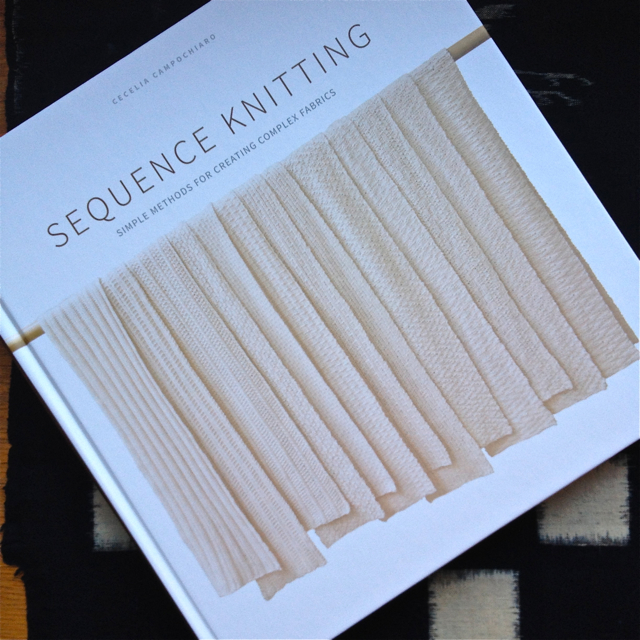
I'm not sure just where it was that I first saw a reference to Cecelia Campochiaro's recently published book, 'Sequence Knitting'. I think it was somewhere in an Instagram post - maybe by tom of holland? Anyway, I liked what I thought sequence knitting might be - repetitions of simple sequences of plain and knit stitches to achieve a textured fabric. A kind of stitch dictionary organised around repetition. I wanted to know more, but 'Sequence Knitting' is a large, expensive book that's not (yet) available in Australia, and postage from the USA adds significantly to the cost.
Fortunately, Cecelia had a pattern available through Ravelry - a scarf or cowl she's named 'Abelan', so I was set to try this new (or as Cecelia, after Elizabeth Zimmermann, says, 'unvented') concept for knitting. It was fun. You simply knit 9 stitches, then purl 3 stitches across a number of stitches that's a multiple of 12 stiches, plus or minus three stitches. (Cecelia's instructions are much clearer than mine!) This particular pattern is an example of what Cecelia has classified as 'serpentine' knitting where you carry the stitch repetitions from one row to the next over four rows to create the textured pattern.
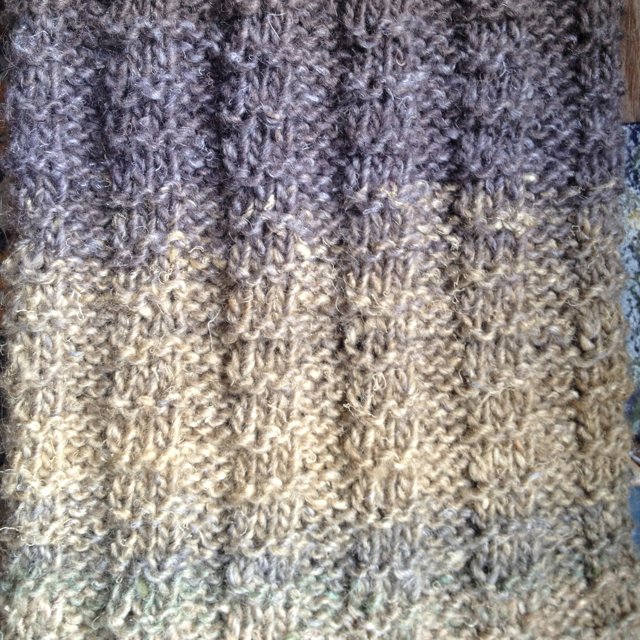
I used two different but similar colours of Noro Silk Garden yarn for this scarf. The long, graded, sometimes unexpected colour sequences in this yarn are ideally suited to the textures produced by sequence knitting. I am very happy with the outcome, which I gave to my ex-husband when he visited Sydney during a particularly cold winter spell:
Indeed, I was so happy with the scarf that I did order a copy of 'Sequence Knitting' from the USA - despite its cost once I'd added in the postage. I haven't regretted my purchase for an instant. It's a beautifully produced book. Lovely paper, elegant lay-out, just enough colour, clear, helpful photographic illustrations of the stitch patterns described. And the content is just as wonderful as the book's physical form. You could say that Cecelia Campochiaro has produced a stitch dictionary. She has, but she's done so much more. She has looked behind the repetitions and sequences that produce the patterns and calculated the stitch formulas to produce a variety of textures. It's a combination of the binary of knit and purl with simple mathematics to calculate a dizzying range of possibilities. It's such a neat book - ordering, classifying, enumerating - lovely!
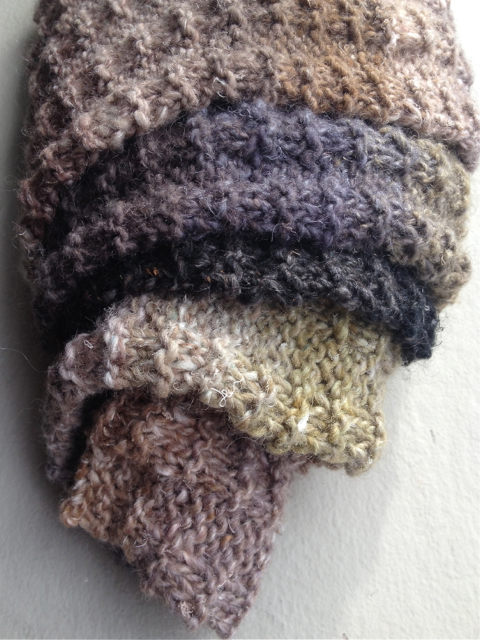
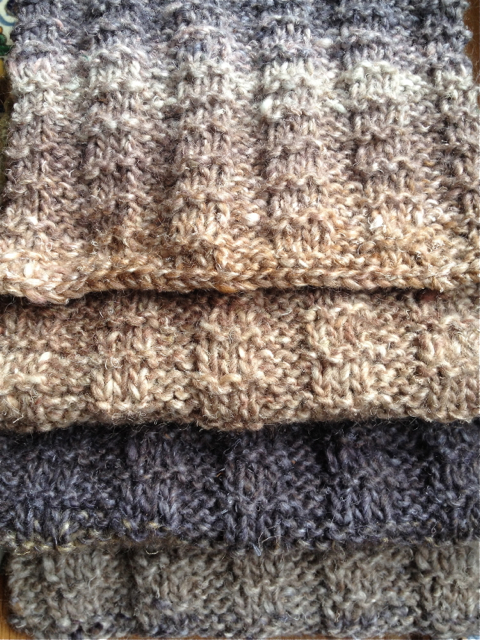
Once I received the book I hunted through for a formula for another scarf and chose a very simple repetition of 5 plain stitches then one purl. This in not a serpentine pattern across rows as in 'Abelan', but just a one-row pattern which really shines when knitted with two-row stripes of two different yarns. Inadvertently I've also discovered that sequence knitting is sometimes a great opportunity for using up single skeins of yarn I have in my yarn collection. This scarf, for example, uses a skein of Zauberball sock yarn in long colour changes of black and white that I've had for years together with a ball of Patonyl (an enduring Australian favourite) I purchased for $5 at a recent Inner-City Knitters' Guild yarn destash.
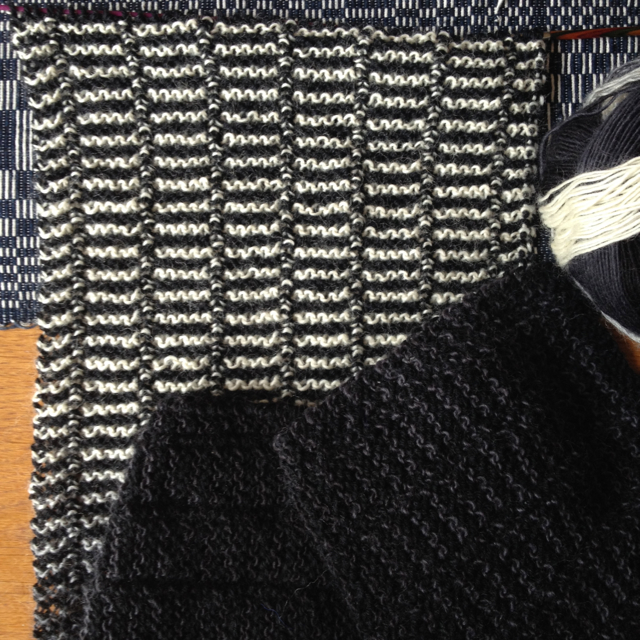
I hope I haven't made sequence knitting sound too complicated. It isn't. It's the absolute opposite of complicated as it simply takes combinations of purl and plain stitches - the very basic building blocks of knitting - and demonstrates the wonderful diversity of textures and patterns they can produce.
I'm already off on another project!
Fortunately, Cecelia had a pattern available through Ravelry - a scarf or cowl she's named 'Abelan', so I was set to try this new (or as Cecelia, after Elizabeth Zimmermann, says, 'unvented') concept for knitting. It was fun. You simply knit 9 stitches, then purl 3 stitches across a number of stitches that's a multiple of 12 stiches, plus or minus three stitches. (Cecelia's instructions are much clearer than mine!) This particular pattern is an example of what Cecelia has classified as 'serpentine' knitting where you carry the stitch repetitions from one row to the next over four rows to create the textured pattern.
I used two different but similar colours of Noro Silk Garden yarn for this scarf. The long, graded, sometimes unexpected colour sequences in this yarn are ideally suited to the textures produced by sequence knitting. I am very happy with the outcome, which I gave to my ex-husband when he visited Sydney during a particularly cold winter spell:
Indeed, I was so happy with the scarf that I did order a copy of 'Sequence Knitting' from the USA - despite its cost once I'd added in the postage. I haven't regretted my purchase for an instant. It's a beautifully produced book. Lovely paper, elegant lay-out, just enough colour, clear, helpful photographic illustrations of the stitch patterns described. And the content is just as wonderful as the book's physical form. You could say that Cecelia Campochiaro has produced a stitch dictionary. She has, but she's done so much more. She has looked behind the repetitions and sequences that produce the patterns and calculated the stitch formulas to produce a variety of textures. It's a combination of the binary of knit and purl with simple mathematics to calculate a dizzying range of possibilities. It's such a neat book - ordering, classifying, enumerating - lovely!
Once I received the book I hunted through for a formula for another scarf and chose a very simple repetition of 5 plain stitches then one purl. This in not a serpentine pattern across rows as in 'Abelan', but just a one-row pattern which really shines when knitted with two-row stripes of two different yarns. Inadvertently I've also discovered that sequence knitting is sometimes a great opportunity for using up single skeins of yarn I have in my yarn collection. This scarf, for example, uses a skein of Zauberball sock yarn in long colour changes of black and white that I've had for years together with a ball of Patonyl (an enduring Australian favourite) I purchased for $5 at a recent Inner-City Knitters' Guild yarn destash.
I hope I haven't made sequence knitting sound too complicated. It isn't. It's the absolute opposite of complicated as it simply takes combinations of purl and plain stitches - the very basic building blocks of knitting - and demonstrates the wonderful diversity of textures and patterns they can produce.
I'm already off on another project!
Wednesday, July 22, 2015
Go East
Sometimes an ordinary day becomes more than you expect. Yesterday I went with a friend to the Art Gallery of New South Wales. We had no particular purpose; no particular expectations; no particular exhibition that motivated our visit. We were simply filling up a day with an everyday pleasure.
In the entrance foyer to the Gallery was a forest of embroidery and quilting hoops of various sizes encasing embroideries of Chinese characters - with their threads still hanging from the subtly coloured characters.
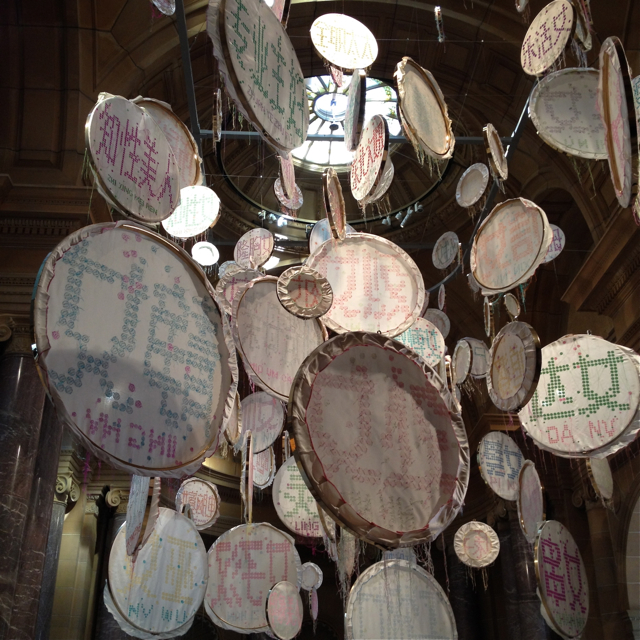
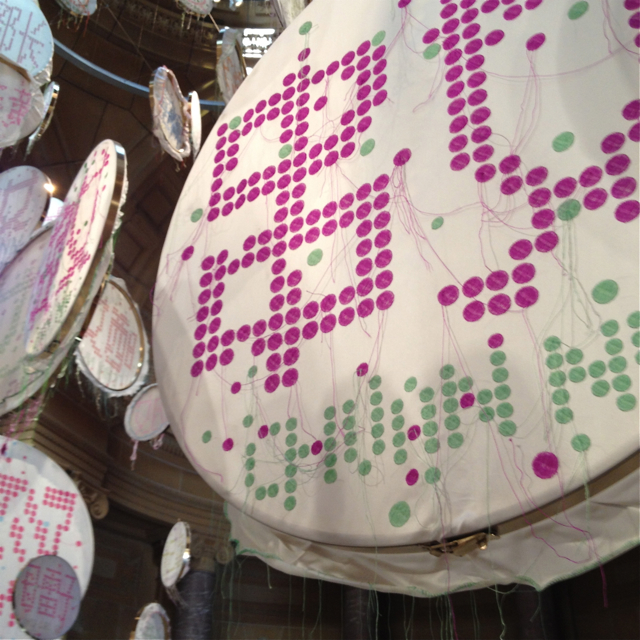
The work is by contemporary Chinese artist Lin Tianmiao and we discovered, by reading the accompanying explanatory description, that the characters were new words that describe women and their roles, made common by social media . Though many of the terms are somewhat derogatory, eg 'husband hunter','gap-toothed beauty', the overall emphasis is on women's agency in modern Chinese life. I liked the use of a traditional women's craft, embroidery, to portray women's roles as depicted through modern technology. Neat. And, as always, I was attracted by the tactile element that comes with the use of textiles. Despite signs warning the work was not to be touched, I noticed many people absently trailing their hands through the hanging threads as they passed by the work. We discovered this work was part of a larger exhibition called 'Go East' and so decided to see the other works in this exhibition.
In Australia we often bemoan the lack of patrons of the arts, so it was a pleasure to discover that this group of modern Asian works was drawn from the private collection of Gene and Brian Sherman. Our galleries don't have the treasures of Western art that one sees in Europe and the USA, but I think as a compensation we in Australia have frequent access to modern Asian art that is well-informed and well-curated.
I thought one of the most moving works in the 'Go East' exhibition was 'Zen Meditation' by Tibetan artist Nortse - a collection of six charred monks' robes arranged in frames.
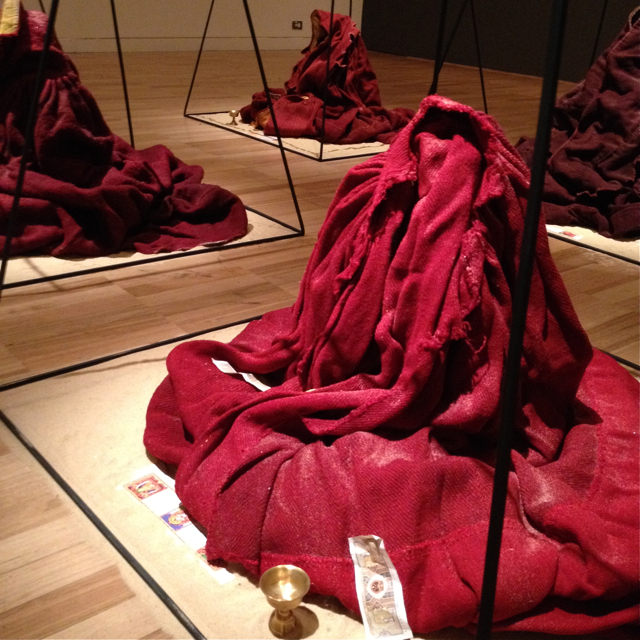
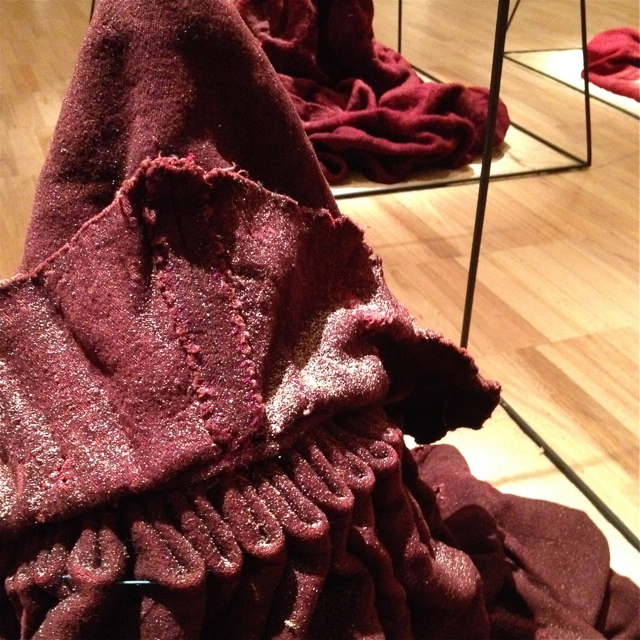
My immediate response was to the deep, rich colours and tactile quality of the roughly woven robes, but it takes only a few moments to be reminded of the many Tibetan monks who have self-immolated in their resistance to the domination of Tibet by China. The Chinese currency in the frames is another reference to the economic intrusion and consumerism with which modern Tibet is confronted. The characteristic I find very interesting about modern Asian art is its engagement with the politics and culture of the day. Sometimes, as with the Tibetan robes, the political message is obvious. At other times, such as with the work below, 'There is no voice...', it is more subtle.
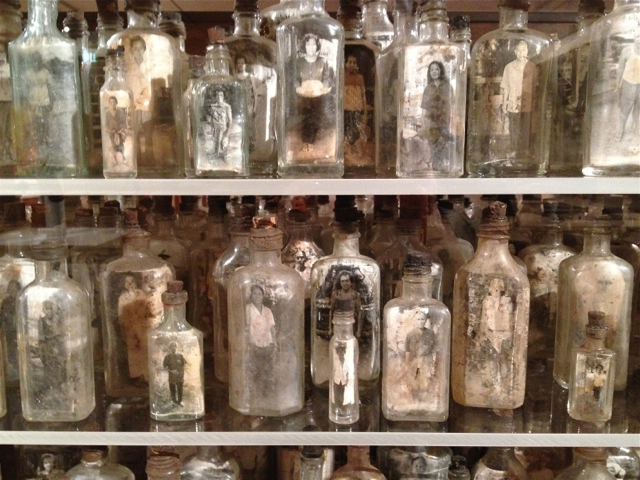
In a collaboration with the older people of the Chiang Mai community, Thai artist Navin Rawanchaikul has constructed an artwork that's a collection of various sized old medicine bottles that have photographs inserted within them. The bottles are crowded into shelves in a simply crafted display case. The older people in the photos are dressed in everyday traditional work clothes and some of the bottles are crazed and clouded. A way of life is fading and disappearing.
'Habitation' is a group of shanty structures built from Ikea packaging and precariously balanced above and below shelves. So many ideas... the need to scavenge to survive; the precariousness, both literal and metaphorical, of a way of life; the creativity of recycling:
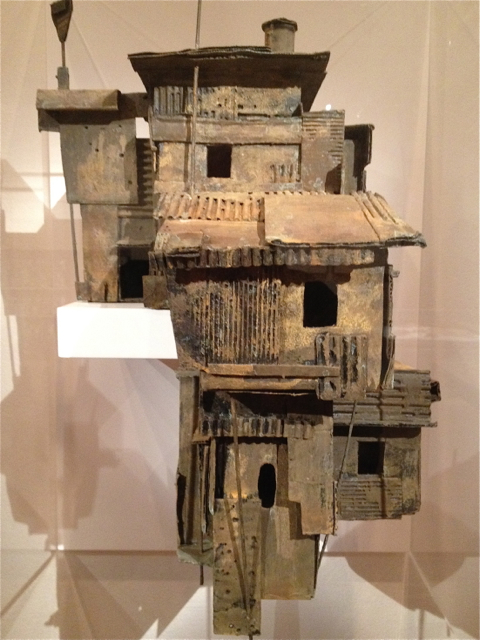
The creators of these delightful structures are Filipino artists Alfredo Juan Aquilizan and Maria Isabel Guardinez Aquilizan. Their names tugged at my memory - I was sure I'd encountered them before and so I trawled through my blog to discover that I'd written about them five and a half years ago when my grand-daughter and I had participated in one of their interactive works at the Queensland Art Gallery. Sometimes blogging has its uses!
There were, of course, lots of other wonderful works. Lots to be delighted by and confronted by (eg some very lifelike furless silicon rats that seemed to breathe!) I always forget that viewing artworks makes me perceive and interpret the world using quite different processes from those I use in everyday life, or even when I'm reading or viewing films. It's always good to be jolted into a realisation that there are other ways of seeing.
In the entrance foyer to the Gallery was a forest of embroidery and quilting hoops of various sizes encasing embroideries of Chinese characters - with their threads still hanging from the subtly coloured characters.
The work is by contemporary Chinese artist Lin Tianmiao and we discovered, by reading the accompanying explanatory description, that the characters were new words that describe women and their roles, made common by social media . Though many of the terms are somewhat derogatory, eg 'husband hunter','gap-toothed beauty', the overall emphasis is on women's agency in modern Chinese life. I liked the use of a traditional women's craft, embroidery, to portray women's roles as depicted through modern technology. Neat. And, as always, I was attracted by the tactile element that comes with the use of textiles. Despite signs warning the work was not to be touched, I noticed many people absently trailing their hands through the hanging threads as they passed by the work. We discovered this work was part of a larger exhibition called 'Go East' and so decided to see the other works in this exhibition.
In Australia we often bemoan the lack of patrons of the arts, so it was a pleasure to discover that this group of modern Asian works was drawn from the private collection of Gene and Brian Sherman. Our galleries don't have the treasures of Western art that one sees in Europe and the USA, but I think as a compensation we in Australia have frequent access to modern Asian art that is well-informed and well-curated.
I thought one of the most moving works in the 'Go East' exhibition was 'Zen Meditation' by Tibetan artist Nortse - a collection of six charred monks' robes arranged in frames.
My immediate response was to the deep, rich colours and tactile quality of the roughly woven robes, but it takes only a few moments to be reminded of the many Tibetan monks who have self-immolated in their resistance to the domination of Tibet by China. The Chinese currency in the frames is another reference to the economic intrusion and consumerism with which modern Tibet is confronted. The characteristic I find very interesting about modern Asian art is its engagement with the politics and culture of the day. Sometimes, as with the Tibetan robes, the political message is obvious. At other times, such as with the work below, 'There is no voice...', it is more subtle.
In a collaboration with the older people of the Chiang Mai community, Thai artist Navin Rawanchaikul has constructed an artwork that's a collection of various sized old medicine bottles that have photographs inserted within them. The bottles are crowded into shelves in a simply crafted display case. The older people in the photos are dressed in everyday traditional work clothes and some of the bottles are crazed and clouded. A way of life is fading and disappearing.
'Habitation' is a group of shanty structures built from Ikea packaging and precariously balanced above and below shelves. So many ideas... the need to scavenge to survive; the precariousness, both literal and metaphorical, of a way of life; the creativity of recycling:
The creators of these delightful structures are Filipino artists Alfredo Juan Aquilizan and Maria Isabel Guardinez Aquilizan. Their names tugged at my memory - I was sure I'd encountered them before and so I trawled through my blog to discover that I'd written about them five and a half years ago when my grand-daughter and I had participated in one of their interactive works at the Queensland Art Gallery. Sometimes blogging has its uses!
There were, of course, lots of other wonderful works. Lots to be delighted by and confronted by (eg some very lifelike furless silicon rats that seemed to breathe!) I always forget that viewing artworks makes me perceive and interpret the world using quite different processes from those I use in everyday life, or even when I'm reading or viewing films. It's always good to be jolted into a realisation that there are other ways of seeing.
Sunday, June 28, 2015
Indigo
I bought two skeins of indigo-dyed yarn when I was at the Edinburgh Yarn Festival earlier this year. It's fingering weight blue faced leicester yarn that's been dyed by Border Tart. One of the skeins I purchased was a deep navy blue with white flecks that reminded me of old Japanese warp-dyed textiles where some of the undyed sections of warp threads show though the textiles. The second skein was a clear mid-blue.
I decided to knit the Magrathea scarf/shawl designed by Martina Behm - a slightly asymmetrical shape that's a lacy variation of her very popular 'Hitchhiker' design.
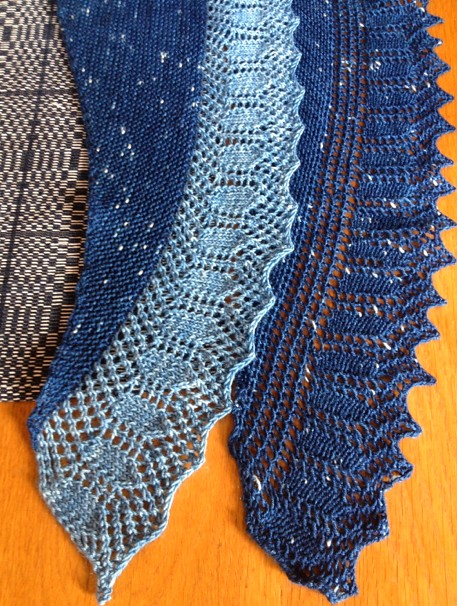
I began with the deep navy but didn't have quite enough yarn for the length and scarf shape I wanted, so I decided to add the final lacy edge in the mid-blue. One of the lovely things about using indigo-dyed yarns or fabrics is that you can be sure that all the variations of hue will match perfectly with each other. I'm very happy with the outcome:
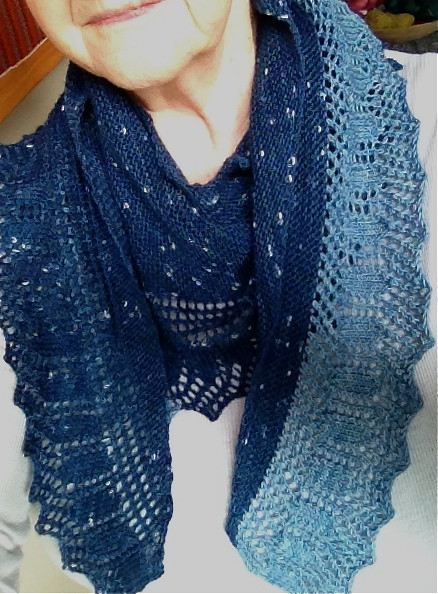
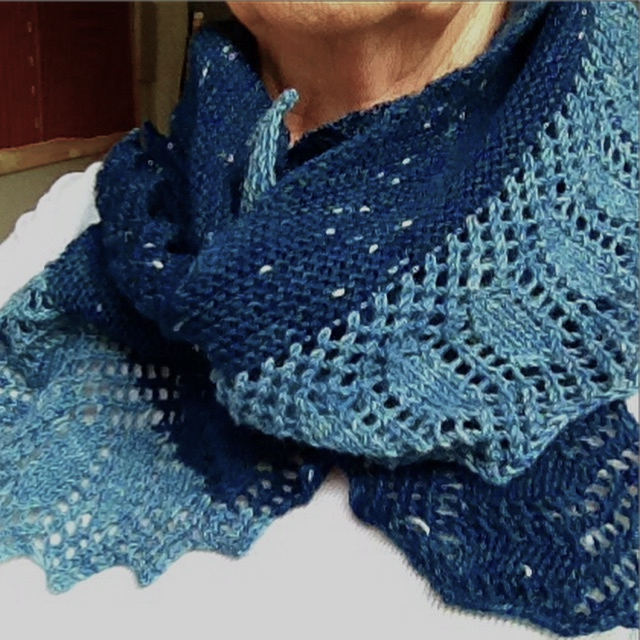
This project has set me wondering about what I find so satisfying about working with indigo dyed yarn. Of course it's beautiful with the subtle variations of blue that merge into one another. And in our modern world where we have instituted so many controls to standardise products there's something satisfying about the random and organic nature of indigo dying. You can never be quite sure what the outcome will be. I also find pleasure in knowing that indigo dying is a process with a long history spread across textile traditions in many countries. Among my rather random memory associations for indigo is a visit in the 1970s to Vigan, an old Spanish city in the northern Philippines, where I was shown huge chest-high pottery vats (bangay) that had been used for dying indigo fabrics that were exported to China in the eighteenth century as part of the Spanish galleon trade. Years later, maybe around 2000, I visited Sapa in the northern mountainous region of Vietnam. Here I saw women of the Black Hmong group using similar pottery jars, but also plastic garbage bins, to dye indigo fabrics from locally grown plants. Some of the fabrics were used to produce the fine indigo background of the women's traditional embroidered dress,
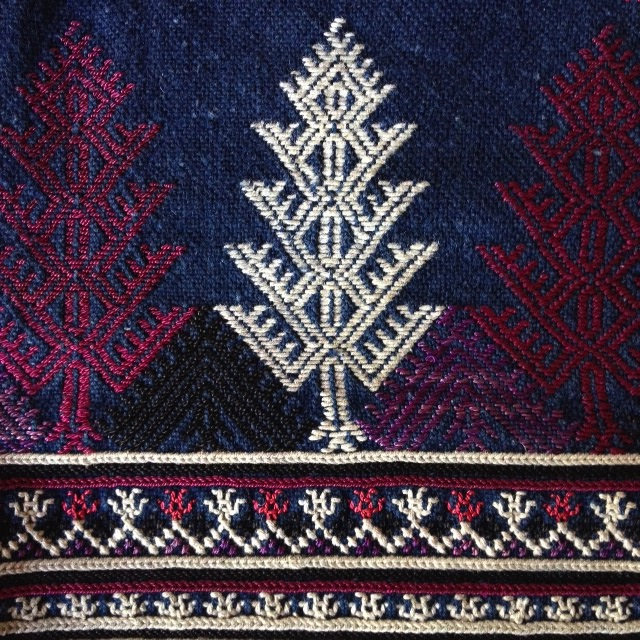
but much of it was quite roughly dyed for the tourist trade. On the overnight train returning from Sapa we shared our sleeping compartment with a young French couple. In the morning, the young man, who was wearing an indigo shirt he'd purchased in Sapa, was dyed blue from neck to hip!
To get back to my knitting... when I'd finished my Magrathea scarf I still had most of my skein of mid-indigo yarn left, so I decided to make some fingerless mitts for a neighbour who'd been complaining of her cold hands. I chose a pattern I'd long admired, probably jane's Glasgow School Mitts - so named because of its echoes of Charles Rennie Mackintosh's lovely early 20th century designs. This yarn has quite a tight twist and is ideal for displaying the small but intricate cables of this pattern.
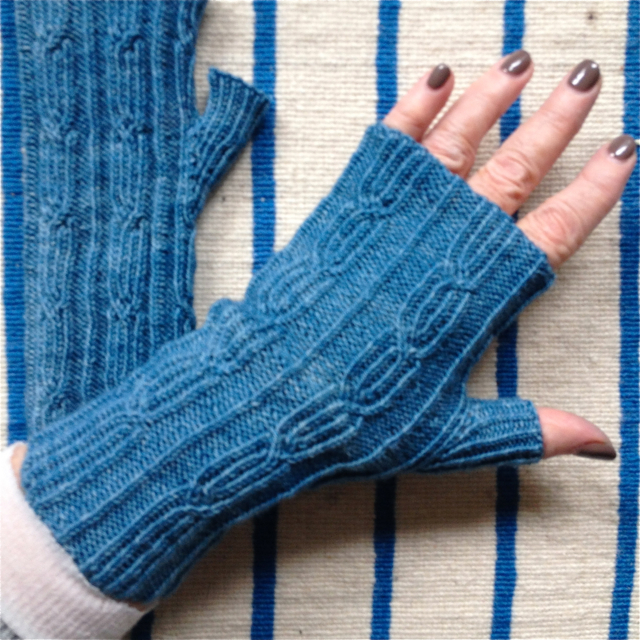
I still have 49 grams of the mid-indigo yarn left. I'd love to use it all up, so I'm interested in ideas for another small indigo project.
I decided to knit the Magrathea scarf/shawl designed by Martina Behm - a slightly asymmetrical shape that's a lacy variation of her very popular 'Hitchhiker' design.
I began with the deep navy but didn't have quite enough yarn for the length and scarf shape I wanted, so I decided to add the final lacy edge in the mid-blue. One of the lovely things about using indigo-dyed yarns or fabrics is that you can be sure that all the variations of hue will match perfectly with each other. I'm very happy with the outcome:
This project has set me wondering about what I find so satisfying about working with indigo dyed yarn. Of course it's beautiful with the subtle variations of blue that merge into one another. And in our modern world where we have instituted so many controls to standardise products there's something satisfying about the random and organic nature of indigo dying. You can never be quite sure what the outcome will be. I also find pleasure in knowing that indigo dying is a process with a long history spread across textile traditions in many countries. Among my rather random memory associations for indigo is a visit in the 1970s to Vigan, an old Spanish city in the northern Philippines, where I was shown huge chest-high pottery vats (bangay) that had been used for dying indigo fabrics that were exported to China in the eighteenth century as part of the Spanish galleon trade. Years later, maybe around 2000, I visited Sapa in the northern mountainous region of Vietnam. Here I saw women of the Black Hmong group using similar pottery jars, but also plastic garbage bins, to dye indigo fabrics from locally grown plants. Some of the fabrics were used to produce the fine indigo background of the women's traditional embroidered dress,
but much of it was quite roughly dyed for the tourist trade. On the overnight train returning from Sapa we shared our sleeping compartment with a young French couple. In the morning, the young man, who was wearing an indigo shirt he'd purchased in Sapa, was dyed blue from neck to hip!
To get back to my knitting... when I'd finished my Magrathea scarf I still had most of my skein of mid-indigo yarn left, so I decided to make some fingerless mitts for a neighbour who'd been complaining of her cold hands. I chose a pattern I'd long admired, probably jane's Glasgow School Mitts - so named because of its echoes of Charles Rennie Mackintosh's lovely early 20th century designs. This yarn has quite a tight twist and is ideal for displaying the small but intricate cables of this pattern.
I still have 49 grams of the mid-indigo yarn left. I'd love to use it all up, so I'm interested in ideas for another small indigo project.
Friday, June 12, 2015
Posting again...on socks
It's almost three months since I last posted on my blog. I'm not sure why I stopped writing posts. It wasn't really intentional. Over time, one of the things I have most valued about blogging is the record I have of my trips and travels, so it's quite odd that I stopped writing just as I began my recent trip to the UK. Now I really regret that I didn't keep a record of what I saw and what I thought at the time of seeing. Somewhere I read recently a comment of novelist Zadie Smith that 'The very reason I write is so that I might not sleepwalk through my entire life'. Writing is not such a central part of my identity as it is for a talented novelist like Zadie Smith, but even writing my blog certainly moves me to observations, comparisons and reflections that fix experiences in my memory.
I've recently been reading Wallace Stegner's 'Crossing to Safety' (which, by the way, is one of the best novels I've read in a long time) where one of his characters observes 'Henry James says somewhere that if you have to make notes on how a thing has struck you, it probably hasn't struck you'. Much as I admire Henry James, I'm not sure I agree with him - or maybe he just had a much better memory than I have. As I get older I panic that if I don't make a note on how a thing has struck me it will simply drop off the edge of my mind.
So to get back into the swing of blogging I'm going to write a simple post about socks. I seem to have spent a lot of time knitting lately, but have very little to show for my activity. This is partly because I've been trying to master new knitting techniques and I've spent just as much time unravelling as I have knitting; I think it will take me the rest of my life to master brioche stitch! But I have been doing some sock knitting. Socks are great to knit when you don't really want to commit to a major project and you want something small enough to carry with you when travelling.
I've knitted two pairs of socks over the last few months - both of them patterns from Nancy Bush's 'Knitting Vintage Socks', my favourite knitting book ever. First there was Nancy's 'Yarrow Ribbed Sock', made from ever-reliable Regia sock yarn in shades of blue and grey :
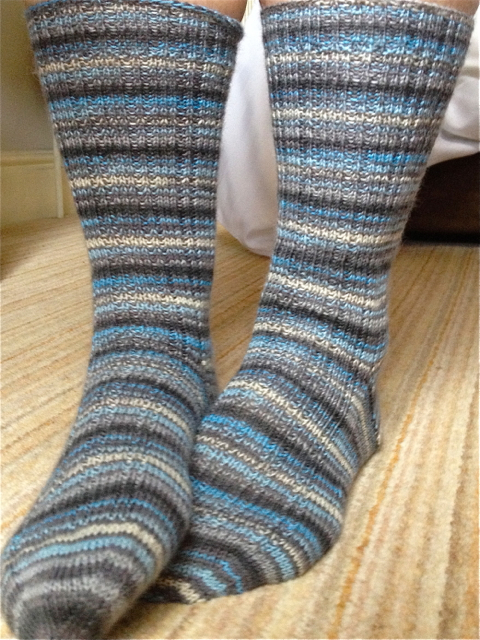
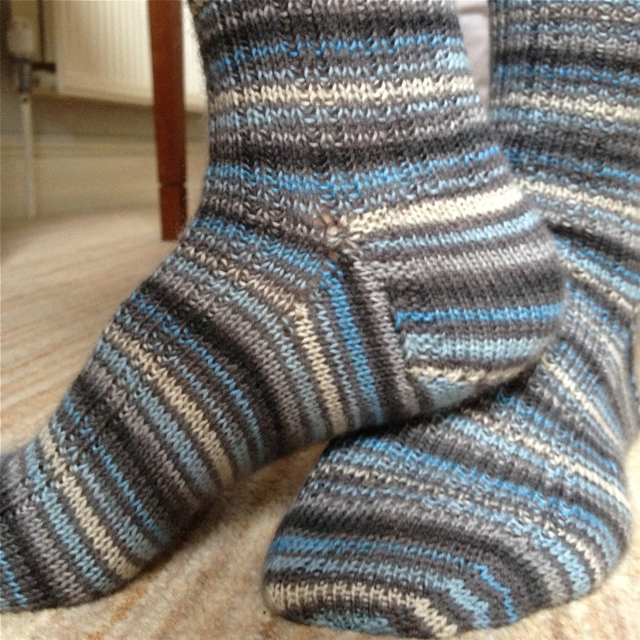
These became a gift for my friend and ex-colleague Maja who generously hosted me for a couple of days during my trip to the UK. By the way, Maja took me on a visit to the intimate Framework Knitting Museum in Nottingham, but maybe that's the subject for another post.
While in the UK I bought some very British sock yarn - West Yorkshire Spinners 4 ply purchased at baa ram ewe in Leeds (that's another story) - and embarked on what must be one of the plainest sock patterns ever, Nancy Bush's 'Gentleman's Plain Winter Sock'. I was still finishing off my first sock when I arrived back in Sydney and was so bored by my knitting (yes, even Nancy can occasionally be boring) I knitted a red toe with some very Australian Patonyl sock yarn donated by my friend Margarita. It then seemed inevitable to add some red stripes to the second sock to speed my knitting to completion.
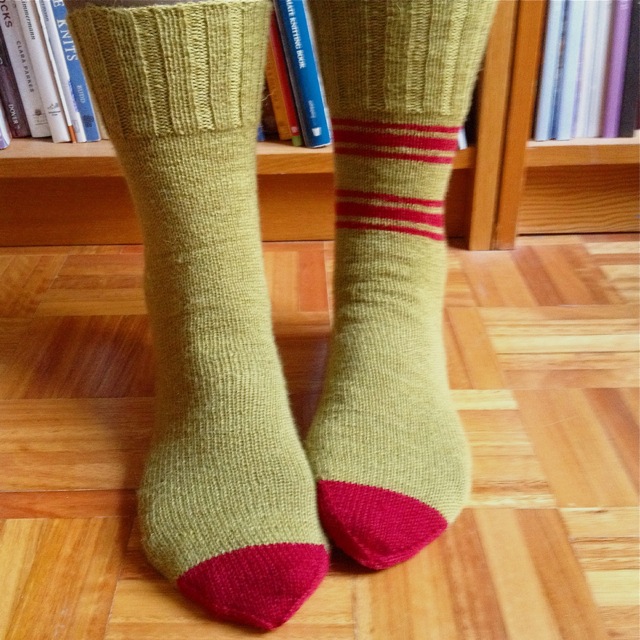
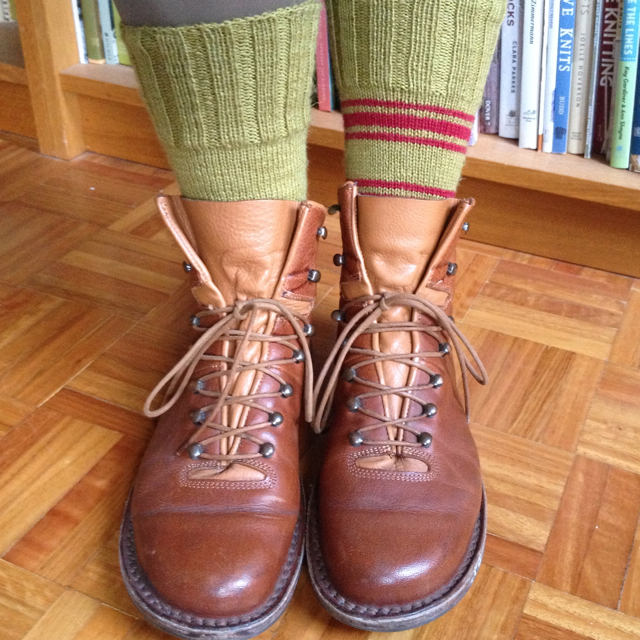
In my head I now ironically label these my Anzac socks. I was happily beginning to knit with what I thought was chartreuse yarn when someone casually asked if I was knitting khaki socks in honour of the centenary of Anzac Day. It hadn't occurred to me that the colour was actually khaki! And then knitting with contrasting poppy red only seems to have heightened the Anzac connection. Hmmm... Not really what I had intended.
I've recently been reading Wallace Stegner's 'Crossing to Safety' (which, by the way, is one of the best novels I've read in a long time) where one of his characters observes 'Henry James says somewhere that if you have to make notes on how a thing has struck you, it probably hasn't struck you'. Much as I admire Henry James, I'm not sure I agree with him - or maybe he just had a much better memory than I have. As I get older I panic that if I don't make a note on how a thing has struck me it will simply drop off the edge of my mind.
So to get back into the swing of blogging I'm going to write a simple post about socks. I seem to have spent a lot of time knitting lately, but have very little to show for my activity. This is partly because I've been trying to master new knitting techniques and I've spent just as much time unravelling as I have knitting; I think it will take me the rest of my life to master brioche stitch! But I have been doing some sock knitting. Socks are great to knit when you don't really want to commit to a major project and you want something small enough to carry with you when travelling.
I've knitted two pairs of socks over the last few months - both of them patterns from Nancy Bush's 'Knitting Vintage Socks', my favourite knitting book ever. First there was Nancy's 'Yarrow Ribbed Sock', made from ever-reliable Regia sock yarn in shades of blue and grey :
These became a gift for my friend and ex-colleague Maja who generously hosted me for a couple of days during my trip to the UK. By the way, Maja took me on a visit to the intimate Framework Knitting Museum in Nottingham, but maybe that's the subject for another post.
While in the UK I bought some very British sock yarn - West Yorkshire Spinners 4 ply purchased at baa ram ewe in Leeds (that's another story) - and embarked on what must be one of the plainest sock patterns ever, Nancy Bush's 'Gentleman's Plain Winter Sock'. I was still finishing off my first sock when I arrived back in Sydney and was so bored by my knitting (yes, even Nancy can occasionally be boring) I knitted a red toe with some very Australian Patonyl sock yarn donated by my friend Margarita. It then seemed inevitable to add some red stripes to the second sock to speed my knitting to completion.
In my head I now ironically label these my Anzac socks. I was happily beginning to knit with what I thought was chartreuse yarn when someone casually asked if I was knitting khaki socks in honour of the centenary of Anzac Day. It hadn't occurred to me that the colour was actually khaki! And then knitting with contrasting poppy red only seems to have heightened the Anzac connection. Hmmm... Not really what I had intended.
Thursday, March 12, 2015
Things, stuff, collections
I'm travelling again. At present I'm in London where a house swap has provided me with a month's stay in a very swish apartment in Royal Docks. I like to travel because I like the glimpses it gives of other ways of living; other ways of constructing the everyday. Things, stuff, collections, what is more formally defined as material culture, are wonderful illustrations of ways of living. There are certain museums I like because they provide these kinds of insights into people's lives. I've been lucky enough to find some of them on this visit.
The Geffrye Museum in London's rapidly gentrifying east end, is one such treasure.
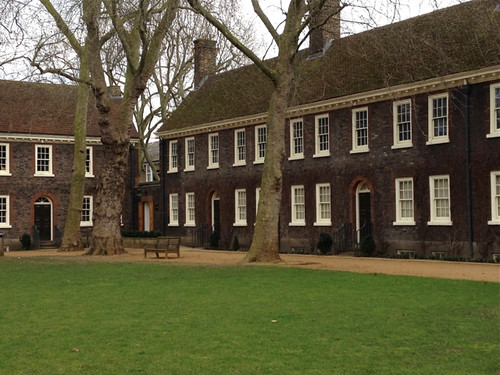
It's a simple, but very lovely 18th century building that was built as an almshouse. It's quite narrow as it originally was a series of independent dwellings - like a long terrace. But now all the interiors have been joined together so there's an enfilade through the building with a series of rooms opening off the hall.
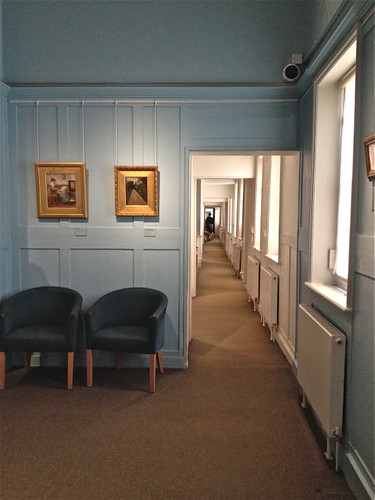
And the 'rooms' are just that - reconstructed living rooms that provide glimpses of how the 'middling sort' (the middle classes) lived from Tudor times to the late twentieth century:

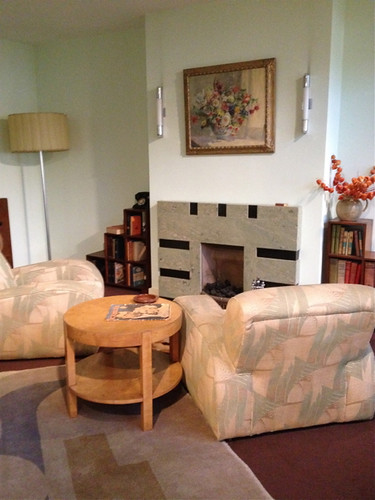
The rooms above are representative of the late eighteenth century and the 1930s. As I child, I grew up with a living room in the style of the 1930s room above, even though it was the 1950s. Perhaps that says something about 'style' in Australia? I still use my parents' living room chairs from that period, though they've been reupholstered several times. Unlike many of the better-known museums the Geffrye had relatively few visitors other than a couple of school groups, so I could linger and wonder over the exhibits.
I also visited the museum exhibition that must thrill the heart of every collector or hoarder:
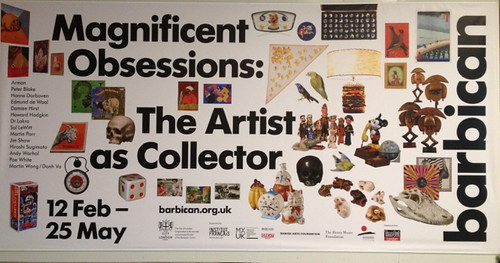
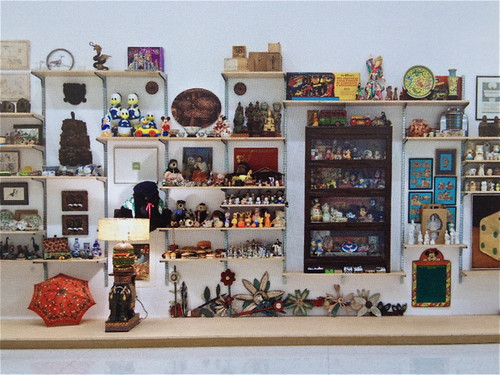
This exhibition, of artists' collections of objects, was fascinating. The great temptation is to believe that the objects give you insights to the artists' work. I can't help but wonder just how these collections are stored and displayed in people's houses. Who dusts them? Are they regularly rearranged? Are they cataloged? Are they loved, or is the thrill in their acquisition? The exhibition raises lots of interesting questions - most centrally, when does 'stuff' become 'art'? Some of the collections, like that of Hanne Darboven, are wonderfully random, with objects of different kinds and different sizes crammed together. Others, like Sol Le Witt's collection of photographs are precisely ordered and displayed. Still others have a double level of obsession where one artist, Danh Vo, has curated, ordered and displayed the collection of another artist, Martin Wong:
Possibly my favourite of the many wonderful collections was Pae White's collection of scarves by prolific mid-twentieth century fabric designer Vera Neumann.
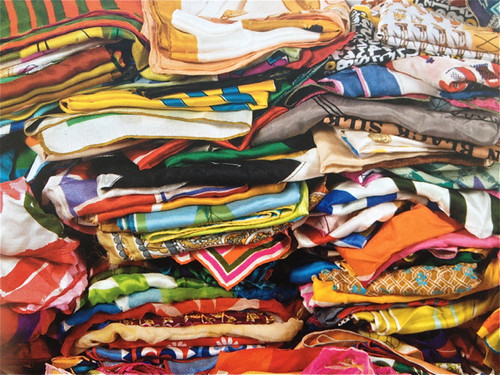
I'm not sure what engaged me most - the extraordinary range of Neumann's scarf designs or Pae White's persistence in finding and gathering the scarves. Either way, I can't help being fascinated by such obsessiveness.
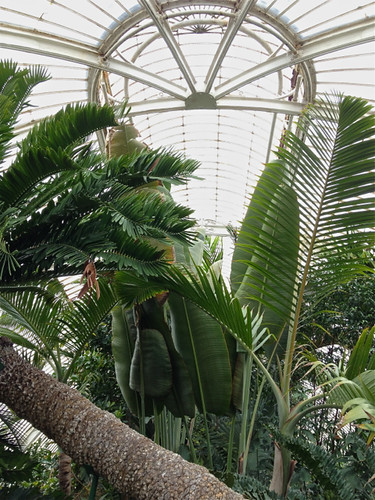
It's not a museum in the usual sense, but I imagine Kew Gardens must be one of the world's best collections of plants. Wikipedia tells me it is the world's largest collection of living plants. There are thousands upon thousands of species of trees and plants which (at least to me) reflect Britain's history of travel, exploration and colonisation. The beautiful Palm House with its specimens from many more tropical countries is a particular example of collecting and curating:
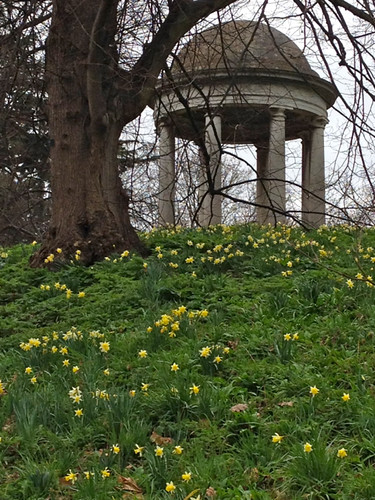
The gardens also reflect the British obsession with gardening and landscaping. We were a month too early for the renowned display of bluebells, and just a couple of weeks too early for the grand display of daffodils, though some early bloomings were a sign of the splendour to come:
However, we were just in time for the display of crocuses and the occasional quiet snowdrops:
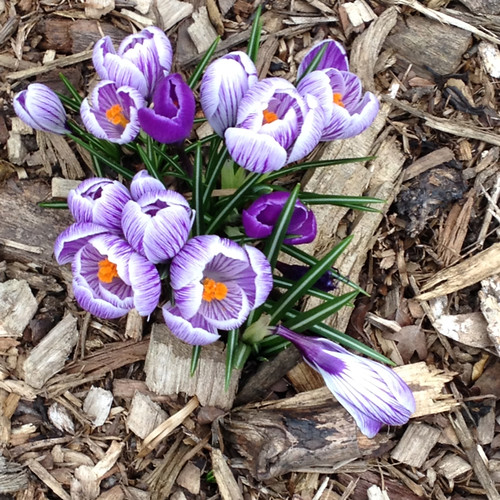
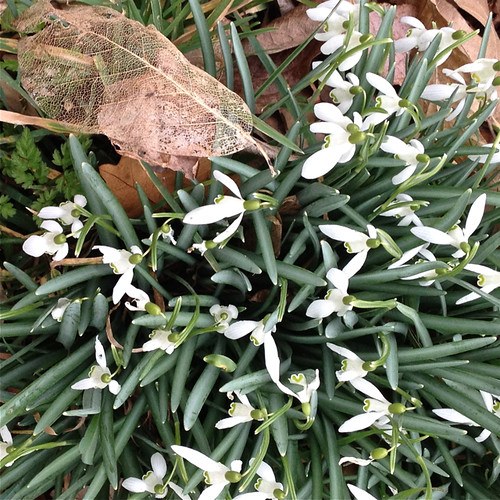
Now I think about it, being a tourist is just another form of collecting, and museums are convenient ways of curating experiences for tourists - though of course they have other functions. I'll continue to blog about the experiences I collect - though I'm only too aware that I have been a much less dutiful travel blogger on this trip than I have been previously.
The Geffrye Museum in London's rapidly gentrifying east end, is one such treasure.
It's a simple, but very lovely 18th century building that was built as an almshouse. It's quite narrow as it originally was a series of independent dwellings - like a long terrace. But now all the interiors have been joined together so there's an enfilade through the building with a series of rooms opening off the hall.
And the 'rooms' are just that - reconstructed living rooms that provide glimpses of how the 'middling sort' (the middle classes) lived from Tudor times to the late twentieth century:
The rooms above are representative of the late eighteenth century and the 1930s. As I child, I grew up with a living room in the style of the 1930s room above, even though it was the 1950s. Perhaps that says something about 'style' in Australia? I still use my parents' living room chairs from that period, though they've been reupholstered several times. Unlike many of the better-known museums the Geffrye had relatively few visitors other than a couple of school groups, so I could linger and wonder over the exhibits.
I also visited the museum exhibition that must thrill the heart of every collector or hoarder:
This exhibition, of artists' collections of objects, was fascinating. The great temptation is to believe that the objects give you insights to the artists' work. I can't help but wonder just how these collections are stored and displayed in people's houses. Who dusts them? Are they regularly rearranged? Are they cataloged? Are they loved, or is the thrill in their acquisition? The exhibition raises lots of interesting questions - most centrally, when does 'stuff' become 'art'? Some of the collections, like that of Hanne Darboven, are wonderfully random, with objects of different kinds and different sizes crammed together. Others, like Sol Le Witt's collection of photographs are precisely ordered and displayed. Still others have a double level of obsession where one artist, Danh Vo, has curated, ordered and displayed the collection of another artist, Martin Wong:
Possibly my favourite of the many wonderful collections was Pae White's collection of scarves by prolific mid-twentieth century fabric designer Vera Neumann.
I'm not sure what engaged me most - the extraordinary range of Neumann's scarf designs or Pae White's persistence in finding and gathering the scarves. Either way, I can't help being fascinated by such obsessiveness.
It's not a museum in the usual sense, but I imagine Kew Gardens must be one of the world's best collections of plants. Wikipedia tells me it is the world's largest collection of living plants. There are thousands upon thousands of species of trees and plants which (at least to me) reflect Britain's history of travel, exploration and colonisation. The beautiful Palm House with its specimens from many more tropical countries is a particular example of collecting and curating:
The gardens also reflect the British obsession with gardening and landscaping. We were a month too early for the renowned display of bluebells, and just a couple of weeks too early for the grand display of daffodils, though some early bloomings were a sign of the splendour to come:
However, we were just in time for the display of crocuses and the occasional quiet snowdrops:
Now I think about it, being a tourist is just another form of collecting, and museums are convenient ways of curating experiences for tourists - though of course they have other functions. I'll continue to blog about the experiences I collect - though I'm only too aware that I have been a much less dutiful travel blogger on this trip than I have been previously.
Saturday, January 24, 2015
Documentation
I often wonder about the need so many of us have to document our lives in some way. On the top shelf of a cupboard I have a box of unsorted photos that I kept when my mother's house was packed away after her death. Many of the people in the photos are no longer identifiable, but I am reluctant to throw them away. Next to the photos is a smaller box of diaries that were kept (in a most minimal way) by my grandfather between the nineteen thirties and fifties. Then there are fragments of family history compiled by cousins and more distant relatives over many years. I think my own persistence in blogging, in the face of waning enthusiasm for blogging as a medium of social communication, is just another variation on this need to record; to document.
Sometime last year I began using instagram. I'm not really an early adopter of new forms of social media. I usually join in rather reluctantly because increasingly they are the best way of keeping up with friends and family. But I've taken to instagram with some pleasure. I like taking photographs, though I hate lugging around a heavy and conspicuous camera. As instagram relies on smart phone photos I can be forgiven the not-so-great quality of my images. At the beginning of the year I had the idea of posting an instagram image each day across the year. I think I had an idea that this might capture the nature of my daily life; that over the year it would become an aide memoire to reflecting on my experiences and concerns.
By January 23 and I'd posted 22 images. Early in the month, before I'd really established the picture-taking habit, I seem to have missed a day. Never mind. Already, I can't help classifying the posts to see what they say about my life. There are posts about Sydney (top left is the Queen Victoria Building). I first came to Sydney in the early 1960s, before the advent of shopping malls in the suburbs. The city centre was where I shopped for everything except food, and this is a habit I've never broken. I shop in the city for clothes, for books, for gifts. I often go to the movies and concerts in the city and I meet people there to catch up. Of course, all this is possible because I'm only a 5 minute train ride from the city centre. I love Sydney and I love keeping a photographic record of the bits of it that I frequent.
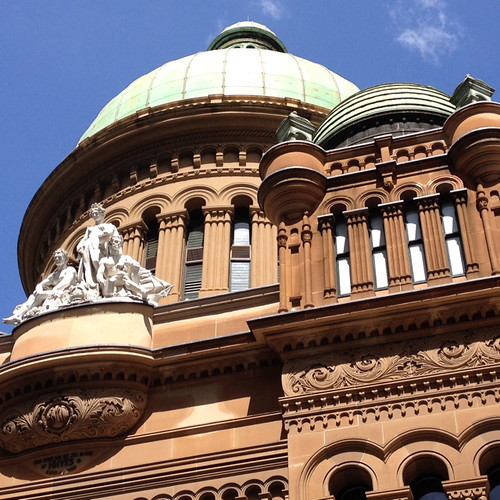

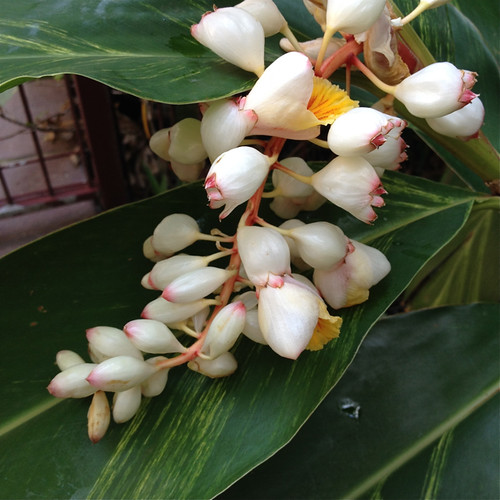
Then there are images of my neighbourhood - of Redfern, and other surrounding areas (top right is a window in the old locomotive workshop at Eveleigh that's next door to where I live). Redfern's an old suburb and is now a mixture of old industrial sites that have been 'repurposed', public housing, new apartment buildings and old terrace houses. There's lots of visual interest. This is where I live my daily life, buying milk and bread, going to the doctor, having cups of coffee, taking daily walks and visiting some of the lovely old parks in the area.
Some days I spend at home. I enjoy my small apartment and the furniture and objects that I've accumulated over time. I've now lived in the same apartment block for nearly thirty years and am part of the small community of my neighbours with our shared concerns. (The flowers bottom left are from our communal garden which kind neighbours tend).
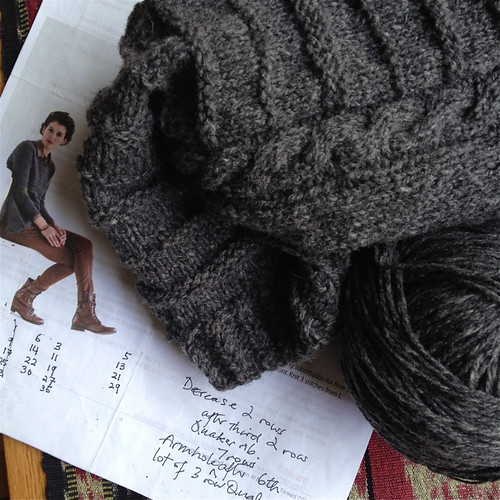
And, of course, there's my knitting.
I imagine that my city, my neighbourhood, my home and my knitting will be the subjects of my instagram record of the year. So far I'm enjoying the small project of visually documenting my days...and I think I'll enjoy looking back on a year of images when the year ends.
If you wish, you can follow me on instagram where I'm smark31.
Sometime last year I began using instagram. I'm not really an early adopter of new forms of social media. I usually join in rather reluctantly because increasingly they are the best way of keeping up with friends and family. But I've taken to instagram with some pleasure. I like taking photographs, though I hate lugging around a heavy and conspicuous camera. As instagram relies on smart phone photos I can be forgiven the not-so-great quality of my images. At the beginning of the year I had the idea of posting an instagram image each day across the year. I think I had an idea that this might capture the nature of my daily life; that over the year it would become an aide memoire to reflecting on my experiences and concerns.
By January 23 and I'd posted 22 images. Early in the month, before I'd really established the picture-taking habit, I seem to have missed a day. Never mind. Already, I can't help classifying the posts to see what they say about my life. There are posts about Sydney (top left is the Queen Victoria Building). I first came to Sydney in the early 1960s, before the advent of shopping malls in the suburbs. The city centre was where I shopped for everything except food, and this is a habit I've never broken. I shop in the city for clothes, for books, for gifts. I often go to the movies and concerts in the city and I meet people there to catch up. Of course, all this is possible because I'm only a 5 minute train ride from the city centre. I love Sydney and I love keeping a photographic record of the bits of it that I frequent.
Then there are images of my neighbourhood - of Redfern, and other surrounding areas (top right is a window in the old locomotive workshop at Eveleigh that's next door to where I live). Redfern's an old suburb and is now a mixture of old industrial sites that have been 'repurposed', public housing, new apartment buildings and old terrace houses. There's lots of visual interest. This is where I live my daily life, buying milk and bread, going to the doctor, having cups of coffee, taking daily walks and visiting some of the lovely old parks in the area.
Some days I spend at home. I enjoy my small apartment and the furniture and objects that I've accumulated over time. I've now lived in the same apartment block for nearly thirty years and am part of the small community of my neighbours with our shared concerns. (The flowers bottom left are from our communal garden which kind neighbours tend).
And, of course, there's my knitting.
I imagine that my city, my neighbourhood, my home and my knitting will be the subjects of my instagram record of the year. So far I'm enjoying the small project of visually documenting my days...and I think I'll enjoy looking back on a year of images when the year ends.
If you wish, you can follow me on instagram where I'm smark31.
Wednesday, January 14, 2015
Knitting 2014
I'm running rather late with my knitting round-up for 2015. I finished fourteen projects in 2015 - perhaps fifteen if you count the Honey Cowl that I've not yet figured out how to block. This is an increase over 2013 when I only managed to complete eleven projects, though I think there were more large pieces of knitting in 2013 than in 2014. I've decided to continue my tradition of awarding my projects prizes in various categories as it's a fun way of reviewing just what I've achieved.
First, the prize for the project of which I'm most proud. Hmmm. This one's difficult, so I've decided to award it jointly to the four hats I knitted to experiment with fair isle colour and motif combinations.
I've really enjoyed playing around with fair isle knitting. Thank you Mary Jane Mucklestone for both your personal inspiration and the book '200 Fair Isle Motifs'. I'm now a bit loaded down with hats and I'm wondering what other garments or objects I can use for playing around with fair isle - maybe wrist or arm coverings? Maybe cushion covers?
Then there's the prize for the project most favourited on Ravelry. There was a clear winner in this category - my Copenhagen shawl:
The shawl was knitted to Melanie Berg's Ashburn pattern using Geilsk Tynd Uld (thin wool) in toning grey and pink colours. Two skeins of the yarn were a generous gift from Bente Geil, the designer of the Geilsk yarn during my visit to Copenhagen in August last year. I think the drape and texture of this shawl shows just how suitable the 'sticky' Scandinavian yarns are for shawl knitting.
The prize for the most frequently worn project is also easily awarded. It goes to my Saffron Hap:
This is Kate Davies' pattern, A Hap for Harriet. I love everything about this shawl that's really a wonderfully drapey scarf. I knitted it from Cascade laceweight Forest Hills yarn that's a mixture of merino wool and silk. It weighs almost nothing but is warm when needed. I particularly like the colour and frequently declared when wearing it that yellow is the new neutral as it seems to go with everything (well, it looks great with grey and black which is mostly what I wear in winter).
And finally there's the prize for the project that was the most fun to knit. This is more difficult, as I think my fair isle hats are also a contender for this category. But in the interests of being generous to my knitting I'll award it to the Unmatched Mitts:
These were fun because they were quick and unproblematic and because knitting with Noro yarn is always fun. I have a self-imposed Noro rule which is to knit with it however the colours fall, even if I've been unlucky enough to have bought one of those problematic balls of yarn that reverse the colour sequence as you're knitting. In this case, sticking with the colour sequence resulted in a completely unmatched pair of mitts. Fun! I didn't really need a pattern for this knit but I used Best Friends Mitts by Sandra Ruppert as a guide.
If I were feeling optimistic I could judge it a relatively successful year of knitting. But if I look back exactly one year to a similar blog post from January 2014 I have to admit that I've not been very diligent about achieving the goals I set then. I wrote:
Completing some part-completed major projects? Fail
Knitting a cardigan for my grand-daughter? Fail
Learning new techniques? Probably, given my experimentation with colour-work.
Maximum achievement, one out of three. This year I'm not going to declare any goals...though my grand-daughter still needs another cardigan.
First, the prize for the project of which I'm most proud. Hmmm. This one's difficult, so I've decided to award it jointly to the four hats I knitted to experiment with fair isle colour and motif combinations.
I've really enjoyed playing around with fair isle knitting. Thank you Mary Jane Mucklestone for both your personal inspiration and the book '200 Fair Isle Motifs'. I'm now a bit loaded down with hats and I'm wondering what other garments or objects I can use for playing around with fair isle - maybe wrist or arm coverings? Maybe cushion covers?
Then there's the prize for the project most favourited on Ravelry. There was a clear winner in this category - my Copenhagen shawl:
The shawl was knitted to Melanie Berg's Ashburn pattern using Geilsk Tynd Uld (thin wool) in toning grey and pink colours. Two skeins of the yarn were a generous gift from Bente Geil, the designer of the Geilsk yarn during my visit to Copenhagen in August last year. I think the drape and texture of this shawl shows just how suitable the 'sticky' Scandinavian yarns are for shawl knitting.
The prize for the most frequently worn project is also easily awarded. It goes to my Saffron Hap:
This is Kate Davies' pattern, A Hap for Harriet. I love everything about this shawl that's really a wonderfully drapey scarf. I knitted it from Cascade laceweight Forest Hills yarn that's a mixture of merino wool and silk. It weighs almost nothing but is warm when needed. I particularly like the colour and frequently declared when wearing it that yellow is the new neutral as it seems to go with everything (well, it looks great with grey and black which is mostly what I wear in winter).
And finally there's the prize for the project that was the most fun to knit. This is more difficult, as I think my fair isle hats are also a contender for this category. But in the interests of being generous to my knitting I'll award it to the Unmatched Mitts:
These were fun because they were quick and unproblematic and because knitting with Noro yarn is always fun. I have a self-imposed Noro rule which is to knit with it however the colours fall, even if I've been unlucky enough to have bought one of those problematic balls of yarn that reverse the colour sequence as you're knitting. In this case, sticking with the colour sequence resulted in a completely unmatched pair of mitts. Fun! I didn't really need a pattern for this knit but I used Best Friends Mitts by Sandra Ruppert as a guide.
If I were feeling optimistic I could judge it a relatively successful year of knitting. But if I look back exactly one year to a similar blog post from January 2014 I have to admit that I've not been very diligent about achieving the goals I set then. I wrote:
Of course I want to be more productive - what knitter doesn't? I think the best way of achieving this is to finish some of the part-completed relatively major projects, so that's my first goal. Then, a practical goal. I want to knit another go-to cardigan for my grand-daughter. And finally, I want to face up to the unadventurousness of my knitting and learn some new techniques and challenge myself.
Completing some part-completed major projects? Fail
Knitting a cardigan for my grand-daughter? Fail
Learning new techniques? Probably, given my experimentation with colour-work.
Maximum achievement, one out of three. This year I'm not going to declare any goals...though my grand-daughter still needs another cardigan.
Tuesday, January 6, 2015
Reading cooking
I read a lot. There's no particular virtue in this. I grew up in a small Australian country town before television arrived and listening to the radio and reading were my entertainment and my escape from the everyday. I read through the children's section of the local library and at around 12 was allowed to borrow from the adult library, under the censoring eye of Mrs Cooke, the librarian. Even so, my tastes were distinctly lowbrow. I'm not at all sure that the library held the great classics of literature; if it did, I never discovered them. I remember reading Frances Parkinson Keyes, Elizabeth Gouge, Georgette Heyer; writers whose books I've not seen for years. It was only in my last year of high school that an enlightened teacher introduced me to Jane Austen, Dickens and EM Forster, and then university study had me devouring the great nineteenth century novels. Even so, my main purpose in reading was enjoyment and, mostly, escape. I can remember a very distinguished professor of literature once telling me that I had excellent taste in second rate novels. Even today you can tell that I'm stressed or in need of solace when I'm rereading Anthony Trollope or Margaret Oliphant.
I still read for pleasure and escape. For some reason I've recently been rereading quite a bit. Partly this is because of a slight guilt I feel at spending so much on books (even frequently purchased Kindle books mount up over time) and partly it's because I read so much and with such distracted attention that I often forget the detail - or even the overall narrative - of what I read. When I was helping to pack my daughter's books for her house moving I came across an old copy (originally mine!) of Nora Ephron's 'Heartburn' and galloped through it. Read this book if you haven't already done so. It's a fictionalised account of Ephron's bitter marriage break up with Carl Bernstein of Bernstein and Woodward Watergate fame, and it's larded with comfort food recipes that have butter as a significant ingredient. (Ephron once said in an interview 'You can never have too much butter – that is my belief. If I have a religion, that's it') While there's some bitterness, it's laugh-out-loud funny and ultimately life-affirming (as we used to say in english literature tutorials in the 1960s).
For no particular reason I then reread Lisa Chaney's biography, 'Elizabeth David'. I suspect every Australian woman who moved out of home and began cooking in the 1950s or 60s has a Penguin edition of at least one of Elizabeth David's cookbooks stashed somewhere. I grew up with the then-accepted Australian diet of plainly cooked meat and veg, and a vast array of cakes, biscuits, slices, and everyday desserts. Elizabeth David's books came at just the right time for me, when hitherto unknown vegetables such as zucchini and eggplant were available in greengrocers' shops, and modest Italian restaurants were almost within reach of a student's budget. Elizabeth David was a pernickety perfectionist who became even more difficult as she aged, but her recipes, her evocative writing style, and more importantly, her insistence that good, local, fresh food was within any cook's reach, revolutionised many people's approach to food.
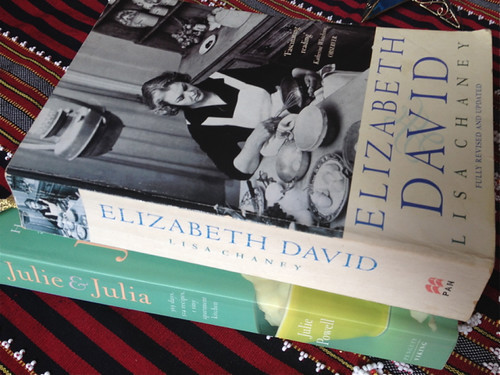
More than a decade after Elizabeth David's first books, Julia Child published her voluminous 'Mastering the Art of French Cooking'. Julia Child has recently had a resurgence of recognition through Julie Powell's 'Julie and Julia' and the same-named film starring the wonderful Meryl Streep. I raced through my rereading of 'Julie and Julia'. Fun, fun, fun. Julia Child, by the way, shares Nora Ephron's love affair with butter - such a guilty pleasure nowadays. It's interesting to compare Elizabeth David and Julia Child. The similarities are obvious in that they shared the desire to place fine food and good cooking within the reach of the everyday cook. But they do this in very different ways. Julia Child's recipes are painstaking - every step is outlined and every difficulty anticipated. Elizabeth David, on the other hand, is more interested in inspiring her readers by evoking the traditions and spirit of the recipe. She encourages you to improvise and above all, to sacrifice all to freshness and seasonality.
I feel much more at home with Elizabeth David than Julia Child, though there are recipes from both that are still very much part of my go-to cooking repertoire.
After all this cooking reading I was inspired to bake. This happens infrequently nowadays. I had some peaches that were nearing the end of their usefulness and I remembered a recipe for peach pie in 'Heartburn'. But my copy of 'Heartburn' has disappeared again - I expect recaptured by my daughter. I retreated to one of those recipes I've made so many times that it is foolproof. It came to me from my old friend Erika as an apple cake recipe, though I never knew her to make it with apples; I've eaten her cake with apricots, berries, plums (yum), but not apples. I've made it with apples many times and it's great, but I thought it would also be good with peaches. It was. So, in the spirit of Nora Ephron's recipe-laced prose I offer you...
Erika's Apple (or Peach) Cake.
120g butter
100g sugar (white or natural - whichever you prefer)
3 eggs
1 teasp vanilla
200g self-raising flour (I've used white flour, but 50/50 wholemeal and white is also good)
2 apples, quartered (or 2-3 peaches or plums, or whatever)
3 tabs milk
1 tablespoon extra sugar
Beat sugar and butter till well-incorporated. Add eggs one at a time, while beating. Add vanilla. Fold in sifted flour, roughly a third at a time, alternating with milk. Place mixture in greased cake tin and press in quartered or chunkily cut fruit. Sprinkle with extra sugar (and cinnamon if using apples). Bake in preheated 175 celsius oven for around 35 minutes. The cake is fine by itself, or good served with cream or sour cream.
If you are feeling energetic, you can make a crumble of roughly mixed butter, flour and brown sugar to sprinkle on top of the cake before baking.
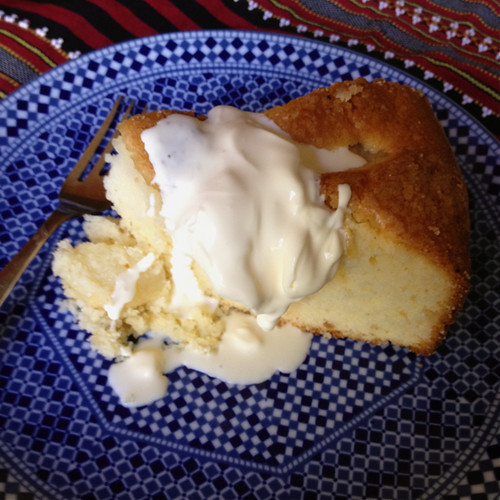
This is what my mother would have called a 'plain cake' - one to be served everyday to family or farm-workers, but not the kind of cake you make if you wish to impress someone with your baking!
I still read for pleasure and escape. For some reason I've recently been rereading quite a bit. Partly this is because of a slight guilt I feel at spending so much on books (even frequently purchased Kindle books mount up over time) and partly it's because I read so much and with such distracted attention that I often forget the detail - or even the overall narrative - of what I read. When I was helping to pack my daughter's books for her house moving I came across an old copy (originally mine!) of Nora Ephron's 'Heartburn' and galloped through it. Read this book if you haven't already done so. It's a fictionalised account of Ephron's bitter marriage break up with Carl Bernstein of Bernstein and Woodward Watergate fame, and it's larded with comfort food recipes that have butter as a significant ingredient. (Ephron once said in an interview 'You can never have too much butter – that is my belief. If I have a religion, that's it') While there's some bitterness, it's laugh-out-loud funny and ultimately life-affirming (as we used to say in english literature tutorials in the 1960s).
For no particular reason I then reread Lisa Chaney's biography, 'Elizabeth David'. I suspect every Australian woman who moved out of home and began cooking in the 1950s or 60s has a Penguin edition of at least one of Elizabeth David's cookbooks stashed somewhere. I grew up with the then-accepted Australian diet of plainly cooked meat and veg, and a vast array of cakes, biscuits, slices, and everyday desserts. Elizabeth David's books came at just the right time for me, when hitherto unknown vegetables such as zucchini and eggplant were available in greengrocers' shops, and modest Italian restaurants were almost within reach of a student's budget. Elizabeth David was a pernickety perfectionist who became even more difficult as she aged, but her recipes, her evocative writing style, and more importantly, her insistence that good, local, fresh food was within any cook's reach, revolutionised many people's approach to food.
More than a decade after Elizabeth David's first books, Julia Child published her voluminous 'Mastering the Art of French Cooking'. Julia Child has recently had a resurgence of recognition through Julie Powell's 'Julie and Julia' and the same-named film starring the wonderful Meryl Streep. I raced through my rereading of 'Julie and Julia'. Fun, fun, fun. Julia Child, by the way, shares Nora Ephron's love affair with butter - such a guilty pleasure nowadays. It's interesting to compare Elizabeth David and Julia Child. The similarities are obvious in that they shared the desire to place fine food and good cooking within the reach of the everyday cook. But they do this in very different ways. Julia Child's recipes are painstaking - every step is outlined and every difficulty anticipated. Elizabeth David, on the other hand, is more interested in inspiring her readers by evoking the traditions and spirit of the recipe. She encourages you to improvise and above all, to sacrifice all to freshness and seasonality.
I feel much more at home with Elizabeth David than Julia Child, though there are recipes from both that are still very much part of my go-to cooking repertoire.
After all this cooking reading I was inspired to bake. This happens infrequently nowadays. I had some peaches that were nearing the end of their usefulness and I remembered a recipe for peach pie in 'Heartburn'. But my copy of 'Heartburn' has disappeared again - I expect recaptured by my daughter. I retreated to one of those recipes I've made so many times that it is foolproof. It came to me from my old friend Erika as an apple cake recipe, though I never knew her to make it with apples; I've eaten her cake with apricots, berries, plums (yum), but not apples. I've made it with apples many times and it's great, but I thought it would also be good with peaches. It was. So, in the spirit of Nora Ephron's recipe-laced prose I offer you...
Erika's Apple (or Peach) Cake.
120g butter
100g sugar (white or natural - whichever you prefer)
3 eggs
1 teasp vanilla
200g self-raising flour (I've used white flour, but 50/50 wholemeal and white is also good)
2 apples, quartered (or 2-3 peaches or plums, or whatever)
3 tabs milk
1 tablespoon extra sugar
Beat sugar and butter till well-incorporated. Add eggs one at a time, while beating. Add vanilla. Fold in sifted flour, roughly a third at a time, alternating with milk. Place mixture in greased cake tin and press in quartered or chunkily cut fruit. Sprinkle with extra sugar (and cinnamon if using apples). Bake in preheated 175 celsius oven for around 35 minutes. The cake is fine by itself, or good served with cream or sour cream.
If you are feeling energetic, you can make a crumble of roughly mixed butter, flour and brown sugar to sprinkle on top of the cake before baking.
This is what my mother would have called a 'plain cake' - one to be served everyday to family or farm-workers, but not the kind of cake you make if you wish to impress someone with your baking!
Tuesday, December 30, 2014
Colours, and more colours
I have been knitting lately; though perhaps not as much or as productively as I would wish. One of my knitting hopes for 2014 was to do more colour-work, and classes with Mary Jane Mucklestone on my transatlantic knitting cruise added both to my enthusiasm and my technique in approaching fair isle knitting. So, I've been knitting hats:
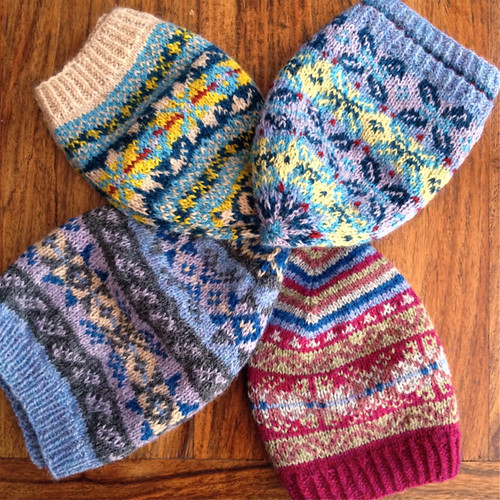
Hats are a perfect project for practicing colour-work. They can be knitted in the round, which is almost compulsory for colour-work. Then, they're just the right size to see if a fair isle pattern works well, but they're not so big that it's a major disaster if the colours or the motif mix don't work too well. I'd bought some 'sticky' fingering weight yarns in a mixture of colours during my visit to the USA - some Harrisville Designs Shetland and some Elemental Affects Shetland Fingering, so I was able to begin by playing around with possible colour combinations. In her classes Mary Jane had given excellent advice on combining and balancing light and dark colours in fair isle knitting, but I found the advice unexpectedly difficult to implement. One of the things I've always taken for granted in my knitting is a capacity to choose and combine colours, so I was unprepared for the amount of experimentation needed to find satisfactory combinations. One thing I think I learned at this stage is that you can never have too many different coloured yarns for fair isle knitting as quite minimal variations in hue can make a significant difference.
I began with the Shwook hat - a pattern from the admired Shetland knitter, Hazel Tindall.
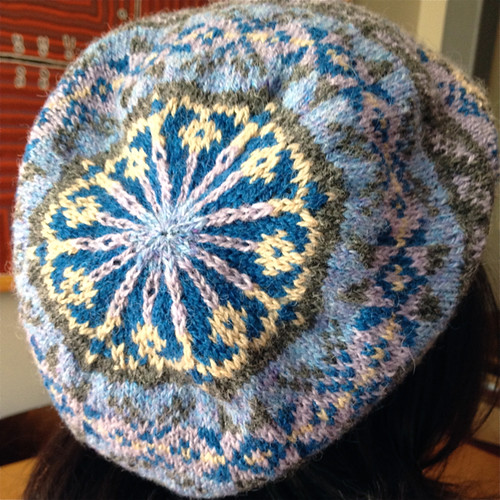
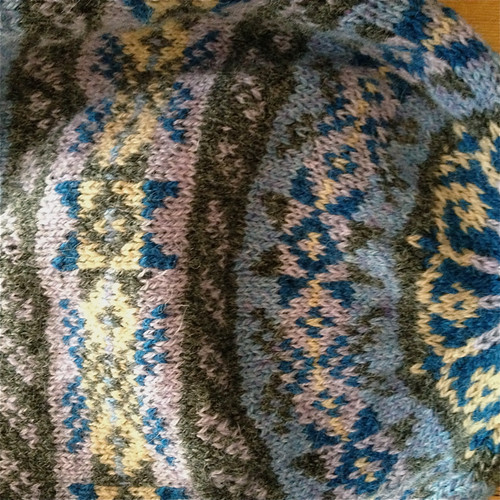
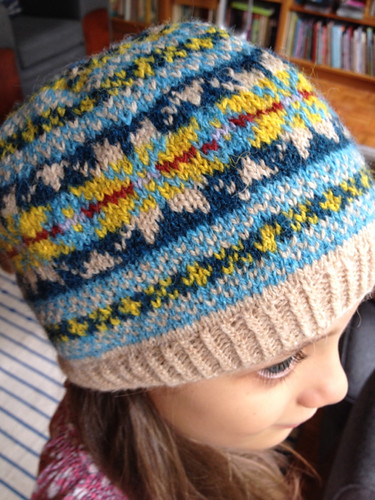
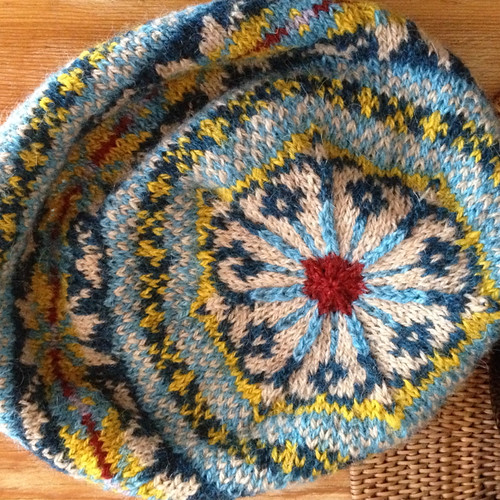
The colours for this hat worked well, but on reflection I thought I had played a bit too safe, and so began another hat. This time I used the basic pattern for the smallest size of the Shwook hat but decorated it with two of the motifs from Mary Jane Mucklestone's '200 Fair Isle Motifs: A Knitter's Directory'. I used one of my favourite colour combinations - yellow and blue. My fair isle pattern designing skills are not yet sufficiently developed to invent a pattern for the crown of the hat, so I've repeated Hazel Tindall's design.
I tried Kyukker, another of Hazel Tindall's hat patterns because I liked its busyness, and was also attracted by the way that a deceptively floral motif had been devised from the squared-off grid that's the starting point for all fair isle. This time the colours didn't work quite so well as the yellow is too bright for the more subtle mauve and blues of most of the hat. I hope I'm learning a bit more about colour combining with each attempt.
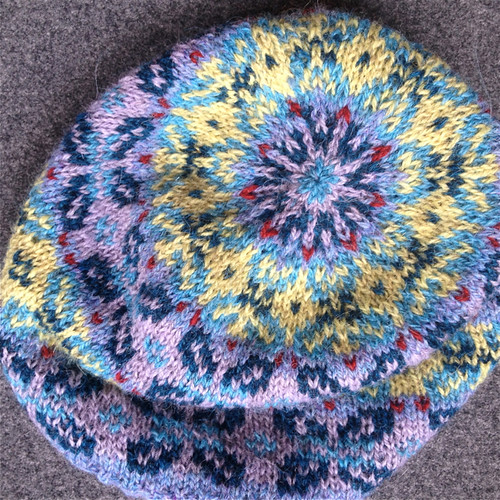
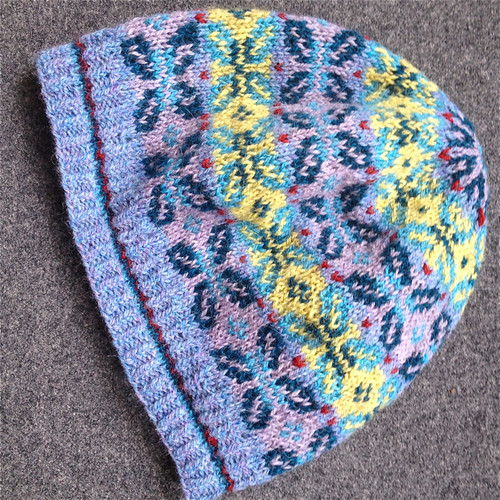
By this stage I was feeling limited by the limited colour palette of my initial yarn purchases and so ordered more yarn, including the lovely rosey colour that was the basis for my next hat. This time I used the idea of Brooklyn Tweed's Turn a Square hat, adapted the pattern for fingering weight yarn and then combined some more of the traditional fair isle motifs from Mary Jane's wonderful book.
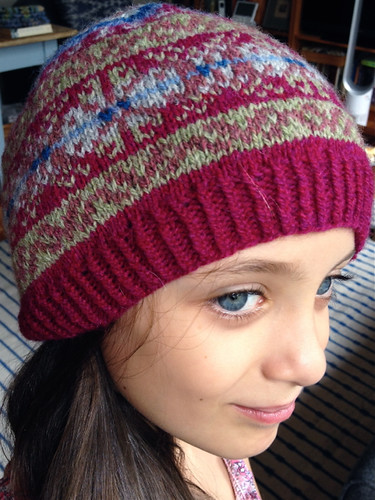
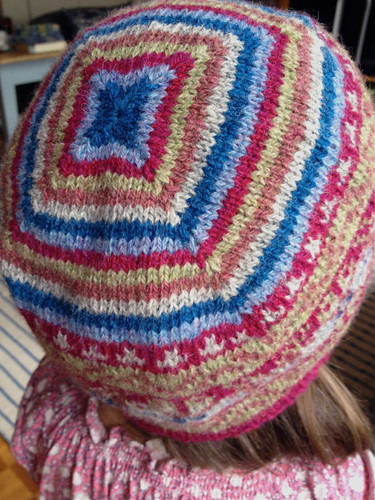
I think I had some vague memory of a Kaffe Fasset hat that combined stripes and florals (or maybe I've invented that recollection) and so striped the crown after completing the fair isle body of the hat. I'm not sure the combination has quite worked, but I think there is a good idea in there somewhere.
Now my problem is what to do with all these hats. My grand-daughter, whom I persuaded to model a couple of them (reluctantly) says they're 'too prickly'. Hmmm. I've offered them to my daughter as last-minute gifts, but she's said, most reasonably, that you can't give someone a warm hat in the heat of a Sydney summer. Maybe I'll just put them away till cooler weather comes and then think again.
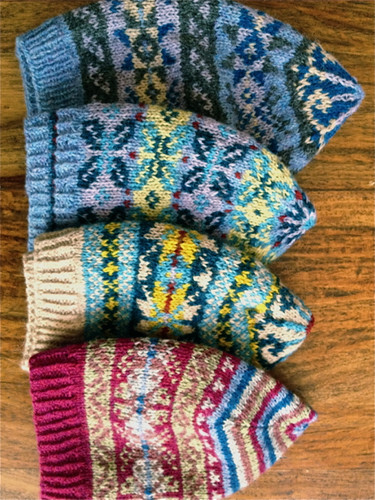
Hats are a perfect project for practicing colour-work. They can be knitted in the round, which is almost compulsory for colour-work. Then, they're just the right size to see if a fair isle pattern works well, but they're not so big that it's a major disaster if the colours or the motif mix don't work too well. I'd bought some 'sticky' fingering weight yarns in a mixture of colours during my visit to the USA - some Harrisville Designs Shetland and some Elemental Affects Shetland Fingering, so I was able to begin by playing around with possible colour combinations. In her classes Mary Jane had given excellent advice on combining and balancing light and dark colours in fair isle knitting, but I found the advice unexpectedly difficult to implement. One of the things I've always taken for granted in my knitting is a capacity to choose and combine colours, so I was unprepared for the amount of experimentation needed to find satisfactory combinations. One thing I think I learned at this stage is that you can never have too many different coloured yarns for fair isle knitting as quite minimal variations in hue can make a significant difference.
I began with the Shwook hat - a pattern from the admired Shetland knitter, Hazel Tindall.
The colours for this hat worked well, but on reflection I thought I had played a bit too safe, and so began another hat. This time I used the basic pattern for the smallest size of the Shwook hat but decorated it with two of the motifs from Mary Jane Mucklestone's '200 Fair Isle Motifs: A Knitter's Directory'. I used one of my favourite colour combinations - yellow and blue. My fair isle pattern designing skills are not yet sufficiently developed to invent a pattern for the crown of the hat, so I've repeated Hazel Tindall's design.
I tried Kyukker, another of Hazel Tindall's hat patterns because I liked its busyness, and was also attracted by the way that a deceptively floral motif had been devised from the squared-off grid that's the starting point for all fair isle. This time the colours didn't work quite so well as the yellow is too bright for the more subtle mauve and blues of most of the hat. I hope I'm learning a bit more about colour combining with each attempt.
By this stage I was feeling limited by the limited colour palette of my initial yarn purchases and so ordered more yarn, including the lovely rosey colour that was the basis for my next hat. This time I used the idea of Brooklyn Tweed's Turn a Square hat, adapted the pattern for fingering weight yarn and then combined some more of the traditional fair isle motifs from Mary Jane's wonderful book.
I think I had some vague memory of a Kaffe Fasset hat that combined stripes and florals (or maybe I've invented that recollection) and so striped the crown after completing the fair isle body of the hat. I'm not sure the combination has quite worked, but I think there is a good idea in there somewhere.
Now my problem is what to do with all these hats. My grand-daughter, whom I persuaded to model a couple of them (reluctantly) says they're 'too prickly'. Hmmm. I've offered them to my daughter as last-minute gifts, but she's said, most reasonably, that you can't give someone a warm hat in the heat of a Sydney summer. Maybe I'll just put them away till cooler weather comes and then think again.
Friday, December 19, 2014
Bye-bye Brisbane
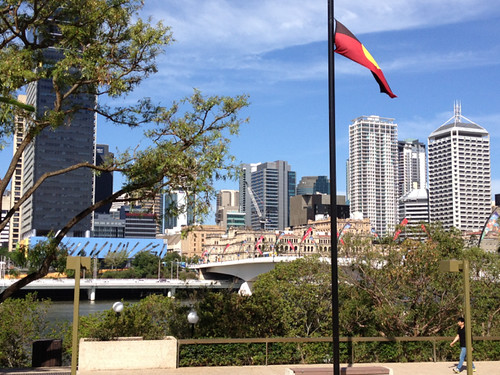
I've just returned from what will probably be my last visit to Brisbane for some time. My daughter and grand-daughter, who have been in Brisbane for nearly seven years, are returning to Sydney, so I'll have no reason for visiting as regularly as I have over those seven years. There are things I've grown to like about Brisbane. Particularly when I've visited in winter, the old tourism slogan of 'beautiful one day, perfect the next' has seemed to describe the bright blue skies, the pollution-free air, the meandering river and the almost tropical landscape with its profusion of flowering trees and bushes. Summer, of course, is a different matter with its heat and humidity. Urgh!
There are two things I'll particularly miss about Brisbane. One is the Tangled Yarns store with its interesting range of yarns, its bright, welcoming space, and its colourful displays. I wrote about my admiration for this store earlier this year. But even if I were continuing to visit Brisbane, this pleasure would no longer be available because the store is, sadly, closing. It will be greatly missed.
I'm also an avid fan of the gallery complex at Brisbane's South Bank so I took a break from helping with house packing up to visit the latest exhibition at the wonderful Gallery of Modern Art (GOMA) - 'Future Beauty: 30 Years of Japanese Fashion'.
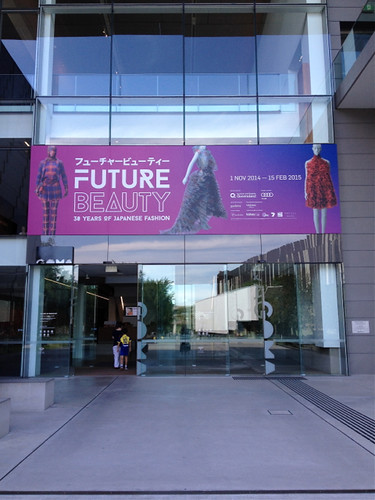
Visitors are not permitted to photograph the items in this exhibition, but the advertisement on the Gallery site gives an impression of the more outrageous designs. What it doesn't really show, however, are the items I found most inspirational; the folded, sculptural, deceptively simple shapes that so revolutionised fashion in the 70s and 80s. There has been some rather critical discussion recently of the phenomenon of displaying 'fashion' in art galleries. But it's a move that has been undeniably popular and has opened galleries to a wider range of people. In the case of this particular exhibition I think it's also not just about what is 'fashionable' but about notions of the body and how it is presented and perceived. It explores how two-dimensional designs can be translated to the unpredictably three dimensional and mobile human form.
I found this special exhibition both thought-provoking and beautiful, but I was equally engaged by a number of the Gallery's own exhibits as I meandered through the lovely (cool) spaces of the Queensland Art Gallery on my way back to the bus stop. There is a shimmering colonnade that on closer inspection is composed of VHS tape.
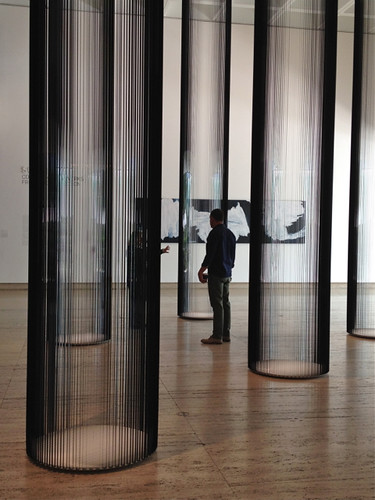
The information on the work noted that the Lithuanian artist, Zilvinas Kempinas 'is interested in the way that magnetic videotape holds images of the past, but these will soon no longer be viewable. Rather than its promise of progress, technology often reveals instead dead-ends and monumental failures'. As someone who constantly worries about what will happen in the future to the images and other documentation I now have stored on today's technology, this was a poignant reminder of the probably inevitable transience of the records of our lives.
The walls of the main entrance space of the Gallery are currently elegantly hung with dance masks and zugub (dance machines) from the Torres Strait Islands:
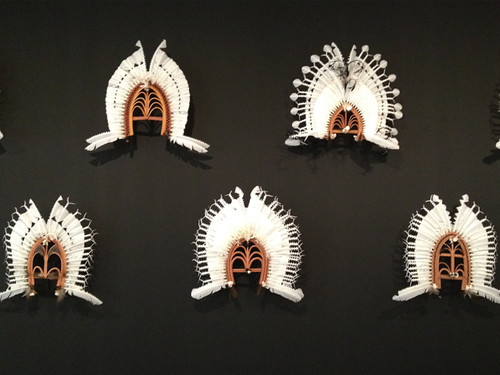
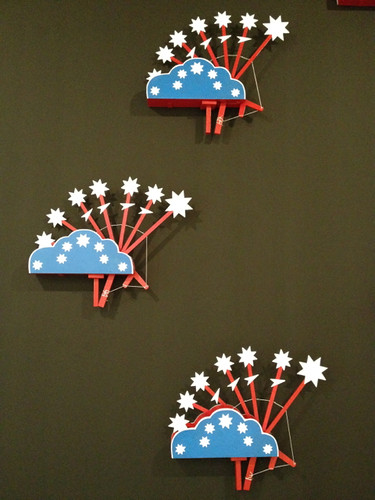
One of the things I've admired across my many visits to the GOMA and QAG is their commitment to exhibiting art from the Torres Strait Islands, and the Pacific more generally. Sydney is a very multicultural city and when here I'm conscious, in many different ways, of our location in Asia. But Brisbane reminds me much more immediately of our Pacific connection. Maybe it's the climate, and the visibility of Pacific Islanders within the community, but for me these relationships have been reinforced by the galleries and their collections.
And finally, just before I exited the Gallery, I was distracted by the ceramic collection and its current display of works by Australian potter Gwyn Hanssen Pigott.
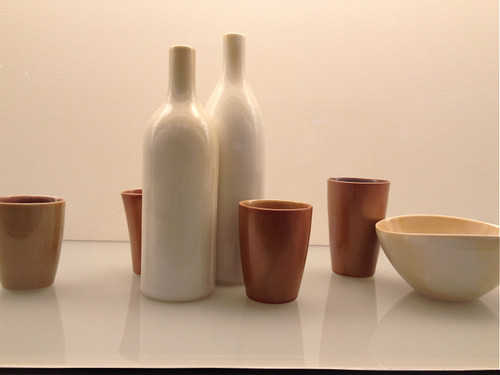
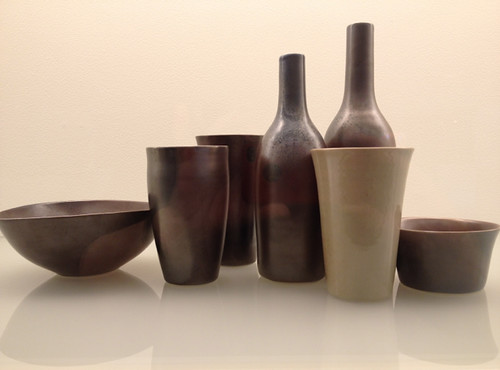
I just stand in front of these works and sigh with pleasure. They are perfection. Each of the pots is perfect in itself, but placed together each of the shapes increases the perfection of the others. They remind me of Alberto Morandi's paintings, which also make me sigh with pleasure.
It's not often that you have the opportunity to get to know another city reasonably well through informal visits over some years, when there's no pressure to see as much as possible in limited time, but I've had this opportunity with Brisbane. But for now, bye-bye Brisbane.
Subscribe to:
Posts (Atom)